
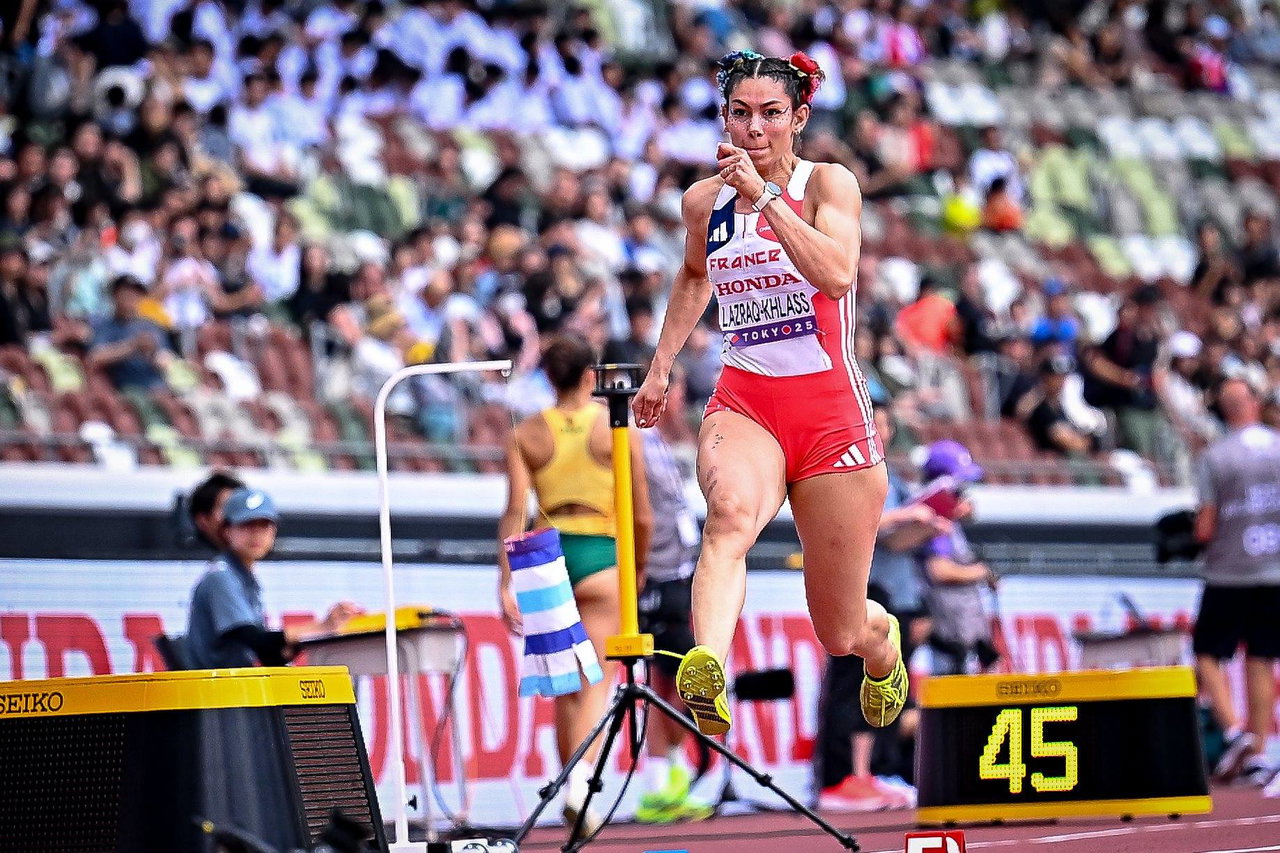
French heptathlete Auriana Lazraq-Khlass enjoyed one of the biggest achievements of her career at the 2024 European Athletics Championships in Rome, where she won the silver medal. She later represented France at the Paris 2024 Olympics. However, her progress was interrupted by repeated injuries and health problems in 2025. After returning to competition in January 2026, she won the French indoor pentathlon title in February and appeared ready to make further progress. But her comeback was soon overshadowed by an anti-doping case involving three whereabouts failures, which eventually resulted in a lengthy 22-month suspension. Now, her lawyer is considering his next move as he questions the severity of the punishment.
Watch What’s Trending Now!
François Battle, who represents Lazraq-Khlass, believes the suspension is too harsh and is considering an appeal to the Court of Arbitration for Sport. Speaking to French newspaper L’Équipe on November 13, he described the punishment as “terribly harsh” and questioned the training athletes receive on using the Anti-Doping Administration and Management System. He argued that the case was not about taking a prohibited substance but about mistakes in using the whereabouts system.
An appeal has not yet been confirmed, but Battle is also exploring whether his client could seek a reduction under anti-doping rules scheduled to take effect in 2027.
The Athletics Integrity Unit announced the 22-month suspension on November 13, 2026, after its disciplinary tribunal found the French athlete responsible for three whereabouts failures. The punishment was backdated to March 26, 2026, when her provisional suspension began. Three missed tests or filing failures within a 12-month period can result in a suspension, even without a positive doping test.
The first two failures occurred on February 16 and August 23, 2025. Lazraq-Khlass did not contest these incidents and acknowledged that she had failed to update her location information in ADAMS. However, she challenged the third failure, which took place on November 10, 2025, the day of her aunt’s funeral. According to her lawyer, she attempted to update her whereabouts for the following day but entered the information incorrectly. He explained that she had tried to complete the required process but had made a mistake while using the system.
The disciplinary tribunal rejected the possibility of a computer malfunction and found that Lazraq-Khlass had shown significant negligence in meeting her whereabouts obligations. However, it also concluded that she had not deliberately tried to make herself unavailable for testing. The death of her aunt was accepted as a minor mitigating circumstance. Although the AIU had requested a two-year suspension, the tribunal reduced the punishment to 22 months.
Battle has particularly questioned the practical training athletes receive before being expected to use ADAMS correctly. He argued that when an organisation provides a system that can have serious consequences for an athlete’s career, it must make sure the person understands how to use it. He also called for practical exercises and simple real-life examples instead of relying only on general instructions.
“When you provide a tool that has significant consequences for the individual, you must ensure that the individual is properly trained,” Battle told L’Équipe. He believes athletes should be given opportunities to practise using the system so they can avoid mistakes that could lead to lengthy suspensions.
However, the tribunal’s ruling also pointed to several training opportunities that Lazraq-Khlass had missed. These included an individual meeting with the AIU after her second whereabouts failure. Her lawyer argued that simply inviting an athlete to a training session does not prove that the person has properly learned how to use the software.
The suspension has also affected her sporting record and future plans. Under the tribunal’s decision, her results from November 10, 2025, onward have been annulled. This includes her performances during that period, meaning her 2026 French indoor pentathlon title is also affected. The suspension prevents her from competing until January 2028 under the current ruling.
She is also restricted from participating in training sessions organised by her club and national training camps, except during the final two months of her suspension. This creates another challenge for the French athlete as she looks towards the Los Angeles 2028 Olympics. Although she could become eligible again before the Games, she will have limited time to return to competition and prepare for another Olympic appearance.
Despite the difficult situation, Battle says his client is trying to remain positive. “She remains positive nonetheless. She doesn’t break down. She remains dignified and quite courageous,” he said while describing her response to the suspension.
For now, the possibility of taking the case to CAS remains under consideration. Battle acknowledged that appealing the decision would not be easy for his client, particularly because of the time and financial commitment involved. “The procedure is lengthy. It’s very expensive. For an athlete, it’s certainly not easy,” he explained.
The French Athletics Federation, meanwhile, has reiterated its commitment to its 2025-2028 anti-doping prevention plan. The programme includes webinars and educational presentations for athletes, coaches, managers and officials, with some sessions organised alongside the French Anti-Doping Agency.
Auriana Lazraq-Khlass overcame career setbacks before her 2024 European Championship breakthrough
Lazraq-Khlass’s journey in athletics began with an Olympic dream she had carried since childhood. At just five years old, she became fascinated by the 2004 Athens Olympics and told her mother that she wanted to compete at the Games one day. However, reaching that level was far from easy. She faced financial difficulties, sporting setbacks and psychological struggles from the French national training centre programme in 2020.
With the support of her coach, Julien Choffart, and a sports psychologist, she gradually regained her confidence and continued working towards her goal.
Her hard work eventually began to pay off. Lazraq-Khlass finished 12 in the heptathlon at the 2023 World Athletics Championships in Budapest with 6,179 points. However, her biggest breakthrough came at the 2024 European Athletics Championships in Rome, where she won silver with a personal-best score of 6,635 points, finishing behind Belgium’s Nafissatou Thiam. The performance included five individual personal bests and secured her qualification for the Paris 2024 Olympics.
Competing at the Paris Games finally fulfilled the childhood dream she had carried for years. Although she finished 16th in the heptathlon with 6,110 points, she remained determined to return stronger.
However, 2025 brought another difficult period as she dealt with several physical setbacks, including a stress fracture in her heel, shoulder surgery, a tropical infection and an Achilles tendon injury. : Despite those problems, she competed at the World Championships in Tokyo, finishing 18 in the heptathlon. She then returned to competition in February 2026 and won the French Indoor Championships pentathlon with 4,634 points, appearing to regain her form before the whereabouts case interrupted her progress.