
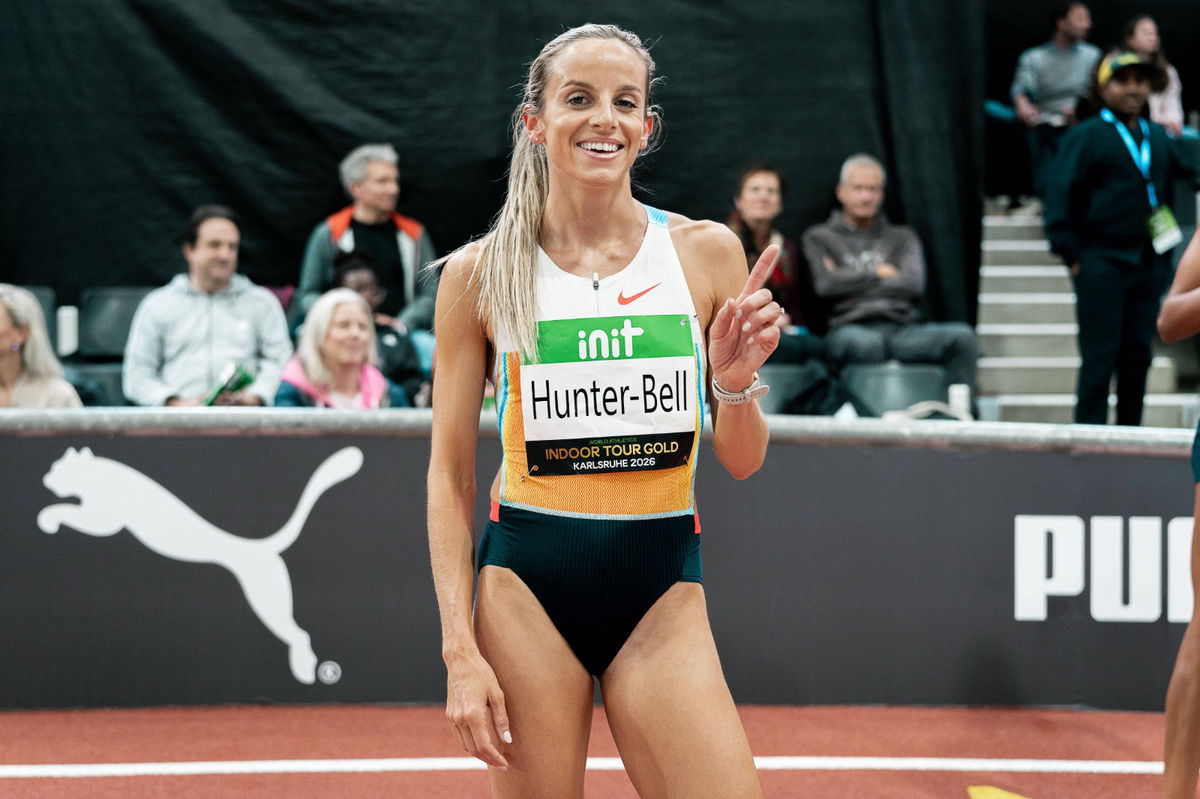
Georgia Hunter Bell once thought her running career was over. After battling repeated injuries and stress fractures, she lost her love for the sport and walked away from athletics at just 23. She then moved to San Francisco to work in cybersecurity but eventually returned to running in 2022. At the time, she was simply happy to be back on the track and compete as an underdog. But after claiming Olympic bronze in Paris in 2024, everything changed. She became one of Britain’s leading middle-distance runners, with people now expecting her to win. With those expectations growing, Bell recently opened up about her shift from being an underdog to becoming a favourite.
Watch What’s Trending Now!
Speaking to The Times in an interview published on November 15, the British runner reflected on how her position in the sport has changed. “I went from someone who was an underdog, who was happy to be there with no pressure on their back, to then going into races being the favourite, expecting to win,” Bell said.
She also explained that the expectations now come from more than just herself and her team. Other people have started seeing her as someone who should win, which has brought a different kind of pressure. However, Bell believes she has learned to handle it and has become more confident in her ability to deliver on big occasions.
That confidence was clear throughout her 2026 season. Bell had a remarkable year, winning three major championship titles across three different competitions. She first claimed the women’s 1500m gold at the World Indoor Championships in March, setting a British indoor record with a time of 3:58.53. She then returned to the track at the Commonwealth Games in Glasgow, where she won the 800m title in 1:59.51.
Her success continued at the European Championships in Birmingham in August, where she claimed another gold medal in the 1500m. Winning both the Commonwealth and European titles on home soil was exactly what she had hoped to achieve. Bell revealed that she had planned her season around those two competitions and wanted to reach her best form at the right time. Although a few minor issues came up during preparation, she remained healthy, trained well, and entered her races with confidence.
“I was healthy, training really well, really confident, and all of those races I went in knowing that I was going to win,” she explained. Bell also spoke about how she approaches the biggest moments in competition. She believes her best performances come when she can remain calm and trust her preparation, even when the pressure is high.
“I feel like the races where I’ve executed the best, I have a bit of a calmness about me. I knew it was a big moment, but I felt completely in control,” she said. Away from the track, Bell has a friendly and cheerful personality, but she believes racing brings out a different side of her. During the interview, she recalled how fellow athlete Harry Aikines-Aryeetey had described her as someone with a smiley personality but a fierce competitive drive.
Bell agreed with his observation, explaining, “You can be friendly and get on with everyone, but when we’re racing it is different, and it does bring out a different side of you, and you have to have that to win, that’s what I’ve realised.”
After once walking away from athletics and returning simply because she missed running, Bell now has a very different challenge ahead. With the Los Angeles 2028 Olympics approaching, she will be looking to build on her recent success and turn the growing expectations into another opportunity to fight for Olympic gold.
Georgia Hunter Bell nearly gave up on her Olympic dream
Georgia Hunter Bell’s journey in athletics began when she was just a teenager. She first discovered her running talent during a school sports day, where she beat the boys in a race. Encouraged to join a running club, she soon began making a name for herself. At 14, she won the English Schools 800m title and became one of Britain’s promising young middle-distance runners. She later moved to the United States to study at the University of California, Berkeley, hoping to take her running career further.
But things did not turn out as she had hoped. The demanding training schedule and frequent competitions began taking a toll on her body. Bell suffered repeated injuries and stress fractures, making it difficult for her to train properly. She kept trying to get back into shape, but the setbacks continued. Eventually, she lost her love for running and decided to leave athletics at just 23.
For a while, she tried to enjoy life away from the track. But giving up running was not as easy as she had imagined. She later admitted that she sometimes questioned whether she had made the right decision and felt she had left her potential unfulfilled. Then, during the COVID-19 pandemic, Bell slowly found her way back to running. She started exercising again, initially without any plans of becoming a professional athlete. But after taking part in a Parkrun and recording an impressive time, she realised she still had the ability to compete. In 2022, around five years after her last track race, she decided to give athletics another chance.
She contacted her former coach, Trevor Painter, who began working with her alongside Jenny Meadows. Bell’s progress was quicker than expected. She started improving her times and gradually began believing that she could compete at a high level again. However, she was still balancing her job in cybersecurity with training and had no idea how far her return would take her.
Everything began to change in 2024. Bell won the British 1500m title, defeating established runner Laura Muir to secure her place at the Paris Olympics. She then claimed silver at the European Championships in Rome. When she arrived in Paris for her Olympic debut, she was not considered one of the main favourites for a medal. But Bell surprised many by winning bronze in the 1500m, setting a British record of 3:52.61.
For Bell, the experience of being an underdog was something she genuinely enjoyed. Speaking to The Standard in March 2025, she admitted that she had been happy competing without the pressure of having to win. “It was quite fun being the underdog. I really enjoyed that role last year because I just knew I was in great shape. I had loads of confidence,” she said.
Her Olympic success changed how people viewed her. She eventually left her cybersecurity job to focus on athletics full-time, and her performances continued to improve. In 2026, she won the World Indoor 1500m title, Commonwealth Games 800m gold, and European 1500m gold. The runner who had once returned simply because she missed the sport was now someone people expected to win major races.