
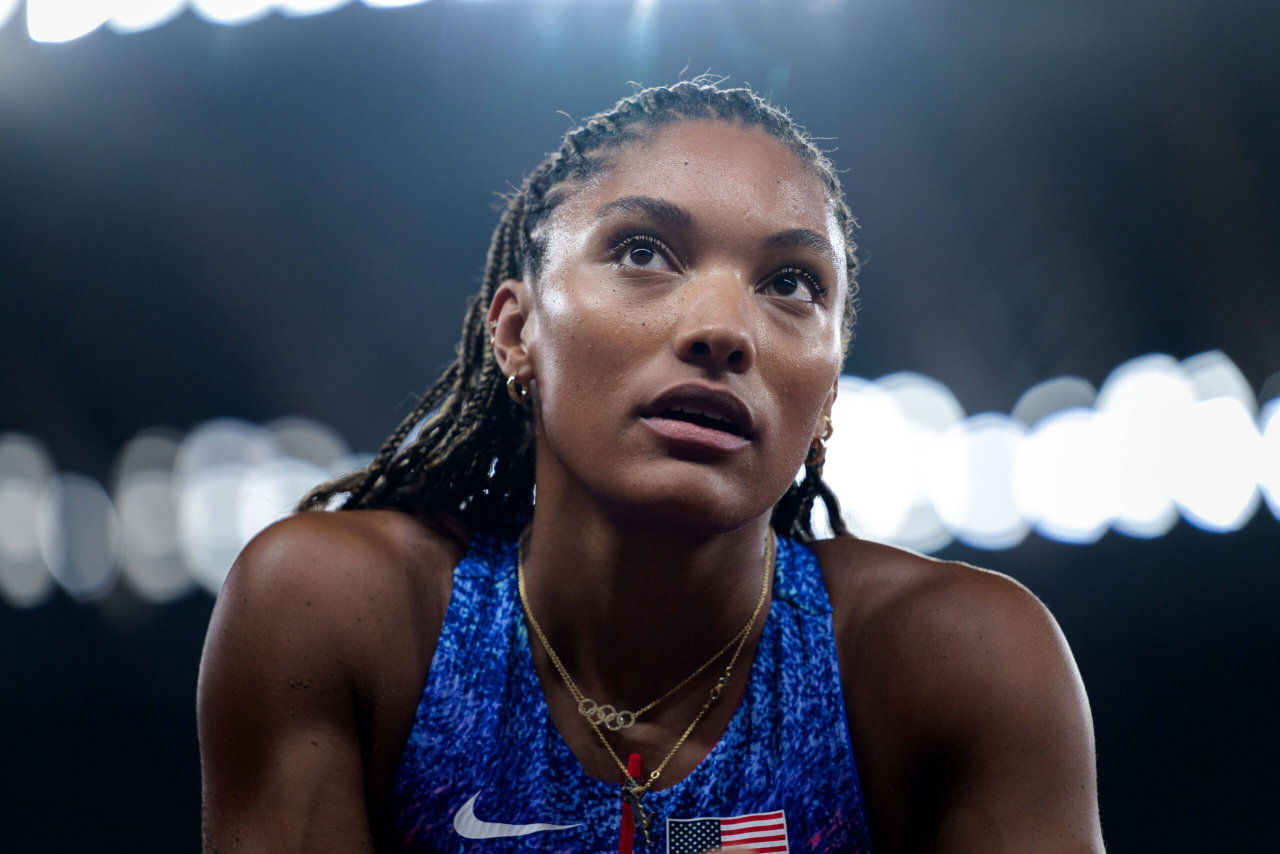
Tara Davis-Woodhall arrived at the 2026 USATF Outdoor Championships as the woman everyone expected to beat. She had soared to a personal-best 7.20m at the Los Angeles Grand Prix earlier in the season, and after going unbeaten since the 2023 World Championships in Budapest, she seemed poised to extend that streak. Then, after her final attempt, a late twist altered the story.
Watch What’s Trending Now!
The competition on July 26 started with Davis-Woodhall immediately making her presence felt. She opened the final with a 6.88m jump to take the lead, finishing ahead of Monae Nichols, the 2024 World Indoor runner-up, who recorded 6.80m. However, Nichols responded in the second round with a 6.92m effort to move into first place. Tara improved to 6.90m, but the battle changed when NCAA champion Alyssa Jones produced a huge 6.96m jump to take control of the competition.
Davis-Woodhall was not ready to give up her title. In the final round, the Olympic champ jumped a 7.16m attempt that looked like it should clinch her fourth consecutive USATF Outdoor championships. She was celebrating the jump and thought that she had won another. But the drama was not over.
Stanford filed a protest after the attempt, and the officials examined Davis-Woodhall’s last jump. After the review, the 7.16m mark was deemed to be a foul and therefore removed from the results. Davis-Woodhall’s record of 6.90m fell to third place after that jump was no longer valid. With her 6.96m effort, Alyssa Jones made herself the USATF Outdoor champion.
What made it a foul, though? Well, the jump was ruled a foul because video review showed her takeoff was illegal, likely by the smallest possible margin, such as her shoe touching or crossing the board line. So even though the distance itself was impressive, the attempt did not count because it broke the takeoff rule. Still, the foul was then appealed, but the decision stood.
“Seven-sixteen final jump. It was a very tough competition,” Davis-Woodhall said post-race via DyeStat. “Coming off two races, I didn’t have the freshest legs I could have hoped for. That’s what makes competition.
“I’ve always been inspired to double up. It just gives me a different challenge to my inner Tara, which I thought today was just that. The hurdles, I have to walk into some other part of my brain. And I got to do that again in the final jump.”
The shocking decision brought an end to Davis-Woodhall’s 18-match winning streak in the long jump in the event and her first defeat in the discipline since the World Championships in Budapest in 2023. At that time, Tara finished second with a mark of 6.91m. Serbia’s Ivana Vuleta won the gold medal with 7.14m.
On the other hand, for Jones, it was a historic moment. She is the first collegiate athlete in 47 years to win the women’s long jump title, following Kathy McMillan of Tennessee State in 1979, per USATF records.
For Tara Davis-Woodhall, the USATF Championships were already a heartbreaking experience after her husband Hunter Woodhall faced a major setback at the same meet.
Hunter Woodhall’s foam block controversy leads to disqualification
Hunter Woodhall, Paralympic champion, competes in the T62 classification, which is for athletes with bilateral lower-limb impairments who race using prosthetic legs. Because of his prosthetic legs, Woodhall has faced challenges with his starting position.
To improve his starting position, he began using a foam block under his hand, helping him create a stronger push at the beginning of the race. The controversy unfolded during the men’s ambulatory 400m final at the USATF Para Championships on 25 July. Woodhall crossed the finish line first in 46.43 seconds and appeared to have secured the victory. However, his result was later removed after officials ruled that the foam block he used at the start was an illegal mechanical aid.
Before the race, officials had warned Woodhall that using the foam block could lead to disqualification. Despite the warning, he chose to compete while challenging the decision. After finishing first, the disqualification was applied, taking away his victory.
“I believe you have to fight for what is right, and I believe what they did today is wrong,” Woodhall said following the decision. “We should be trying to push the sport forward and help athletes with disabilities; they deal with enough stuff day to day. I am so disappointed with USATF.”
He believes para athletes should be allowed to use approved adaptations that help them compete on equal terms rather than being penalized for equipment that supports their needs.