
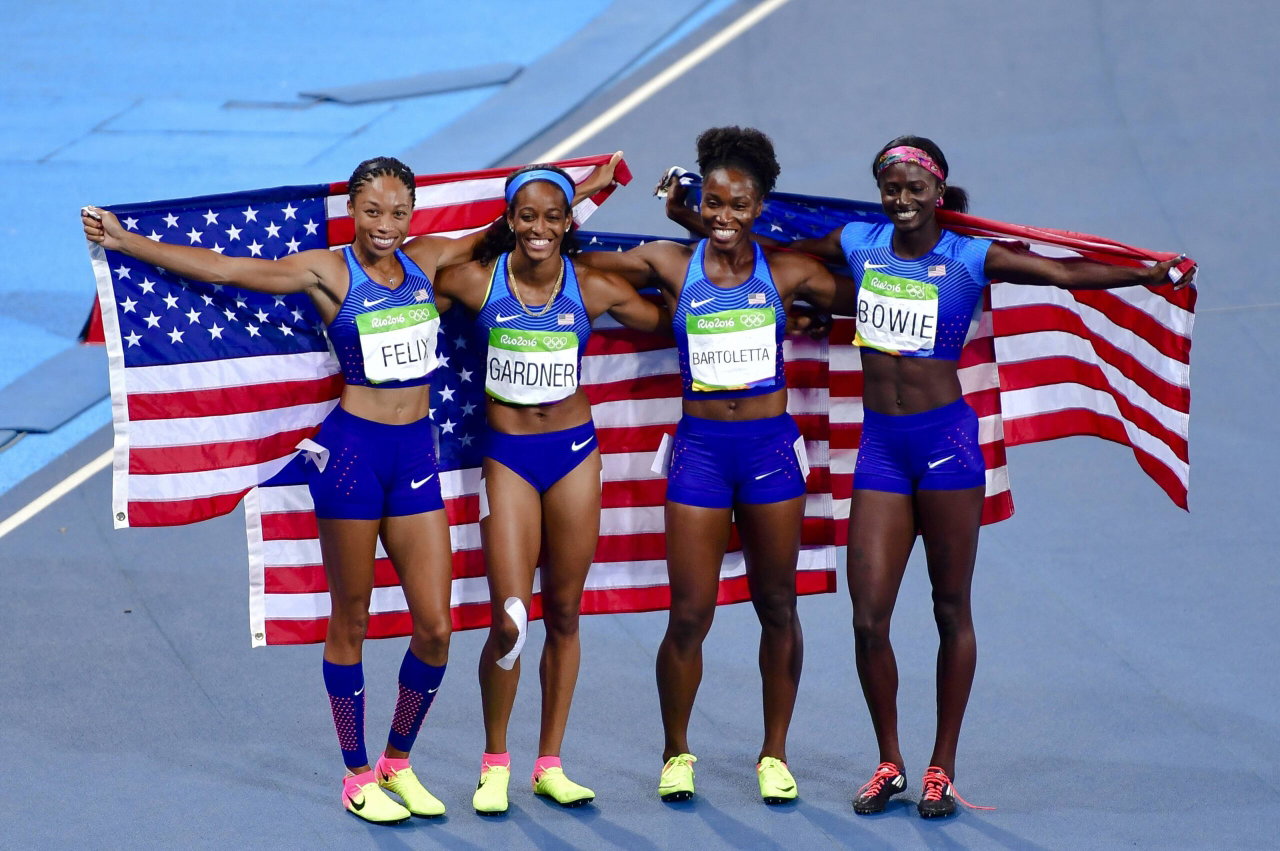
For most athletes, an ACL, MCL, and meniscus tear could have ended their careers. For English Gardner, it was only the beginning. Eight years after suffering the injury, she won Olympic gold with the US 4x100m relay team, before adding another medal, a silver, at the Tokyo Games five years later. But Gardner says it wasn’t the injury that drove her forward. It was being rejected by her dream college.
Watch What’s Trending Now!
The injury to her right leg in 2008 changed everything. In the months that followed, many colleges that had been pursuing Gardner had largely backed away. She had gone a year without racing while recovering and rehabbing her leg, leaving schools uncertain about whether she could return to her previous level. Gardner recalled how LSU was among them, changing its offer from a full scholarship to a partial one.
“He (LSU’s head coach Dennis Shaver) looked me in the eye and was like, ‘You know, English, I think you’re a great talent, but we can’t offer you a full scholarship’,” Gardner recalled on the Ready Set Go podcast.
“My parents had already made it clear, like I can’t go to college unless I get a full scholarship. So he was like, ‘You know, the most we could do is 30, 40%.’ And I kind of looked at my parents, and the tears kind of swelled in my eyes a little bit, cause this is my dream school basically telling me, I’m not good enough to be here,” she added.
The rejection changed Gardner’s mindset. She knew that, despite being one of the fastest high school sprinters in the country, her position had changed. The injury had not only affected her game but also her chances of getting a full scholarship.
But Gardner kept working. She returned to competitive action for the 2010 season, 13 months after the injury. Gardner said she ran the fastest 55m time in the world that season. The result also put her back on the radar of colleges that had previously backed away.
This time, though, Gardner had a choice to make. She ultimately committed to the University of Oregon, where she went on to win multiple NCAA titles and set records. She gave up her final year of college eligibility to turn professional, later representing the United States at the 2013 and 2015 World Championships.
Gardner’s time at Oregon eventually paved the way for her professional career. After missing out on the 2012 Olympics, she qualified for the 2016 Games and won her first Olympic medal, taking gold with the US 4x100m relay team. But the foundation for that Olympic run was laid in 2011, when Gardner began setting records and showing that she had returned from her injury stronger than before.
The 100m record that put English Gardner back on the map
Being rejected by LSU forced Gardner to look elsewhere, and she chose Oregon. It was a gamble, but Gardner quickly began to make the program her own. After missing the indoor season because of another injury, she returned in the spring ready to make up for lost time.
She did exactly that at the 2011 Pac-10 Championships. The then-19-year-old clocked 11.03 seconds in the 100m, breaking Olympian Angela Williams’ US junior record as well as multiple Olympic gold medalist Gail Devers’ meet record. It was the performance that announced Gardner as one of the country’s top young sprinters.
“That day… I got there and just felt great,” Gardner told NBC in 2011. “I rarely feel like that, but it was one of those days I just felt amazing. On top of the world. Nobody could tell me that day I wasn’t going to do something great.”
“Then, I heard the ESPN announcers didn’t even mention me when they were introducing the race. They didn’t mention me once. I remember at the starting line thinking, I’m going to shock the world,” she added.
Even Gardner’s father struggled to believe what he had witnessed. He called her record-breaking run a “miracle,” and the teenager backed it up by winning two NCAA outdoor 100m titles over the next two seasons.
What began with LSU turning Gardner away ultimately led her to Oregon and the next stage of her career. The records and NCAA titles that followed helped establish her as an elite sprinter, setting the stage for her eventual run to the Olympics. Today, Gardner remains involved in track and field, using her experience to mentor and inspire the next generation of athletes.