
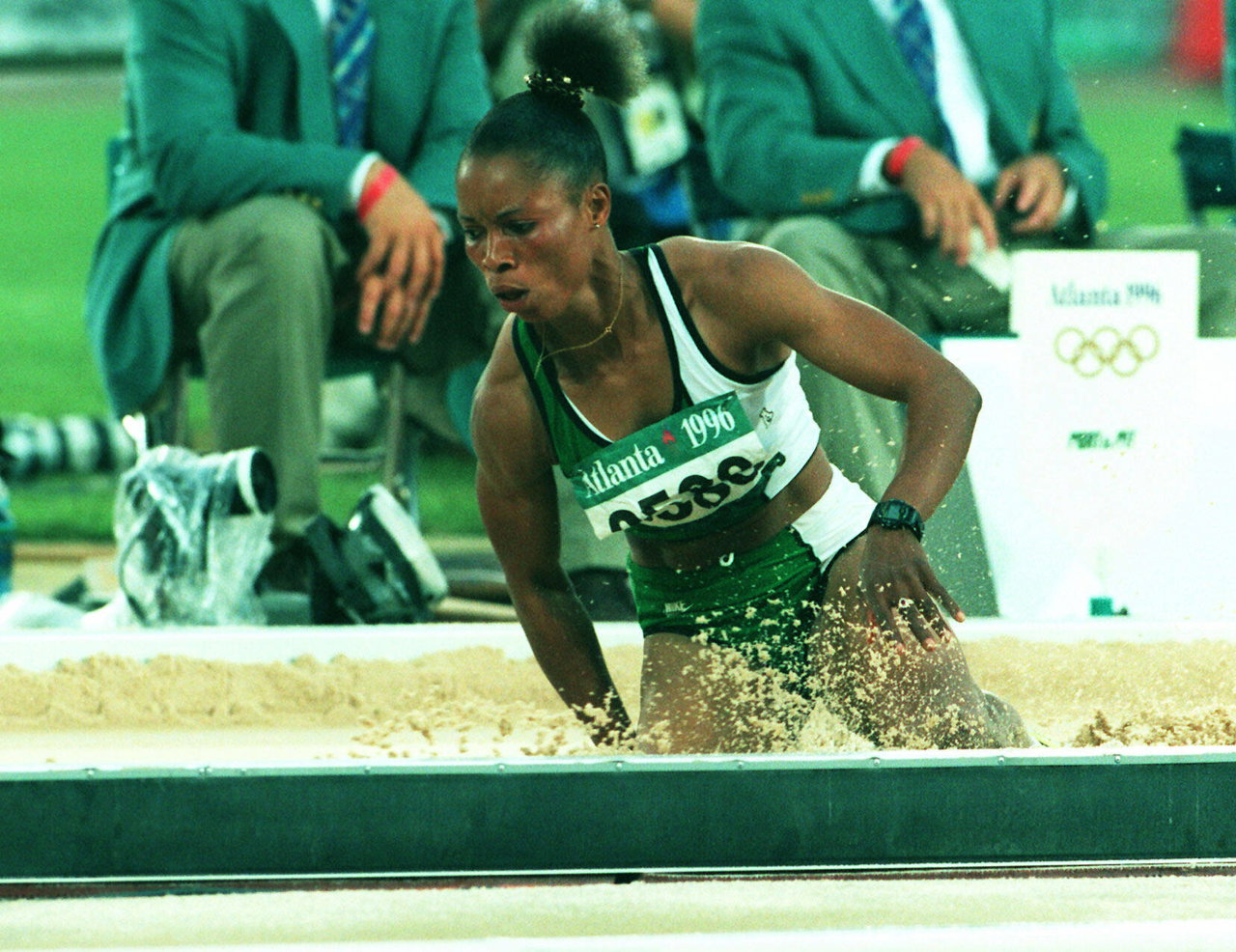
For more than two decades, Nigerian Chioma Ajunwa had been unable to take part in athletics following a lifetime ban imposed over a doping violation. The former long jumper, who made history by winning gold at the 1996 Atlanta Olympics, was sanctioned after testing positive for nandrolone at the Athens Grand Prix Tsiklitiria on June 10, 2002. It was her second doping violation, following an earlier positive test for methandienone in 1992, for which she had served a four-year suspension. Under the anti-doping regulations in force at the time, a second violation of this nature resulted in a lifetime ban. Now, 24 years after the positive test and more than 23 years after the formal sanction, she has finally been cleared to return to athletics.
Watch What’s Trending Now!
Ajunwa’s long wait for a second chance ended after she approached the Athletics Integrity Unit on August 28, 2026, requesting a review of her case. She argued that the regulations under which she received the lifetime suspension had since changed and that the newer rules should be applied to her punishment. The AIU accepted her application in a decision dated November 18, 2026, applying the legal principle of “lex mitior”, which allows individuals to benefit from more lenient rules introduced after an offence.
Under the World Athletics Anti-Doping Rules that came into effect on January 1, 2026, the AIU calculated that her second violation would have resulted in an eight-year suspension rather than a lifetime ban. Having already served more than 23 years, Ajunwa had exceeded that period. The AIU consequently reduced her lifetime ineligibility to the time already served, restoring her eligibility with immediate effect.
The review also brought attention to how her original case was handled. According to the AIU’s assessment, there were grounds to appeal the original sanction, but the matter was not properly pursued at the time. Ajunwa blamed officials of the Athletics Federation of Nigeria for failing to follow the necessary procedures, claiming that her attempts to challenge the punishment were unsuccessful. She also recalled how fellow athlete Rosa Collins travelled to Monaco to seek another hearing but was directed to take the matter through the Nigerian federation.
“Even my fellow athlete, Rosa Collins, travelled all the way to Monaco to press for another hearing, but she was told to push the case through the AFN,” Ajunwa said, as reported by Nigerian media. She added that Collins returned and approached federation officials, but they were unwilling to listen. “That is how I was meted an undeserved punishment, which brought my career to an abrupt end,” she said.
Reacting to the AIU’s decision, Ajunwa expressed relief that the restrictions had finally been lifted. “I give thanks to God that the stain has been removed from my athletics career. I am now free to participate in all activities,” she said. She also urged Nigerian athletics administrators to improve their understanding of technical and anti-doping regulations so that other athletes do not face similar situations.
However, the decision does not erase Ajunwa’s doping record or overturn the original finding against her. It only reduces the length of her suspension under the revised rules. The ruling now allows her to take part in athletics activities again, including roles outside competitive sport. At 54, however, a return to competitive long jump seems unlikely. So, what does her journey in sport look like, and how did she become one of Nigeria’s greatest athletes?
Chioma Ajunwa’s journey from football to Olympic gold
Chioma Ajunwa’s journey in sports began long before she became an Olympic champion. The Nigerian athlete initially pursued football and was part of the country’s women’s national team, the Super Falcons, at the inaugural FIFA Women’s World Cup in China in 1991. She also captained Rivers Angels for several years and later formed the Police Female Machine Team. However, her biggest achievements would come in athletics.
After turning her attention to track and field, Ajunwa gradually established herself as one of Nigeria’s leading athletes. She competed in the long jump and sprint events before making history at the 1996 Atlanta Olympics. With a remarkable leap of 7.12 metres, she won the women’s long jump gold medal, becoming Nigeria’s first individual Olympic gold medallist and the first African woman to win Olympic gold in a field event. She also won silver at the 1997 World Indoor Championships in Paris. However, her successful athletics career was later interrupted by a doping controversy.
Despite losing her opportunity to compete in athletics, Ajunwa continued serving Nigeria through another career. She had joined the Nigeria Police Force and managed to balance her duties with her sporting commitments. Over the years, she rose through the ranks, eventually becoming a Deputy Commissioner of Police. She retired from the force in 2023 after a career spanning several decades.
Her achievements also earned her national recognition, including the Member of the Order of the Niger honor and the Special Golden Jubilee Independence Award presented in 2010. Ajunwa also returned to education after retiring from competitive sports, earning a bachelor’s degree in Human Kinetics and Health Education and a master’s degree in Sports Administration and Management from the University of Lagos.
Away from her police duties, she has remained involved in sports through mentorship and youth development. She established the Chioma Ajunwa Foundation to help young Nigerians develop their sporting abilities while also encouraging education. Now, at 54, the former Olympic champion is technically free to return to athletics following the removal of her lifetime ban. However, after more than two decades away from competitive long jump, a return to the track seems unlikely.