
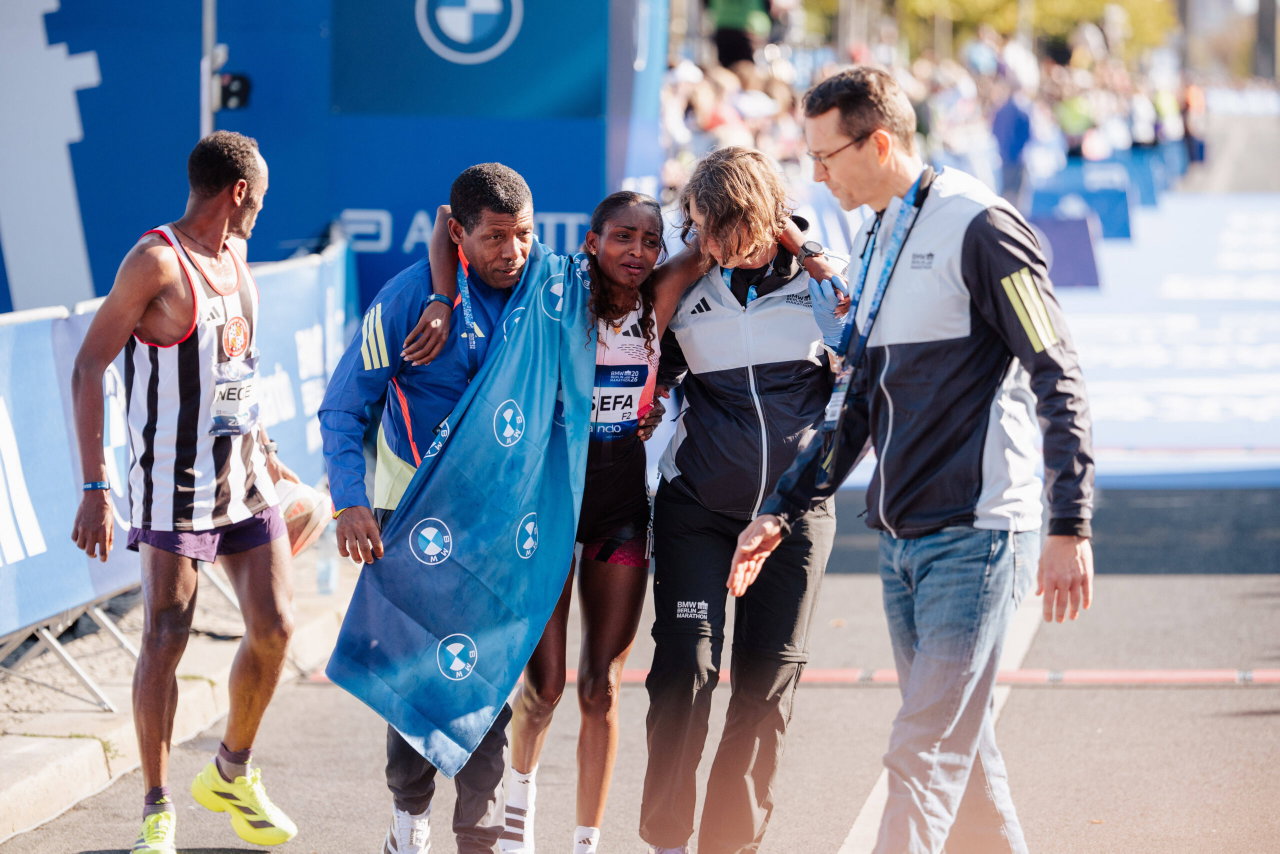
Tigst Assefa returned to the BMW Berlin Marathon with one goal in mind: to reclaim the women’s marathon world record once AGAIN. Three years earlier, she had made history on the same course with a 2:11:53, becoming the first woman to run under 2:12. However, Ruth Chepngetich later lowered the record to 2:09:56 in Chicago in 2024, giving Assefa a new mark to chase. So, when she returned to Berlin this time, she was hoping to take the record back, but her bid ended in heartbreak as a late-race injury left her limping toward the finish line.
Watch What’s Trending Now!
Despite that, Assefa refused to stop and eventually crossed the finish line in 2:11:04. Even limping, the 30-year-old finished only 68 seconds behind the world record. However, concern over her injury overshadowed the celebration. Assefa did not take part in the usual post-race interviews and was taken for medical assessment after the finish. The exact nature of the injury was not immediately clear.
That changed later when her manager, Gianni Demadonna, told Pura Vida Sports Africa that “the right tendon is broken.” He said Assefa would undergo surgery in Munich on Monday, September 28, with assistance from Adidas and Dr. Johannes Gabel.
That hits hard, especially considering that Tigst Assefa was absolutely flying through the course. So much so that a world record time seemed all but inevitable until her injury. Her pace was relentless: she crossed the 5km mark in 15:30, then passed 10km in 30:48. By 15km, she had a one-minute lead over the competition and crossed 25km in 1:17:00 before reaching 30km in 1:32:15.
At that point, her projected finishing time was around 2:09:45, inside Chepngetich’s 2:09:56 world record. Instead of slowing down, Assefa pushed even harder. So much so that after clocking 2:03:00 at the 40km mark, the 30-year-old had 6:55 left to cover the remaining 2.2km of the course.
It should have been easy pickings considering her pace until that point but then the final two kilometres changed everything. Assefa suddenly began running with a pronounced limp. Her stride became uneven, she was visibly grimacing, and her pace dropped. Still, Assefa refused to stop as she eventually crossed the finish line in 2:11:04.
Now her focus will shift to surgery and Gabel is the chief physician for foot and ankle surgery at BG Unfallklinik Murnau, a specialist trauma hospital south of Munich. According to Demadonna, Assefa could need around six months before returning to competition. That would put her earliest possible return in spring 2027, but her return date would depend on her recovery.
The upcoming months are crucial for Assefa due to their timing. The Tokyo Marathon will be on March 7, 2027, just under five months after her surgery on September 28.
Esther Pfeiffer’s German record bid ends early
Esther Pfeiffer also came to the Berlin race with a major target of her own, hoping to break the German women’s marathon record of 2:19:19, which Irina Mikitenko had set in Berlin in 2008 and which had stood for 18 years. Pfeiffer started at the pace needed to challenge the record and initially looked on track. However, things quickly began to go wrong.
After around 14 kilometers, the 29-year-old stopped and withdrew from the race after struggling physically, with stomach problems affecting her during the attempt. Her husband and coach, Hendrik Pfeiffer, also explained that the pressure surrounding the record attempt had taken a physical toll on her.
After the race, Pfeiffer admitted that she was “sad and heartbroken” because she had spent months preparing specifically for the Berlin Marathon and wanted to turn that work into a successful record attempt. Still, the setback did not appear to change her ambitions. She made it clear that she intends to return and still has big plans for the marathon.