
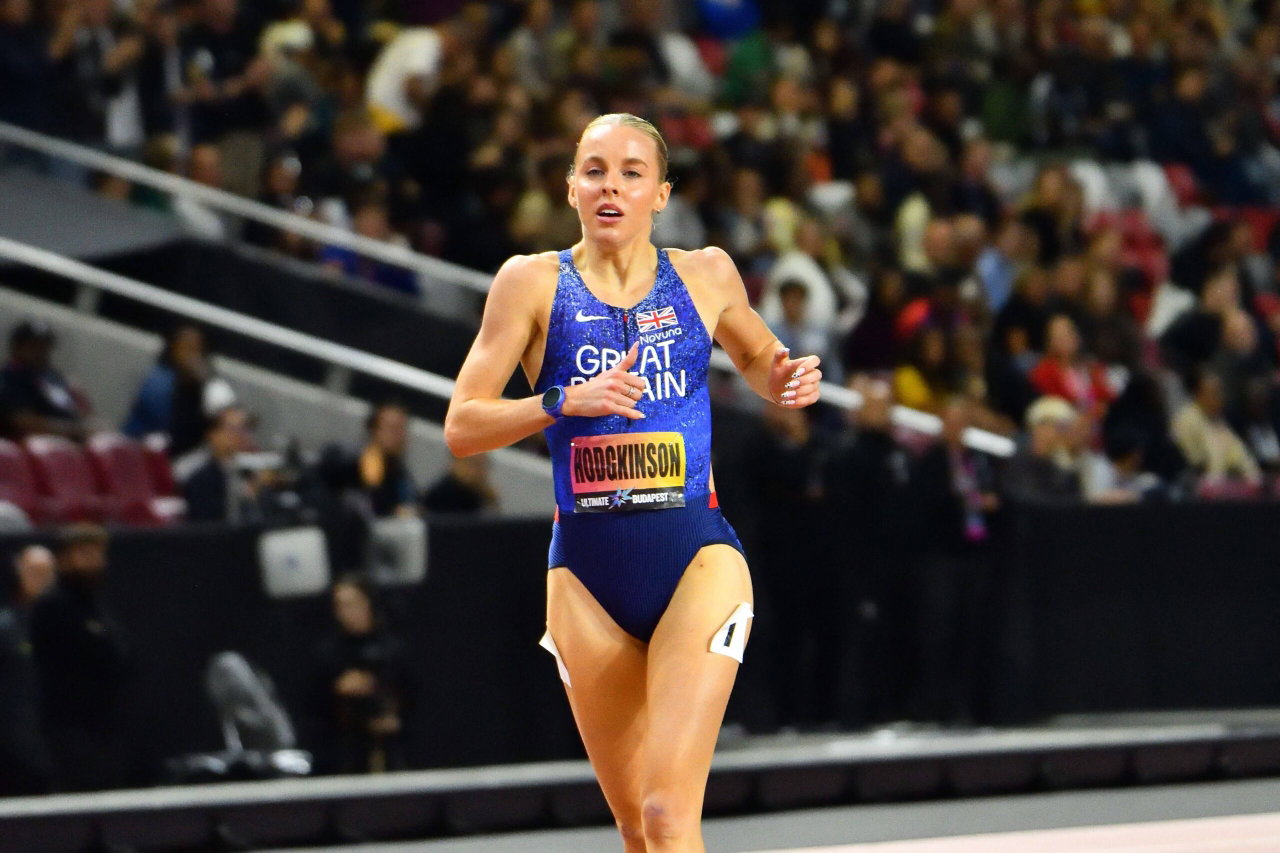
Athletes can collapse from overheating during intense exercise in hot conditions, especially when their clothing makes it harder for the body to release heat. But Olympic 800m champion Keely Hodgkinson tested Nike’s unusual speed suit during a training camp in South Africa, where temperatures reached 37°C, before making its competition debut at Athlos London. The black, skin-tight outfit, complete with a hood and 3D-printed aerodynamic details, certainly turned heads. However, coach Jenny Meadows was less concerned about the heat and more interested in whether Hodgkinson could run comfortably in that unusual suit.
Watch What’s Trending Now!
Hodgkinson first showed the suit to Meadows and fellow coach Trevor Painter during a training camp in Potchefstroom, South Africa, in January 2026. The coaches were taking a break and playing padel when Hodgkinson asked what they thought of the outfit. Meadows admitted that her first reaction was to the suit’s bold appearance. “My initial reaction was like: ‘Oh, you’ve got to be brave to wear that,’” she recalled to Athletics Weekly.
Painter, however, was quick to embrace the look, comparing Hodgkinson to Catwoman. “Yeah, you’re like Catwoman! Go for it. It’s so you,” he reportedly told her. After all, the design was certainly different from the traditional racing kit worn by middle-distance runners, but the real test would come when Hodgkinson began running in it.
The idea for the suit came after Hodgkinson watched Faith Kipyegon wear a specially designed Nike outfit during her attempt to run a mile in under four minutes in Paris in June 2025. That caught her attention, and discussions with Nike began in October. Nike’s innovation team in Beaverton, Oregon, worked with Hodgkinson to develop a custom suit designed around her body and running movements.
There were a number of technical features in the design that were aimed at making it more aerodynamic. These included a specially shaped knee area, a patented 4D mobility gusset, and openings under the arms and down the back for ventilation. The hood was another important part of the design. Hodgkinson wanted her ponytail to remain visible, making that feature non-negotiable. Dan Farron, Nike’s vice president of apparel innovation product design, explained how the team worked to make the hood and sunglasses fit together without compromising the suit’s intended aerodynamic features.
“There are tiny pockets that [the glasses] insert into, so there are no gaps for them to drag around,” Farron said. “The hood also has 3D-printed vortex generators on top, so all of that felt right for her and didn’t impede the way she runs.” Farron acknowledged that asking an athlete to race in a hooded suit was a bold decision. He credited Hodgkinson’s willingness to experiment and provide detailed feedback throughout the development process.
“When you’re bringing out a hooded suit for any athlete to wear, it’s a big, bold move. You’ve got to be bold to want to try it,” he said. “She was so open and she could feel things that we wouldn’t have noticed, so right from the beginning we knew we would create something special out of this.” After months of development and testing, Hodgkinson finally got to wear the suit in competition at Athlos London in September 2026.
Hodgkinson went on to win the 800m in 1:56.40, finishing more than two seconds ahead of the field. But the question arises: did Nike’s unusual speed suit actually give Hodgkinson a performance advantage, or was its impact more difficult to measure?
Did the suit make Keely Hodgkinson faster?
Hodgkinson reportedly produced encouraging times during training while wearing the suit. However, coach Jenny Meadows acknowledged that the Olympic champion was already in excellent shape, making it difficult to determine how much difference the outfit itself made.
“When she wore the speed suit, the stopwatch said really good things but, arguably, she’s been in great shape anyway. The suit wasn’t doing anything negative and we just wanted to make sure it didn’t slow her down. Mentally and physically, she felt like it was really working for her,” Meadows explained. Nike designed the suit to improve aerodynamics and reduce drag.
A report by The Telegraph suggested that the design could potentially save around half a second over 800 metres. There is also a major question over whether she will be able to wear the same outfit at future international championships. Despite making its competition debut at Athlos London, the bespoke Nike suit is not automatically eligible for use at the Olympic Games or World Athletics Championships.
The main obstacle for Hodgkinson at the Los Angeles 2028 Olympics is Team GB’s longstanding partnership with Adidas. The British Olympic Association has maintained a kit agreement with the German sportswear company for decades. Although athletes may be permitted to use technical equipment from other brands under applicable rules, that does not mean Hodgkinson could simply wear her custom Nike racing suit at the Games.
World Athletics’ competition regulations and any relevant approval requirements would also need to be considered. As a result, the suit’s appearance at Athlos does not guarantee that it can be used at future major championships. Hodgkinson could also face restrictions at the 2027 World Athletics Championships in Beijing. UK Athletics has its own longstanding partnership with Nike, but the one-off suit was designed specifically for Hodgkinson and does not automatically form part of the British team’s championship kit.