
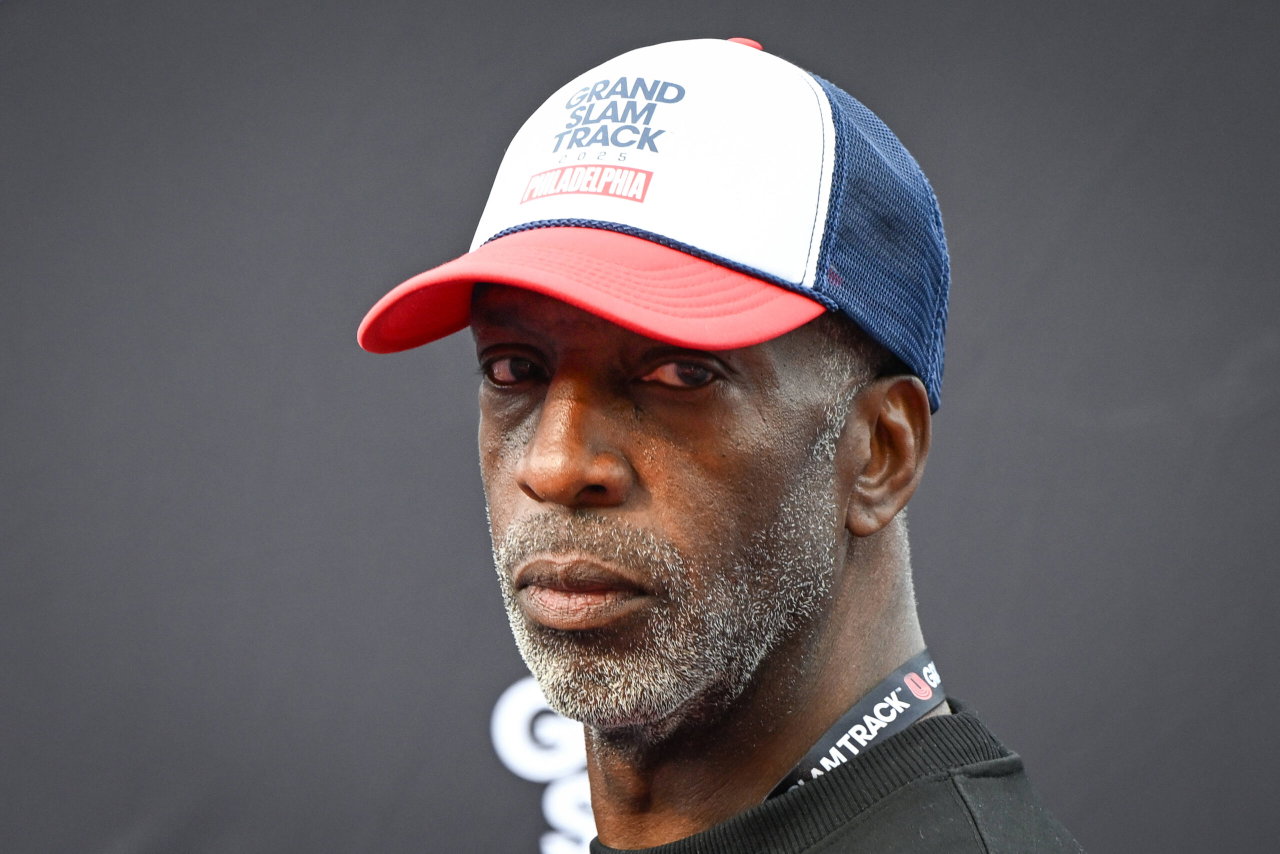
Michael Johnson arrived at the 1992 Barcelona Olympics believing the 200m gold was his to lose. Instead, a bout of food poisoning turned his Olympic debut into the kind of failure he would carry with him for years.
Watch What’s Trending Now!
More than three decades later, the four-time Olympic champion still remembers those days vividly. In a recent Instagram post, Johnson opened up about the disappointment that preceded his golden chapter in Atlanta, admitting that Barcelona taught him lessons that no victory ever could.
“Barcelona 1992. My first Olympics. I was running the 200m, and I did NOT win gold. I didn’t even make the final. Everyone knows me for Atlanta ‘96 – the gold shoes, the double gold, the records. Everyone remembers the wins. But I always remember Barcelona, the disappointment, the feeling of failure, and the doubt that creeped in after,” he wrote.
It was a painful reality for an athlete who had entered Spain at the height of his powers. Johnson was the reigning world champion, had gone unbeaten for two years and sat at the top of the world rankings. He had also come agonizingly close to the 200m world record shortly before the Games, missing Frankie Fredericks’ mark by just 0.33 seconds.
Johnson further added, “I came into Barcelona the World Champion, riding a two year win streak, and heavy favorite to win gold. Illness from food poisoning ruined my chances of winning. That failure taught me more than any of my gold medal performances. It forced me to look at what I control and what I don’t, and how to focus relentlessly on what I can control, and ignore the rest.”
He believed he was in the best shape of his life at that time. But everything changed for him after he and his agent contracted food poisoning at a restaurant in Spain.
Suddenly, years of preparation meant very little. His body simply would not cooperate when the biggest race of his life arrived.
The warning signs appeared immediately. Johnson later remembered battling through the opening round in a way he had never experienced before, describing the sensation as though he were “running in someone else’s body.” He survived the heat, but only barely.
The semifinal delivered the confirmation he had feared. Johnson finished sixth and missed the 200m final by just 0.16 seconds. For an athlete who had entered Barcelona as the overwhelming favorite, the disappointment was crushing.
Yet Barcelona did not completely take the gold away from him.
Johnson recovered in time to join the United States 4x400m relay team. The Americans won gold and set a world record of 2:55.74, with Johnson running a 44.73-second split. Still, the relay medal could not erase what happened in the 200m.
And perhaps that was precisely why the memory stayed with him.
Johnson’s latest reflection makes clear that he no longer views Barcelona simply as the race he lost. He sees it as the moment that forced him to understand the difference between controlling preparation and controlling circumstances.
“Four years later, the world saw the person I’d become after Barcelona,” he wrote, pointing toward the resilience that defined his Atlanta campaign.
By 1996, Johnson had transformed that disappointment into fuel. At the Atlanta Olympics, he produced one of the most memorable performances in track and field history, winning both the 200m and 400m while wearing the gold-colored spikes that would become synonymous with his image.
His 19.32-second 200m run also set a world record that survived until Usain Bolt broke it in 2008. Johnson’s 400m victory completed a double no man had previously achieved at the same Olympics.
The contrast could hardly have been sharper. Barcelona left Johnson outside the 200m final. Atlanta made him an Olympic icon. That is why he now describes the earlier failure as more instructive than many of his victories.
“Winners and successful leaders aren’t defined by avoiding failure,” Johnson wrote. “They’re defined by their resilience, their willingness to examine themselves, and their commitment to evolving as a person.”
The lesson also explains why Johnson has continued to talk about that difficult Olympic debut. Even in 2024, he looked back on Barcelona while discussing his career and the memories that shaped him.
The sprinter ultimately collected four Olympic gold medals and eight World Championship titles. He also spent years rewriting the record books, including his 43.18-second 400m world record in 1999, a mark that stood until Wayde van Niekerk broke it in 2016.
But the victories never completely replaced the memory of the race he never got to finish.
Michael Johnson’s competitive fire never really left
Johnson’s competitive edge remained evident long after his retirement.
In 2016, when asked about a hypothetical 200m showdown with Usain Bolt in their primes, Johnson answered with the confidence that had defined his career.
“I win that race every day,” he told TODAY. “Every time we line up, I win that race, guaranteed.”
Yet his view of Bolt evolved with time. Ahead of the 2024 Paris Olympics, Johnson pushed back against the idea that athletics needed another version of the Jamaican superstar.
“Nobody. There’s never going to be another Usain Bolt,” Johnson told Olympics.com, emphasizing that athletes should create their own identities rather than chase someone else’s legacy.
It circles back to the lesson he took from Barcelona.
Johnson could not control the food poisoning that derailed his 200m campaign. What he could control was what came next. Four years later, he returned to the Olympic stage with a different perspective, a stronger resolve and two gold medals around his neck.
“Everyone faces Barcelona moments,” Johnson wrote. “The question is what you learn, how you adapt, and whether you have the courage to face the work ahead.”
For Johnson, the most painful Olympic memory did not disappear. Instead, he learned how to carry it – and eventually turn it into part of the story behind the gold.