
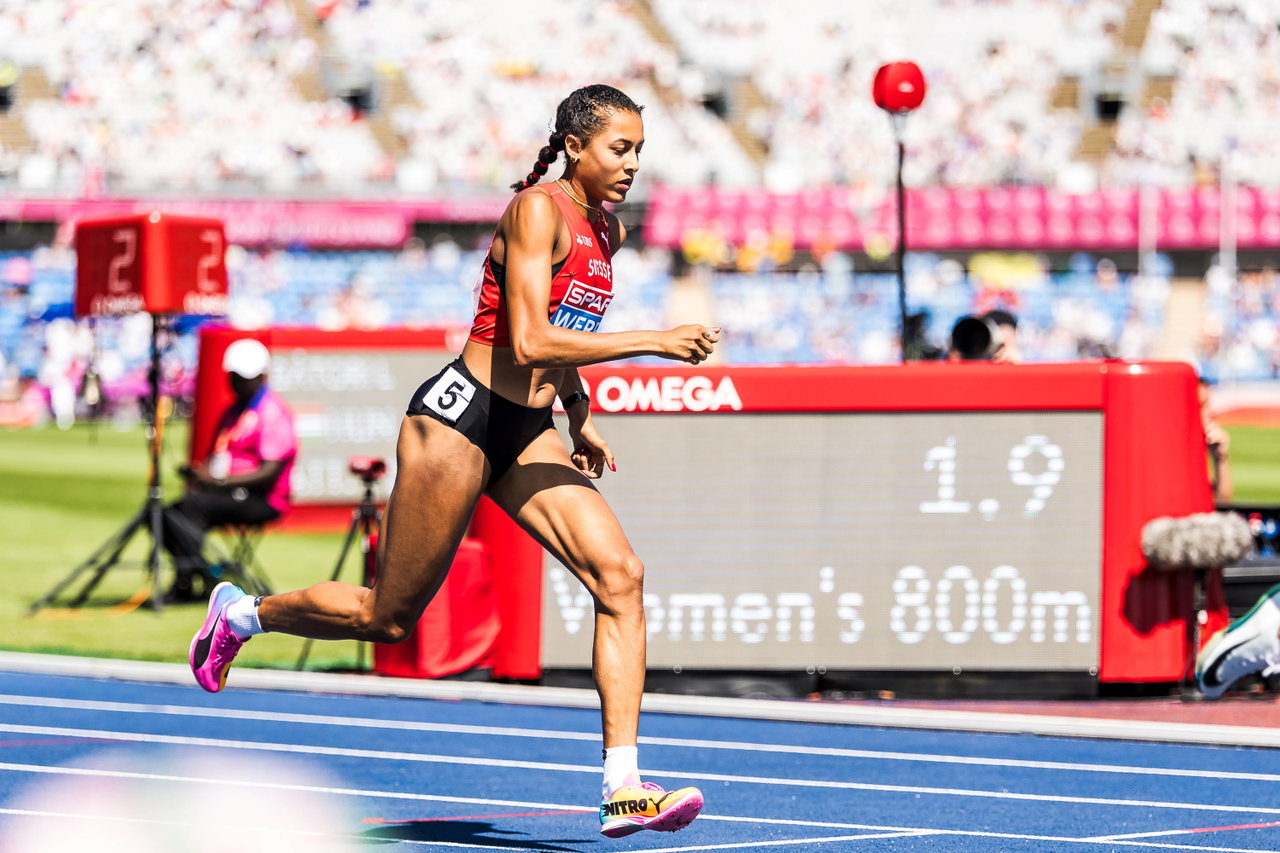
Three days ago, Audrey Werro ran the third-fastest 800m in history. On Saturday, she made a very different decision.
Watch What’s Trending Now!
Werro’s management informed the GalAthletics Bellinzona organizers on Saturday that she would withdraw from Sunday’s 800m. The decision came after an extraordinary run of racing that had taken the 22-year-old from a European title in Birmingham to a meeting record in Lausanne and then to a 1:53.70 in Zurich.
Werro said she now needs to step back to protect both her mind and body. “In my races, I always have the habit of giving my best and committing myself 100%. Today I need time to regenerate and preserve my mental and physical health.” The decision is not a retirement or the end of her season. It is a pause at the most remarkable point of her career so far.
The decision also carried more weight because Bellinzona was not simply a race Werro could quietly skip. The organizers said their contract gave them the right to require her participation, but they chose not to enforce that clause after discussions with her team.
The organizers had every reason to want her on the track. Werro was the European champion, the world’s fastest 800m runner this season and the biggest name in the field. Instead, they accepted that another race three days after Zurich was not worth pushing her further.
The timing becomes clearer when the last two weeks are put together. Werro fell in the European Championship semifinal on August 13, returned less than 24 hours later to win the 800m final in a championship-record 1:54.81, raced again in Lausanne seven days later and then produced the run of her life in Zurich six days after that.
That is five 800m race rounds in 14 days, across three venues and three countries. The sequence included a heavy fall, a European title, a meeting record and the third-fastest time ever recorded in the event.
The Birmingham semifinal alone could have changed the entire championship for Werro. With about 120 meters remaining, contact with France’s Anaïs Bourgoin sent her crashing to the track. Werro got back up, finished last in 2:35.35 and then waited to learn whether she would be allowed into the final.
Swiss Athletics appealed, officials reviewed the footage and Werro was reinstated after the contact was judged to have caused the fall. But there was another reason she had to finish that race. By crossing the line, she preserved her eligibility to be advanced after the appeal.
“I made a conscious choice to try and manage the race at a moderate pace. It’s always safer to run at the front, but today there were risks; I could sense things were hectic behind me. A fall can happen in an instant.”
Less than 24 hours later, she was European champion.
Werro took the lead early in the final and pulled away over the last 100 meters to beat Hodgkinson 1:54.81 to 1:55.01, setting a championship record in the process.
And the racing did not stop after Birmingham. Seven days after winning the European title, Werro returned in Lausanne and won the 800m in 1:55.33, setting another meeting record. Six days later, she lined up in Zurich without Hodgkinson, who had withdrawn because her body was not ready to race again after the European Championships.
“Unfortunately the body isn’t quite ready to race again after the European Championships. We’ve made the decision to skip this race and get ready for the next one, sad to miss it, hopefully see you next year!” Hodgkinson said.
Then came Zurich.
At Letzigrund Stadium on August 27, Werro ran 1:53.70 to win the 800m. It was a Swiss record, a Diamond League record, a meeting record and the fastest time in the world in 2026. More importantly, it moved her to No. 3 on the all-time list, behind only Jarmila Kratochvílová’s 1:53.28 and Nadezhda Olizarenko’s 1:53.43.
The gap to Kratochvílová’s world record was just 0.42 seconds. And that record has been standing since July 26, 1983. Werro was not even born when Kratochvílová set it.
Zurich was also Werro’s third sub-1:54 performance of the season. She had already run 1:53.98 in Stockholm in June and 1:53.80 in Paris later that month. No athlete had ever run under 1:54 three times in the same calendar year.
Keely Hodgkinson knows exactly how fast Audrey Werro has become
The numbers have changed the rivalry, too. At the start of the year, Hodgkinson was still the Olympic champion and the woman to beat. At the World Indoor Championships in Toruń, she beat Werro for gold while Werro took silver in a Swiss-record 1:56.64.
By June, the gap had changed. In Stockholm, Werro ran 1:53.98 to beat Hodgkinson’s 1:54.33. In Birmingham, she did it again, winning the European title ahead of Hodgkinson.
Hodgkinson has never treated Werro as an easy target. After Stockholm, she said:
“Massive respect to Audrey, that was incredible racing from her and she helped me to run faster today. I was glad of her pushing me throughout the race and then fighting me to the line at the end — but I won’t let that happen again! The European Champs will be such a great battle between us and it’s so fun to be a part of such an exciting time for 800m running. She’s getting the best out of me and I still believe in myself.”
Werro’s own motivation was just as clear after Stockholm. “It was a big day for me because it was my first win in the Diamond League with Keely. It’s been a goal for me just to finish in front of her because I know she’s really fast.”
Hodgkinson even chose to enter Zurich before eventually withdrawing, saying she wanted to be racing alongside the best. “I signed myself up for Zurich because I knew everyone was in it but me. I want to be in with the best and I think that’s going to bring out the best in me.”
She never got that rematch. Her body was not ready, and Werro went on to run 1:53.70 without her.
But Werro did not think Zurich was the night to break the record.
“As far as the world record is concerned, I saw the light, but there was a lot of movement during the race and it was not calm. But I still had enough energy at the end of the race to accelerate and to stay in the lead.”
The fact that she could run 1:53.70 without everything lining up perfectly is what made the performance so interesting. Werro had been chasing the stadium’s world-record pacing lights, but movement in the field prevented the race from becoming the clean record attempt she had hoped for.
The day before Zurich, Werro had already warned that she was not planning her season around the record.
“Things have happened really fast. I was not prepared for a world record this year. I just want to focus on running fast and winning some races and I think with this mentality the world record will fall one day. But I don’t know when.”
“Yes, it was tight for the WR, it was not meant for today. I am so proud to be able to run those sub-1:54 times, which shows that I can run consistently and fast now and this is good for the future.”
Her consistency is almost as striking as the 1:53.70 itself. Werro now owns four of the ten fastest performances in women’s 800m history: 1:53.70 in Zurich, 1:53.80 in Paris, 1:53.98 in Stockholm and 1:54.45 in Ostrava.
She has gone from being a young Swiss talent to holding four places on a list that includes some of the greatest 800m runners ever.
The change that helped Werro reach another level
Werro has said the biggest change in her career came away from the track. After finishing university, she was able to focus fully on athletics rather than balancing training with her studies.
“The biggest difference this year was that I finished university one year ago. Now I’m just focused on athletics and I just have more time for the competition, the training, the recovery, everything.”
The results have been dramatic. Werro’s 800m best was 1:57.25 in 2025. In 2026, she has run under 1:54 three times, won the European title and moved to No. 3 on the all-time list.
She has also spoken about the mental side of her development.
“I have worked a lot more in the mentality part over the past two years and you are seeing the result now.”
That makes her latest decision especially notable. Werro has spent the last two years working on the mental side of her racing, and now, after the busiest stretch of her season, she has decided that protecting that side of herself matters more than one more race.
The next race could tell us even more
Werro’s season is not over. She is confirmed for the Diamond League Final in Brussels on September 5, where Hodgkinson is also on the preliminary entry list.
That gives Werro nine days between her Zurich race and her next scheduled appearance, rather than the three-day turnaround that would have taken her from Zurich to Bellinzona.
It also gives the two rivals another chance to race each other after their Zurich rematch disappeared. And this time, both will have had more time to recover.
Six days later, Werro is also scheduled for the inaugural World Athletics Ultimate Championship in Budapest, which runs from September 11 to 13.
The interesting part is that Werro does not need to prove anything in Bellinzona. She already has the European title, the fastest time in the world this year and four places inside the all-time top 10.
She is also closer to Kratochvílová’s record than almost anyone has been in decades. But after Zurich, Werro made it clear that she was not chasing it at any cost.
“It was crazy, I am very proud. Thank you everybody. I am getting better and better and I am simply very motivated. I achieved my goals for this year, so now everything is for fun.”
Now she has chosen to give herself time before racing again. The next time Werro steps onto a track, the question will not simply be whether she can beat Hodgkinson. It will be whether the 22-year-old who came within 0.42 seconds of a 43-year-old world record can find the race she believes is still waiting for her.