
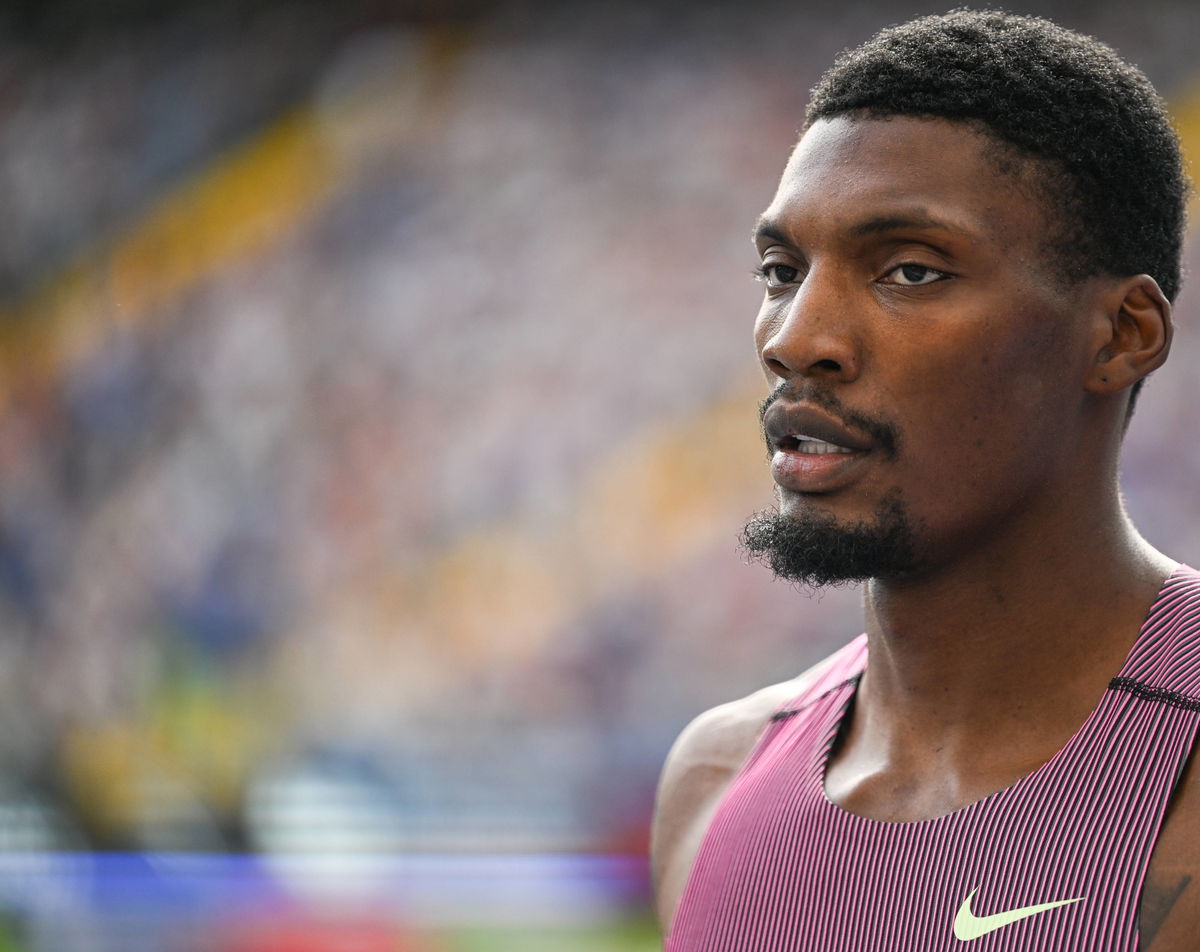
Behind Fred Kerley’s Olympic medals and world championship glory lies a childhood far removed from the spotlight. Before the American sprinter became one of the fastest men on the planet, he witnessed hardships no child should have to endure. Now, he is ready to share the story that shaped the man behind the medals.
Kerley recently offered a glimpse into his difficult past through a teaser for his upcoming appearance on Jumpers World. Reflecting on his upbringing in San Antonio, Texas, the 31-year-old revealed how drugs, violence, and his parents’ incarceration shaped his early years.
“I came up in the projects of San Antonio. I grew up with drugs all around me, saw both my mom and dad go to prison, and got adopted move to Taylor. I saw things no kid should have to see. Then at 12 years old, I got sent away for something I didn’t do,” Kerley wrote in the Instagram caption.
He then highlighted the gap between what fans know about his achievements and what they rarely hear about his life before athletics. “A lot of people know what I did on the track. They don’t know what I lived through before I ever stepped on it. This is the part of my story I’m ready to tell in my own words.”
The interview, titled Fred Kerley — The Untold Story, will premiere on December 4. However, the sprinter has previously offered glimpses of the difficult circumstances that defined his childhood.
Kerley’s childhood took a different turn when his biological father, Ricky, went to prison for murder. His mother also struggled to provide a stable home, leaving his aunt Virginia and uncle to take responsibility for him and his siblings.
In a May 2023 essay for World Athletics’ Spikes website, Kerley recalled moving in with his aunt, whom he affectionately calls Meme. The household already had several children, and space was scarce. He and his siblings eventually shared a single bedroom with their relatives, sleeping on pallets.
“We had one bedroom. There were 13 of us in one bedroom. We were on the pallet,” he recalled after winning the 100m world title in Oregon in 2022. Despite the crowded conditions, Meme ensured that the children grew up with discipline, care, and a sense of family. For Kerley, her influence went far beyond providing a roof over his head. She helped him find direction when his circumstances could easily have pushed him elsewhere.
His gratitude is also permanently etched into his body. While many athletes choose the Olympic rings to commemorate their sporting journeys, Kerley has a tattoo of Meme’s name on his left arm.
“To me, the tattoos are messages to myself every day to just keep on going and don’t take anything for granted,” he explained in his Spikes essay. “In that sense, the one that means the most is that one on the inside of my left arm: Meme.”
Her influence also shaped his competitive mindset. Kerley has often credited his difficult beginnings for his determination to build a different future. “What motivates me is coming from what I come from and not being in the same predicament,” he said in 2022. “Keep on accomplishing great things. You don’t want to be in the same position as you were when you were younger.” That determination eventually found an outlet on the track.
From a difficult childhood to the pinnacle of track and field
Kerley initially explored football and basketball before committing himself to athletics. A collarbone injury during his senior year of high school also disrupted his football ambitions, but track offered another opportunity.
He initially established himself as a 400m specialist, winning bronze at the 2019 World Championships in Doha. However, the COVID-19 pandemic forced him to reconsider his career when his local training track closed.
The switch to the 100m raised eyebrows, but Kerley silenced the doubts with an Olympic silver medal at Tokyo 2020. A year later, he reached another milestone by winning the 100m world championship in Oregon in 9.86 seconds, leading an American sweep of the podium.
He added another Olympic medal with bronze at Paris 2024, further cementing his place among the world’s elite sprinters. Yet, his journey has also entered an unconventional chapter.
Kerley joined the 2026 Enhanced Games, an alternative sporting competition that permits performance-enhancing substances. He insisted that he had no intention of using them, maintaining that his natural ability and hard work were enough.
His participation came amid a separate two-year suspension imposed by the Athletics Integrity Unit for whereabouts failures, which runs until August 2027. Nevertheless, Kerley has maintained his ambition to return to the traditional Olympic stage, declaring his intention to compete at LA28.
His Enhanced Games appearance also attracted attention when he predicted Usain Bolt’s 9.58-second world record would be broken. Kerley eventually won the 100m in 9.97 seconds, falling well short of the historic mark.
But while his career continues to attract headlines for both his performances and decisions away from the track, Kerley’s latest revelation offers a reminder that his journey began long before the starting gun.
For the sprinter, the medals tell only one part of the story. The rest belongs to a childhood marked by adversity, a family that gave him another chance, and an aunt whose influence continues to stay with him wherever he runs.