
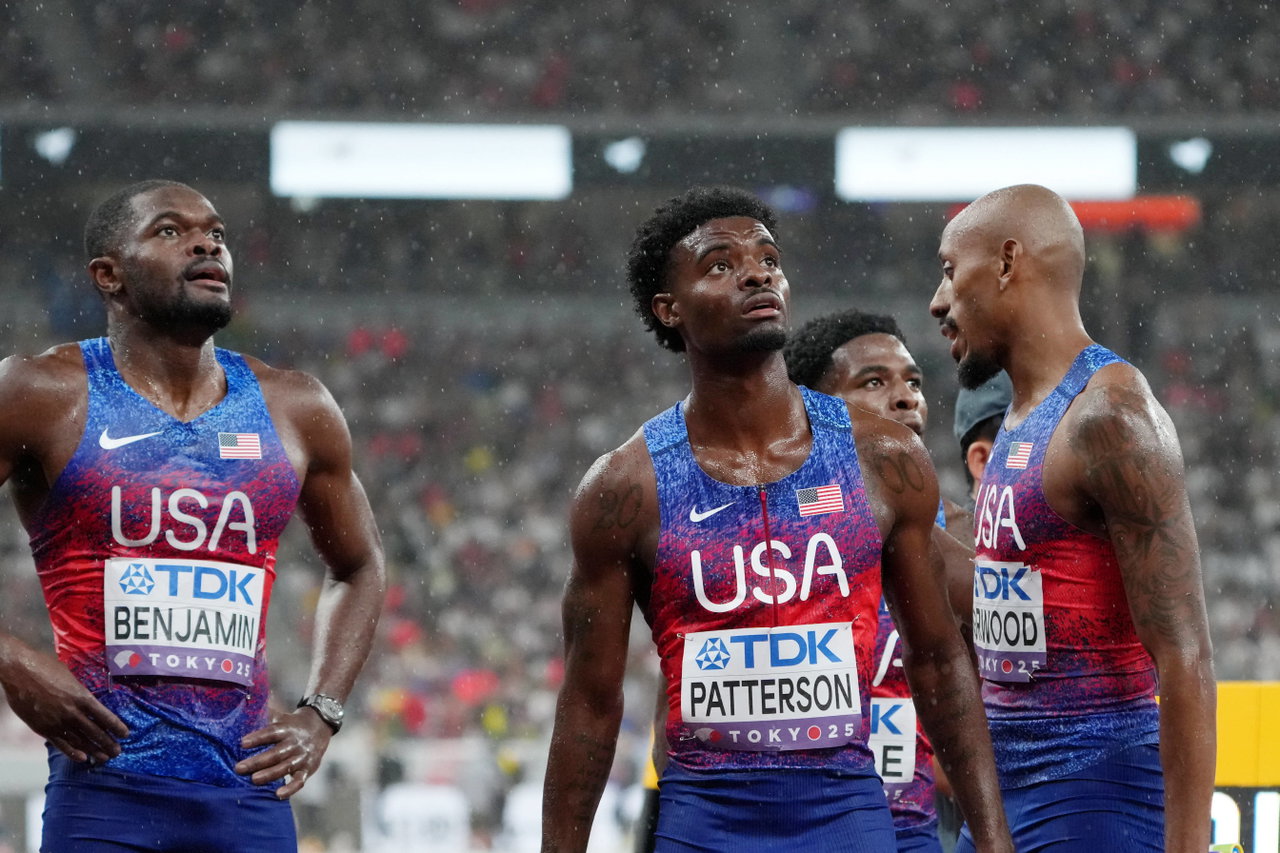
A 43.83-second run should have felt like a celebration. Instead, Rai Benjamin crossed the finish line looking like a man who had nothing left in the tank.
Watch What’s Trending Now!
The Olympic champion had just produced the fastest 400m of his career, breaking 44 seconds for the first time, but all that stayed with him was the aftermath.
Standing alongside the track after his runner-up finish at the Silesia Diamond League, Benjamin’s mind was already on what went wrong.
Imago
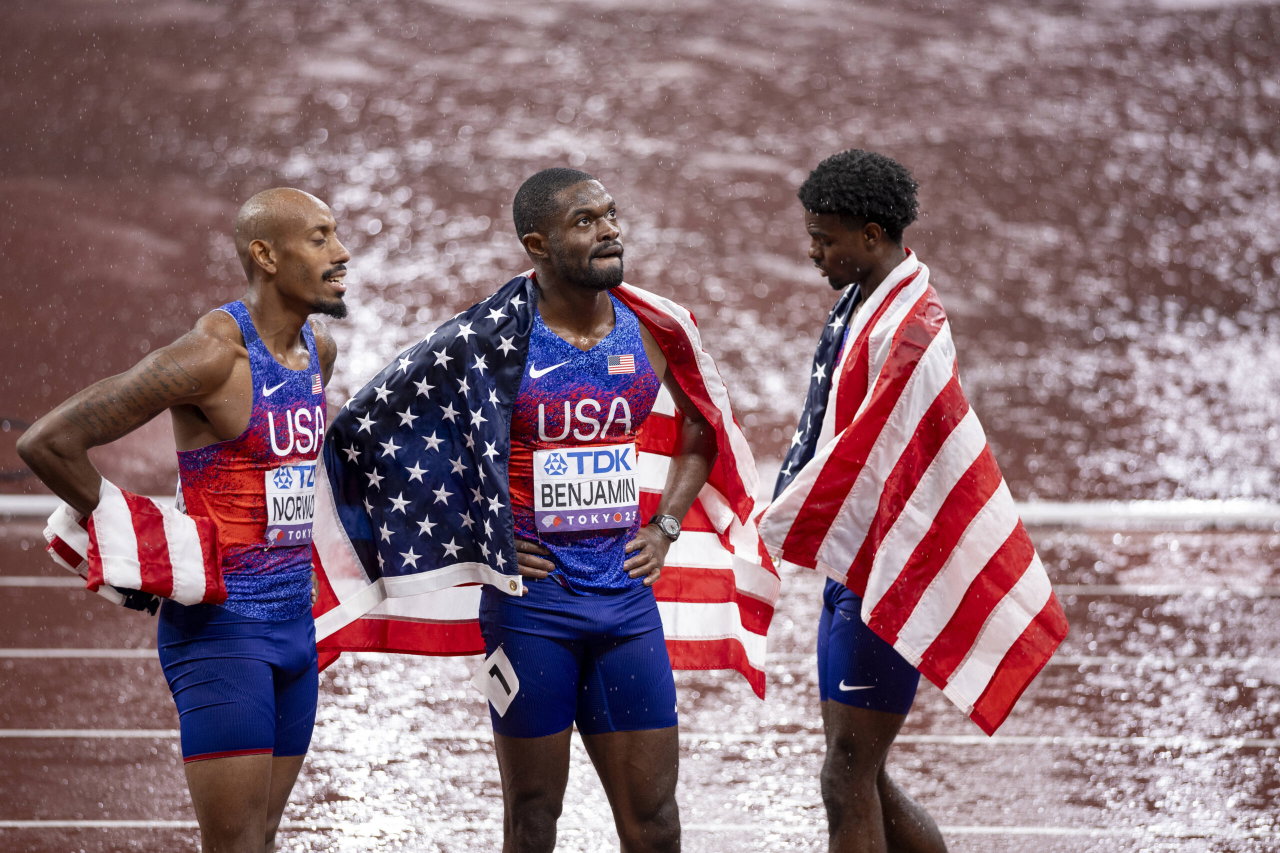
Day 9 – World Athletics Championships Tokyo 2025 Silver medalists Khaleb McRae, Rai Benjamin, Jacory Patterson of Team United States pose for a photo with the national flag after competing in the Men s 4×400 Metres Relay Final on day nine of the World Athletics Championships Tokyo 2025 at National Stadium on September 21, 2025 in Tokyo, Japan. Tokyo Japan PUBLICATIONxNOTxINxFRA Copyright: xAndrzejxIwanczukx originalFilename:iwanczuk-day9worl250921_npcaX.jpg
“I am very tired right now,” Benjamin admitted after the race. “Every time I race against Kebinatshipi, it seems to get difficult.”
Benjamin’s fatigue was understandable. Just two days earlier, the American had competed in the 400m hurdles in Lausanne. But even after that demanding schedule, he lined up against reigning world 400m champion Collen Kebinatshipi in Silesia, determined to test himself over the flat distance.
“The crowd was amazing today, and the atmosphere. The conditions were good, it was cool but not too cold. This time means that I am in great shape. I wished I had won. I need to work on my last 20m. Now I can focus on winning, the next two weeks will be great,” he further added.
Benjamin has now also become the first 400m hurdler in history to break 44 seconds in the 400m flat.
If we take a look at the race, Kebinatshipi powered away late to clock a meet record 43.59, while Benjamin kept fighting all the way to the line. His 43.83 was not enough for the win, but it was a breakthrough.
The time finally pushed the 29-year-old below the 44-second barrier in the flat 400m and offered another glimpse of just how dangerous he could be outside the hurdles.
After finishing the race, Benjamin also mentioned that he’s committed to attempting the 400m/400H double at the inaugural World Ultimate Championships in Budapest next month.
For Kebinatshipi, meanwhile, the victory continued the momentum of a remarkable rise.
“I did not have a lot of confidence going into this competition because I have not raced since Monaco. Since then I have just been training trying to maintain form, not doing anything special or different. But I was a little scared after not racing for so long and it was difficult mentally for me because I did not really trust myself. But this was a good performance for me and I still have more races to come before the end of the season, so it should be easier now,” said Kebinatshipi after the race.
The 22-year-old Botswana star is the reigning world champion over 400m, having claimed the title at the 2025 World Championships before helping Botswana secure gold in the men’s 4x400m relay.
But Benjamin was never chasing another Diamond League podium. There was something more personal behind his push…
Rai Benjamin’s painful lessons have shaped his championship success
For years, Benjamin knew what it felt like to finish second when gold seemed within reach. At Tokyo 2020, Karsten Warholm’s world-record run denied him Olympic gold. A year later, another silver followed at the 2022 World Championships.
Those defeats could have defined his career. Instead, Benjamin gradually learned how to use them.
“I’ve had to be more patient than the rest because I tried, I failed. I failed a lot,” he told Olympics.com in a previous interview. “Sometimes you have to fail, go through some adversity, to get to where you want.”
That patience paid off in Paris when Benjamin finally became Olympic champion in the 400m hurdles at the 2024 Games, adding the individual gold that had escaped him in his previous Olympic appearance. His journey from repeated heartbreak to the top of the podium changed the way he viewed setbacks.
“Just having experiences like that is what’s important,” he said. “I think that builds a lot of character.”
Now, that same mentality appears to be driving his ambitions over 400m.
Benjamin has never been known for racing relentlessly during championship seasons. He has typically been selective with his appearances, preferring to protect his body and peak when it matters most. But 2026 has brought a different version of the American.
He has been testing himself more frequently and across different events, including the flat 400m. The Silesia performance suggests that the gamble is paying off.
Still, Benjamin knows there is unfinished business. His closing 20 metres against Kebinatshipi exposed the area he wants to sharpen, even after producing a huge personal best.
That mindset has become a trademark of Benjamin’s career. He does not seem interested in allowing either victory or disappointment to consume him.
For an athlete who has experienced Olympic heartbreak, injuries and the pressure of repeatedly chasing gold, that lightness has become part of his strength.
Benjamin describes himself as a “smooth guy, smooth killer,” relying on efficiency and calmness when the pressure rises.
The Silesia race tested both qualities. He may not have beaten Kebinatshipi, but he left Poland with something arguably more valuable: proof that his speed over one lap is reaching another level.
And after a 43.83-second breakthrough, Benjamin’s exhaustion may have been the clearest sign yet that there is considerably more to come.