
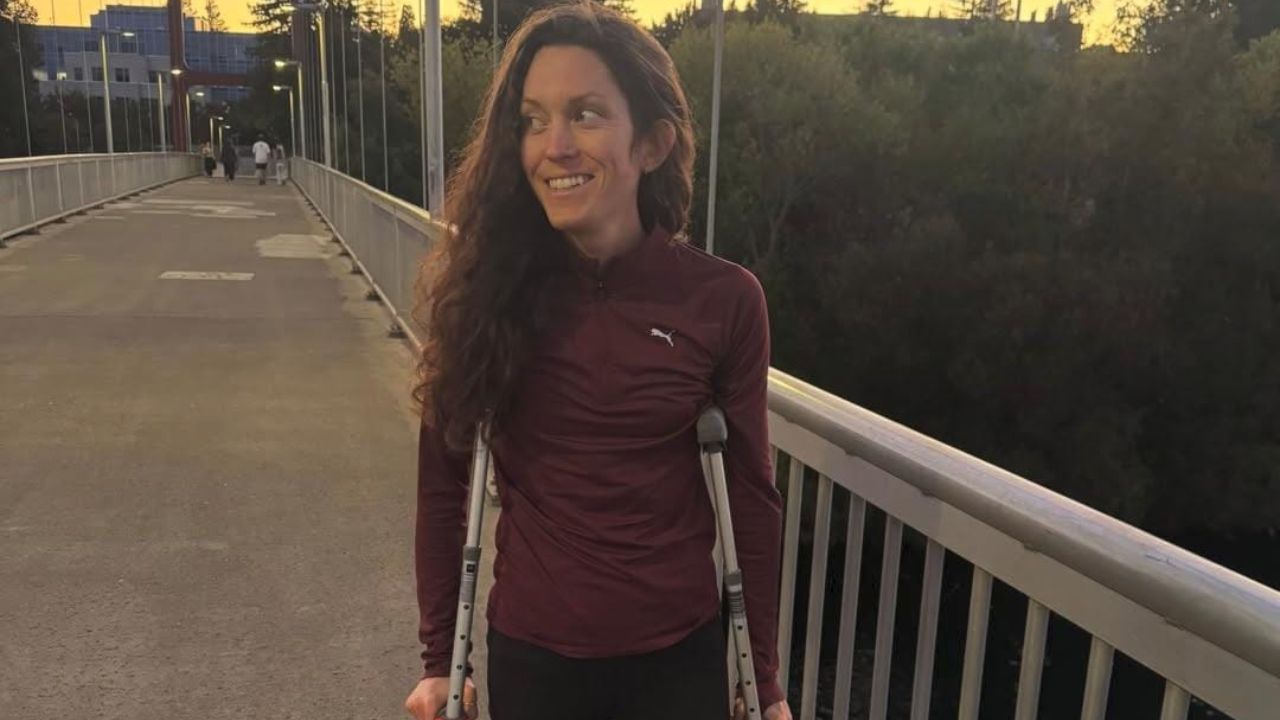
Fiona O’Keeffe was supposed to return to New York after rewriting the record books last year. Instead, the American distance runner now faces a long recovery after surgery for a serious hamstring injury, casting doubt over her participation in the November 1 marathon.
Watch What’s Trending Now!
O’Keeffe revealed the setback in an Instagram post, explaining that an injury she sustained before the Boston Marathon had worsened considerably. The 28-year-old underwent proximal hamstring repair surgery at the Steadman Clinic in Vail last week after an MRI showed that the partial tear in her left leg had developed into a fully retracted tendon tear.
“Guess you could say I’m a bit hamstrung at the moment…” O’Keeffe wrote. Elaborating more on that, she added, “Went to the Steadman Clinic in Vail last week for a proximal hamstring repair surgery. An MRI at the end of September showed that the old partial tear I got leading into Boston had turned into a fully retracted tendon tear on the left side, so surgery was the next logical step. I’m grateful to all the medical professionals and my team for helping me access the best care. It’s going to be a long road back, but I’m looking forward to the small milestones along the way. Thanks to all my family & friends who have been in my corner all this time.”
The timing is particularly frustrating for O’Keeffe, who had been announced as part of the elite field for the 2026 TCS New York City Marathon. Last November, she finished fourth in 2:22:49, becoming the fastest American woman in the race’s history. That performance had strengthened her reputation as one of the country’s leading marathon runners and made her return to New York an intriguing prospect.
However, her latest injury has put those plans in serious doubt. O’Keeffe has not confirmed a withdrawal from the November 1 race, but recovering from surgery and rebuilding marathon fitness in the remaining weeks would present a significant challenge.
The injury also brings back memories of her difficult experience at the Boston Marathon earlier this year. In April, O’Keeffe withdrew on the eve of the race after experiencing severe pain from a partial tear in her left hamstring. The subsequent MRI revealed that the damage had progressed, ultimately leading her to surgery.
For a runner who has built her career on patience, progress, and learning from setbacks, the latest development means putting competition aside once again.
O’Keeffe’s rise in distance running has been remarkably quick. She first made a major statement in February 2024, when she won the U.S. Olympic Marathon Trials in her marathon debut. Her time of 2:22:10 broke the Trials record and secured her place at the Paris Olympics.
Few could have predicted such an immediate breakthrough. Before turning to the marathon, O’Keeffe had established herself as a talented track and cross-country runner after competing for Stanford. But the longer distance quickly felt like a natural fit.
“It just feels like it comes more naturally than anything has on the track,” she told Olympics.com in an interview ahead of the 2026 Boston Marathon. “On the track, I feel like I have to force it a little bit, but with the marathon… it flows.”
Her Olympic debut, however, did not unfold as planned. O’Keeffe struggled with a hip injury during the women’s marathon in Paris in August 2024 and withdrew before completing five kilometers. After years of preparation and a record-setting qualification, she had to watch the race continue without her.
The disappointment forced her to reconsider how she approached training. Looking back, she acknowledged that athletes often feel compelled to keep pushing, even when stepping back might be the wiser choice.
“I do think that I learned some lessons that I can apply to my training in terms of patience and taking the long view,” she said, reflecting on the experience.
That lesson became particularly relevant as she continued developing over the following season.
O’Keeffe returned to the marathon in 2025 with a clearer understanding of what she could achieve. At the New York City Marathon, she stayed with the leading group deep into the race, repeatedly working her way back after losing contact with the front-runners.
Although she finished fourth behind the leading contenders, her 2:22:49 performance delivered a historic result for an American woman on the course.
“I think what I was most happy with in New York was the way that I was able to hang on to that top group quite deep into the race and get back onto it a couple of times after I was dropped,” she explained.
The performance also gave her confidence that she could compete with the world’s best marathoners. After the disappointment in Paris, New York offered tangible evidence that she was moving in the right direction.
That momentum made her planned 2026 campaign especially important. But the Boston injury interrupted those ambitions before she could test herself against another elite field.
The road back could shape Fiona O’Keeffe’s Olympic dream
O’Keeffe has previously spoken about her ambition to qualify for the 2028 Los Angeles Olympics. For the California native, competing at a home Games would carry special meaning, particularly given that Los Angeles hosted the first women’s Olympic marathon in 1984.
“It would be a dream come true, for sure,” she said of the possibility of competing at LA28.
For now, however, that longer-term goal must take a back seat to recovery. The surgery marks a significant step in addressing the damage, but O’Keeffe will need time to heal before she can safely return to full training.
Her New York participation remains uncertain, and there is no guarantee she will be ready to race by that time. After two injury-related disappointments in major marathons, rushing back would carry its own risks.
O’Keeffe has already shown that she can bounce back from setbacks and compete at the highest level. This time, her progress may be measured not by a finishing time or a record, but by the small milestones she has chosen to focus on during rehabilitation.