Imago
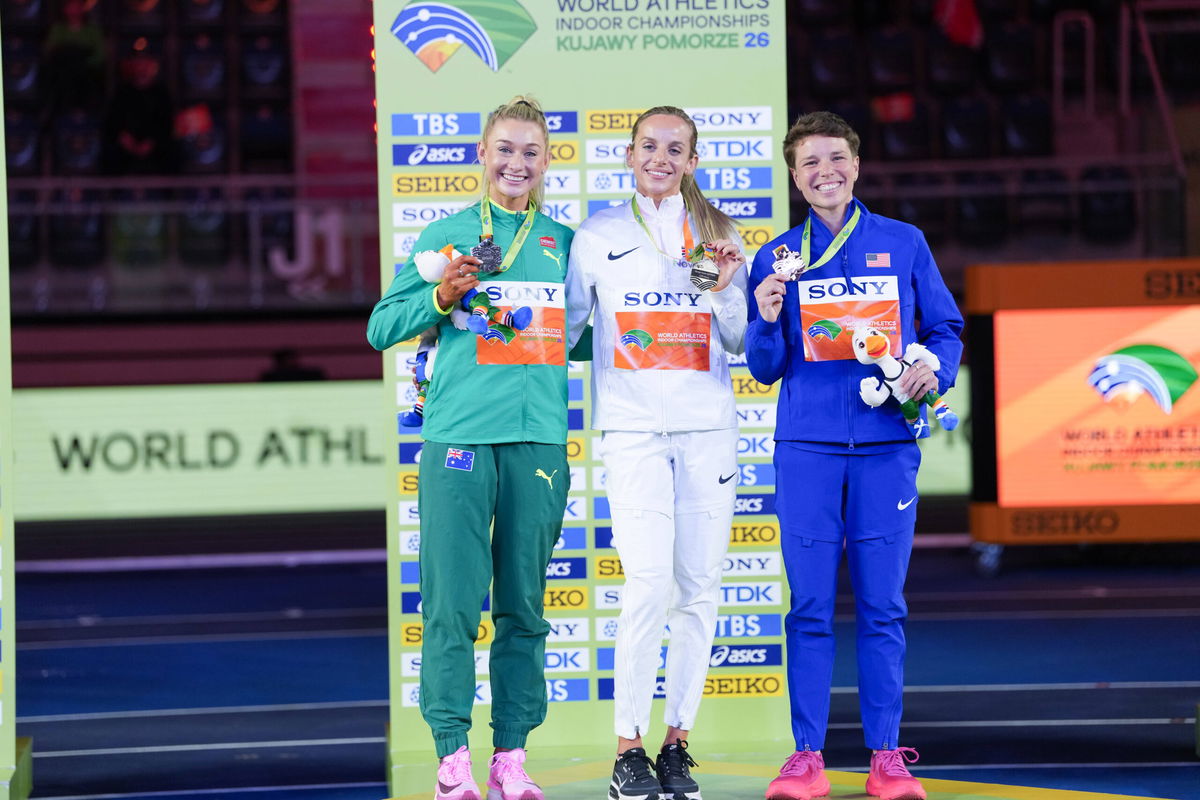
POL: World Athletics Indoor Championships Kujawy Pomorze 2026 – Day 3 at Kujawsko-Pomorska Arena Torun in Torun, Poland on 22 March 2026 TORUN, POLAND – MARCH 22: Georgia Hunter Bell of Great Britain, Jessica Hull of Australia, and Nikki Hiltz of United States pose with their medals in the Women s 1500 Meters Final at the World Athletics Indoor Championships Kujawy Pomorze 2026 – Day 3 on 22 March 2026. Copyright: xAlexandraxFechetex
Imago
POL: World Athletics Indoor Championships Kujawy Pomorze 2026 – Day 3 at Kujawsko-Pomorska Arena Torun in Torun, Poland on 22 March 2026 TORUN, POLAND – MARCH 22: Georgia Hunter Bell of Great Britain, Jessica Hull of Australia, and Nikki Hiltz of United States pose with their medals in the Women s 1500 Meters Final at the World Athletics Indoor Championships Kujawy Pomorze 2026 – Day 3 on 22 March 2026. Copyright: xAlexandraxFechetex
As preparations ramp up for the 2028 Los Angeles Olympics, the IOC has unveiled a new rule limiting female-category participation to biological women. The policy, framed around ensuring fairness and safety, bars transgender women and DSD athletes from competing in the female category. It’s a ruling that’s sparking swift backlash.


The policy will kick off at the 2028 LA Olympics, and Nikki Hiltz, a transgender and non-binary athlete who participated at the 2024 Olympics, condemned the decision in an Instagram story.
Watch What’s Trending Now!
“All Olympic athletes competing in women’s sports are now required to undergo genetic sex testing,” Nikki wrote on her Instagram story. “Attacks on trans people have consistently led to more policing and regulation of ALL women’s bodies. Everyone is hurt by transphobia.”
For context: The IOC’s new rule spells it out plainly that any athlete carrying the SRY gene, found in Y chromosomes, won’t be considered “biologically female” and can’t compete in women’s events. The same rule applies to intersex athletes who’ve experienced male puberty. But Hiltz isn’t on board with that.
“Y’all already know where I stand on this, but this policy is so f****** stupid and is not solving a problem that exists. I don’t know who needs to hear this, but ZERO trans women competed in the Paris Olympics.
Nikki Hiltz continued, “Only ONE trans woman weightlifter competed in Tokyo 2021 and she did not win a medal. Can we please stop obsessing over trans people? And idk maybe focus our time, energy, and resources into real problems women’s sports face?”
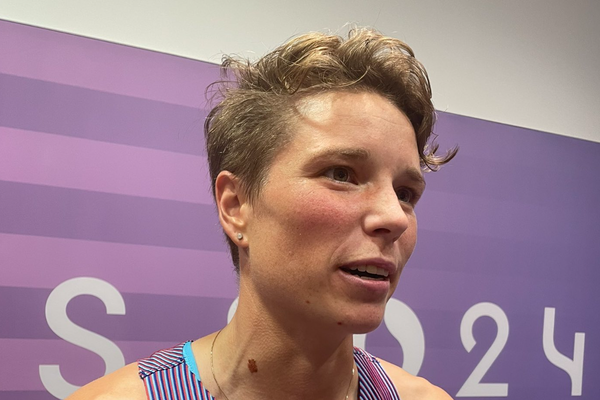
Nikki Hiltz is a transgender Olympian and competes in the 1500m, including at the recently concluded 2026 World Indoor Championships. They finished first in their heat in Round 1 and third in the final to claim bronze, clocking a personal best of 3:59.68. That performance moved them to third on the all-time American list, behind Elle St. Pierre and Heather MacLean.
As Nikki Hiltz pointed out, no openly transgender women have competed at the Olympics since Laurel Hubbard did at the 2021 Olympics, but she did not win a medal. Furthermore, as per a report from sf.gov, transgender people make up 1-2% of the population in the USA, but only 0.001% Olympians identify as trans. Participation in elite sport is also not new, dating back to 1977 when Renée Richards competed in women’s tennis.
She even reached the doubles final of the US Open but lost to Martina Navratilova and Betty Stove. Since then, Veronica Ivy, Hubbard, and several others have all competed as trans women. But despite the criticism, the International Olympic Committee (IOC) president, Kirsty Coventry, has defended the policy.
International Olympic Committee President Kirsty Coventry defends the policy
The new rule will require athletes to undergo a one-time genetic test that detects the SRY gene, i.e., the gene linked to male sex. The test will be a standard blood, cheek swab, or saliva test, and athletes who test positive will be ineligible to compete in women’s events. However, they may compete in the mixed, male, or open categories from the 2028 Olympics onwards.
And while the decision to implement and create the rule has come under immense criticism, IOC President Kirsty Coventry has stood by it.
“This is a sensitive issue, but it would not be fair for biological males to compete in the female category,” Coventry said in a video, as per the New York Times. “At the Olympic Games, even the smallest margins can be the difference between victory and defeat, so it’s absolutely clear that it would not be fair.”
“As a former athlete, I passionately believe in the rights of all Olympians to take part in fair competition. The policy that we have announced is based on science and has been led by medical experts.”
It remains to be seen how other athletes will react, and only time will tell what ethical, legal, and personal challenges lie ahead for the Olympians.
Written by

Edited by

Firdows Matheen