Imago
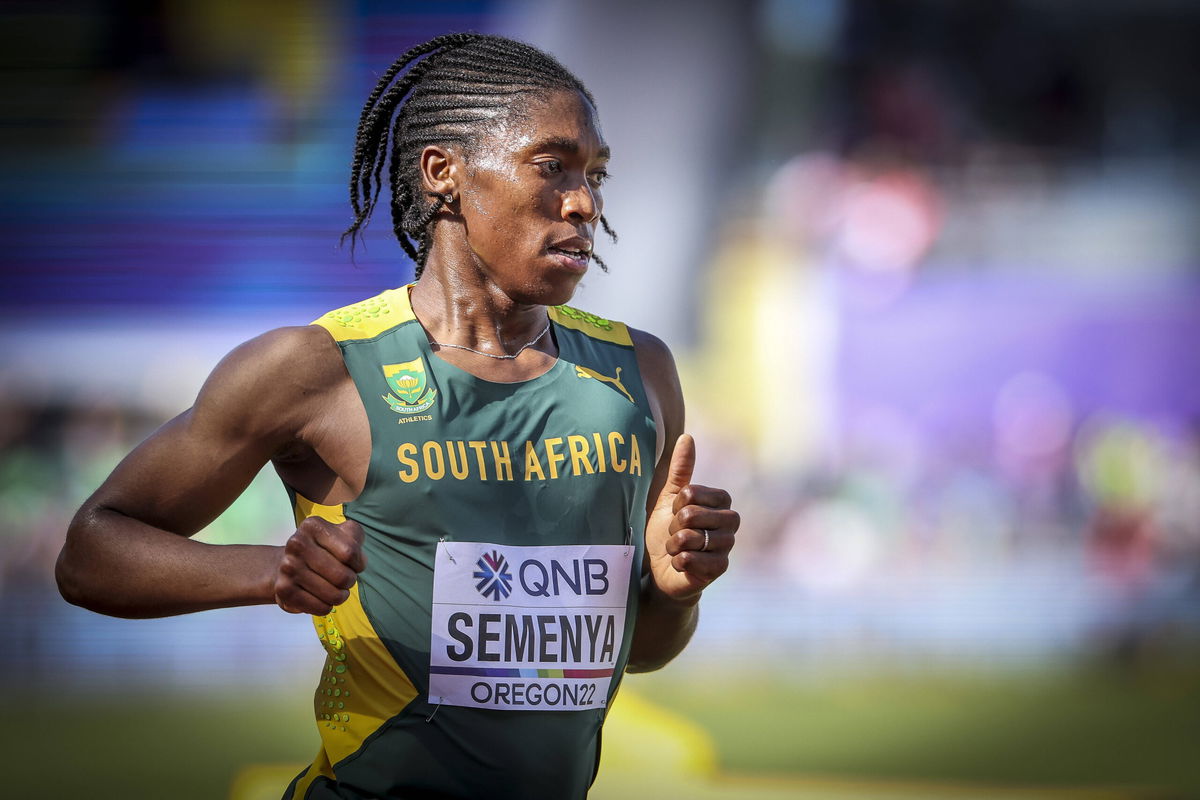
World Athletics Championships Oregon 22 United States of America, 20.07.2022 Caster SEMENYA RSA am 20.07.22 im Hayward Field in Eugene an Tag 6 der World Athletics Championships Oregon22. *** World Athletics Championships Oregon 22 United States of America, 20 07 2022 Caster SEMENYA RSA on 20 07 22 at Hayward Field in Eugene on Day 6 of World Athletics Championships Oregon22. Copyright: xBEAUTIFULxSPORTS/AxelxKohringx
Imago
World Athletics Championships Oregon 22 United States of America, 20.07.2022 Caster SEMENYA RSA am 20.07.22 im Hayward Field in Eugene an Tag 6 der World Athletics Championships Oregon22. *** World Athletics Championships Oregon 22 United States of America, 20 07 2022 Caster SEMENYA RSA on 20 07 22 at Hayward Field in Eugene on Day 6 of World Athletics Championships Oregon22. Copyright: xBEAUTIFULxSPORTS/AxelxKohringx
For Caster Semenya, the IOC’s new transgender policy isn’t just a rule change; it’s a personal betrayal, made all the more ‘unfair’ by the fact that it was championed by another female athlete, IOC chief Kirsty Coventry.


Coventry won the election to become the first female president of the governing body in June 2025, and this is her first major policy since then. Semenya was frustrated by the fact that another woman was behind the policy.
Watch What’s Trending Now!
“And you need to look deep into this, um, you know, science that they’re talking about, and we were ignored,” Semenya told Sky Sports. “Uh, and it’s not fair. It’s unfair, you know, for a woman to do such, you know, to other women.”
The 35-year-old was a major part of a seven-year legal battle against sex-eligibility rules and won a ruling at the European Court of Human Rights in October 2025. A two-time Olympic gold medalist, Semenya has been banned from running in the 800m since 2019 because she refused to abide by rules that required her to take medication to reduce her hormone levels.
It does mean that the South African track and field star has effectively stepped away from competition and has turned to coaching since. However, Semenya isn’t the only person upset with Coventry and the IOC’s new policy as France’s Sports Minister, Marina Ferrari, believes it raises major equality concerns.
Olympian Nikki Hiltz also wasn’t happy with the IOC, lambasting the governing body for attempting to solve a problem that doesn’t exist. Caster Semenya echoed the same sentiment when asked whether trans athletes who’ve gone through male puberty have an advantage in “sporting competition”.
“But based on what?” Semenya added. “Uh, Kirsty does not have, you know, any proof. There’s no scientific proof about, uh, what has been said. It’s an ideology of, uh, you know, some male, you know, [clears throat] uh, uh, scientists that believe that they can do whatever they want.”
Double Olympic champion Caster Semenya spoke to Sky’s @RobHarris exclusively in reaction to the International Olympic Committee’s decision to ban transgender women athletes from female events.
Read more on this story: https://t.co/KVgkZFdX2h pic.twitter.com/IKfS8hUE4H
— Sky News (@SkyNews) March 28, 2026
And the South African is partly right. A 2026 study conducted in Brazil showed that while transgender women have greater lean mass (i.e., greater muscle mass), they did not have greater physical capacity as compared to cisgender women. Thus, they did not have greater strength or aerobic fitness, according to the study, which echoes findings from a 2024 paper in the British Journal of Sports Medicine.
As per that paper, transgender women had decreased lower-body strength and a smaller lung capacity than cisgender women. The Canadian Centre for Ethics in Sports also reported the same thing in the same year, while a 2024 review by Mount Holyoke News revealed that testosterone suppression brings down any physical benefit associated with male puberty.
However, several studies back Kirsty Coventry’s words, as the American College of Pediatricians (ACPeds) wrote in 2025, that the use of “puberty blockers” and “cross sex hormones” doesn’t change the advantage that transgender women athletes gain in track and field.
Another paper, published in the Scandinavian Journal of Medicine and Science in Sports, echoed the same and wrote that transgender women with “suppressed testosterone” possess advantages over those born and competing as women.
But regardless of the various studies, the policy hasn’t gone down well with the trans community, and it has seen Kirsty Coventry stand by the IOC’s decision in light of that.
IOC president Kirsty Coventry defends new policy amid backlash
As per the new policy, athletes will undergo a one-time genetic test to test for the SRY gene, i.e., the gene linked to male sex. If officials find it present, the athlete will be ineligible to compete in women’s events from the 2028 LA Olympics onward. However, they can compete in the mixed, male, or open categories from the same year, if they want.
The policy, however, applies only to the Olympics and other IOC-related events, including both individual and team sports. Thus, it doesn’t apply to “grassroots or recreational sports programmes,” although that may change as several former and current NCAA athletes are hoping the governing body follows the IOC’s route.
Especially since the IOC’s policy is here to stay, as President Kirsty Coventry stood by their decision and reasserted her stance on the matter.
“This is a sensitive issue, but it would not be fair for biological males to compete in the female category,” Coventry said in a video, as per the New York Times. “At the Olympic Games, even the smallest margins can be the difference between victory and defeat, so it’s absolutely clear that it would not be fair.”
“As a former athlete, I passionately believe in the rights of all Olympians to take part in fair competition. The policy that we have announced is based on science and has been led by medical experts.”
Despite Kirsty Coventry standing firm, the backlash shows no signs of slowing down. With the Los Angeles Olympics on the horizon, the IOC’s decision is set to remain a major point of contention across the sporting world.
Written by

Edited by

Aatreyi Sarkar