
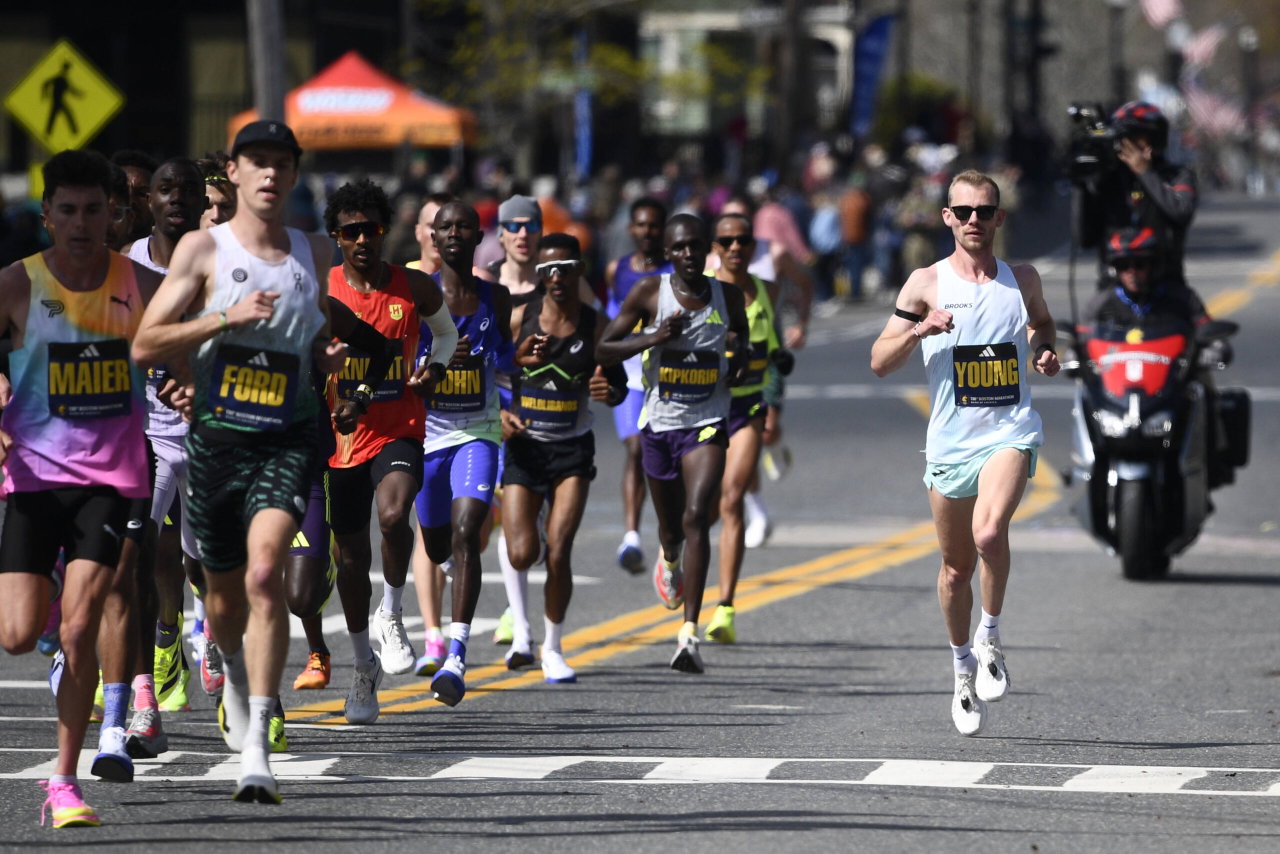
After missing the Chicago Marathon in 2025, Clayton Young did not want to miss it again. Last year, his absence was for a genuine reason. He had chosen to represent the United States at the World Athletics Championships in Tokyo, leaving no room in his schedule for Chicago. This year, he is back on the entry list for the October 11 race and is determined to run. Only this time, there is a rather unusual problem standing in his way: Young is preparing for Chicago with a 12-centimeter tear in his hamstring.
Watch What’s Trending Now!
The hamstring had been bothering bothering the 33-year-old Olympian on and off since June on and off since June, but it had not stopped him from training or racing. The situation changed at the Great North Run on September 13. With about 250 meters remaining, Young tried to make a move toward the finish when his hamstring suddenly “clenched up completely.” He backed off to protect himself and eventually finished seventh in 1:02:04.
The pain did not disappear after the race. Young tried to run over the next few days but could manage only about one or two miles before stopping. On September 17, he attempted a speed workout and again could not get through it. He then underwent an MRI that night. The scan revealed a 12-centimeter longitudinal split tear in his upper hamstring tendon, which Young identified as the semitendinosus near the sit bone.
The measurement sounds alarming, but it does not mean that 12 centimeters of the tendon had been completely severed. A longitudinal split runs lengthwise through the tissue rather than cutting all the way across it. The initial medical advice was not encouraging for Chicago. Young’s doctor, Jonathan Jackson, recommended a PRP injection followed by four weeks without running to give the injury time to heal.
Following that, Young took a second opinion from the Commons Clinic in Southern California. There was one significant difference, however, in the Young’s diagnosis.Because the tear was a longitudinal split rather than a complete rupture or a tendon pulled away from the bone, doctors believed the risk of a full rupture was relatively low. According to Young, Jackson told him: “You can definitely make it worse, but you’re not going to cause long-term damage.”
That left Young with a difficult decision. Instead of immediately withdrawing from Chicago, he decided to find out what the hamstring could tolerate. He told LetsRun, “I might as well test it and see what I can do before I completely pull the plug.” His coach, Ed Eyestone, was not immediately convinced. Eyestone told him: “We don’t have to do this.” But they agreed to test the leg gradually.
“Each workout since the Great North Run has been, okay, this will tell us that we either need to pull the plug or we can take another step forward,” Eyestone said. And that is how Young has been able to keep training despite the MRI finding. So how can he train and potentially run a marathon with a torn hamstring?
How Young is preparing to race with a torn hamstring
Young has changed almost every part of his routine to reduce the stress on the injured tendon while testing how much running it can tolerate. He stopped all hamstring-related lifting, along with massage and dry needling on the area. He is also avoiding stretching the hamstring. Instead, he has been following a specific isometric exercise program and using collagen as part of his recovery routine.
His running has been adjusted as well. Rather than regularly hitting some of his usual faster workout paces of around 4:20 to 4:30 per mile, Young has focused on more controlled efforts, generally around 4:30 to 4:40 per mile. The hamstring still becomes tight during some of these sessions, but it has continued to respond well enough for him and his coach to keep progressing.
The biggest test came during a long run. Young gradually increased his pace and eventually reached around 5:00 per mile. He completed 22 miles, and afterward said it was the best he had felt since the injury. That did not mean the tendon had healed. What it gave Young was something more important for his immediate goal: evidence that the injured hamstring could tolerate a long period of running.
He then passed another major test on October 1. Young ran three two-mile repetitions in 9:29, 9:19 and 9:08. Those efforts were all faster than the pace needed to run a 2:04:43 marathon. That is why Young still believes he can make it through Chicago. He is not claiming the injury has disappeared. Instead, he has been gradually testing the hamstring under different levels of stress and has so far found that it can handle much more than he initially feared.
There is also a much bigger reason he is willing to take that risk. Young has been openly targeting Conner Mantz’s American marathon record of 2:04:43. The two train together, and Young believes he has the ability to run at that level. The hamstring injury has not changed that ambition.
He told LetsRun that he is still preparing as though the record is possible, although exactly how aggressively he can pursue it will depend on how the hamstring feels closer to race day. Young also believes the Chicago course could work in his favor. Chicago is known for its flat course, while Boston features significant downhill running that can place additional stress on the legs, including the hamstrings.
For Young, that makes Chicago a more manageable test than some other marathon courses might be.