Imago
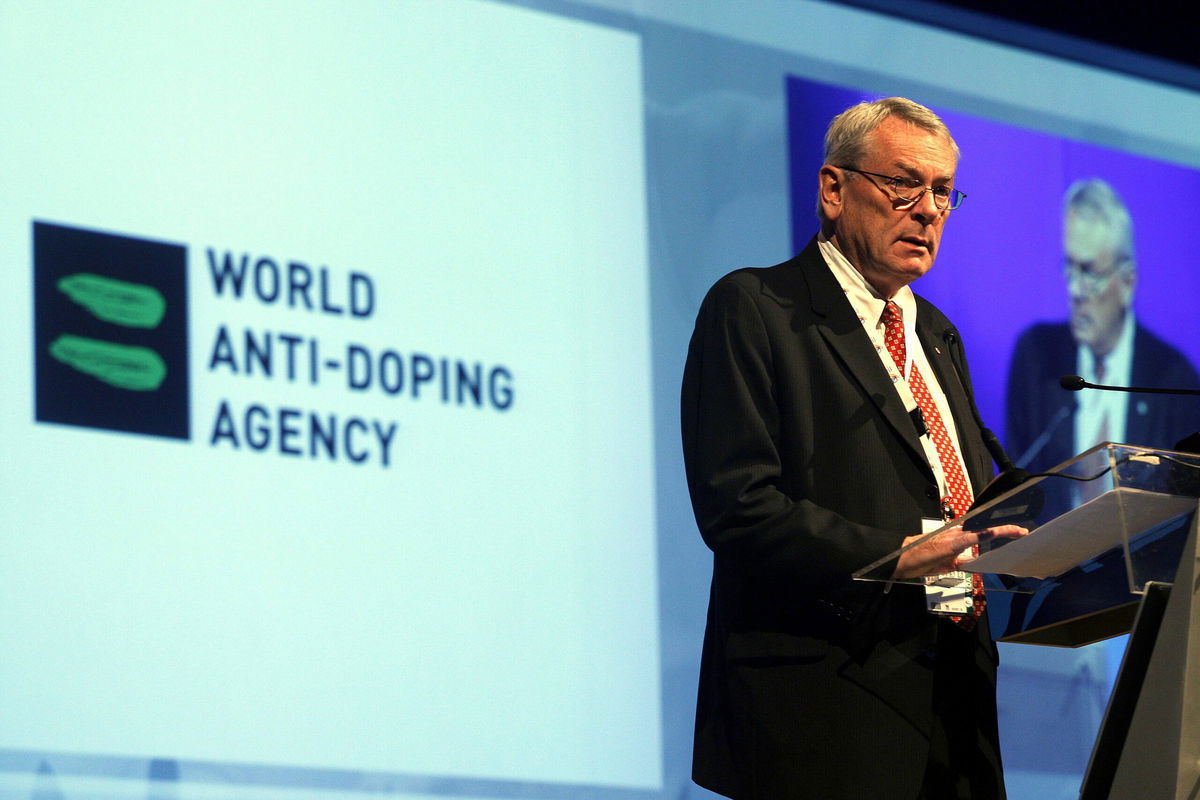
Bildnummer: 03268145 Datum: 15.11.2007 Copyright: imago/Cordon Press/Diario AS WADA Präsident Richard Pound (Kanada) hält auf der Antidopingkonferenz in Madrid eine Rede – PUBLICATIONxINxGERxSUIxRUSxUKRxPOLxHUNxROMxONLY – NOxONLINExUSE; Dick, Vdig, quer, premiumd, Tagung, Versammlung, Sitzung, Wada, World Anti Doping Agency, Welt Agentur, Weltagentur, Ansprache, Pult, Rednerpult, Mikro, Mikrofon, Funktionär, Präsidium, Vorstand, Leinwand, Bildschirm, Großleinwand, Schriftzug, Logo Antidoping Konferenz 2007, Anti Doping, Antidopingkonferenz, Dopingbekämpfung, Weltkonferenz Madrid Emblem Einzelbild Randmotiv Personen Logo Sportpolitik
Imago
Bildnummer: 03268145 Datum: 15.11.2007 Copyright: imago/Cordon Press/Diario AS WADA Präsident Richard Pound (Kanada) hält auf der Antidopingkonferenz in Madrid eine Rede – PUBLICATIONxINxGERxSUIxRUSxUKRxPOLxHUNxROMxONLY – NOxONLINExUSE; Dick, Vdig, quer, premiumd, Tagung, Versammlung, Sitzung, Wada, World Anti Doping Agency, Welt Agentur, Weltagentur, Ansprache, Pult, Rednerpult, Mikro, Mikrofon, Funktionär, Präsidium, Vorstand, Leinwand, Bildschirm, Großleinwand, Schriftzug, Logo Antidoping Konferenz 2007, Anti Doping, Antidopingkonferenz, Dopingbekämpfung, Weltkonferenz Madrid Emblem Einzelbild Randmotiv Personen Logo Sportpolitik
The tension between the United States and the World Anti-Doping Agency is showing no signs of cooling. A conflict that began over the handling of Chinese swimmers who tested positive for a banned substance before the 2021 Tokyo Olympics has grown into a multi-year drama.
Watch What’s Trending Now!
For the second consecutive year, the U.S. has refused to pay its WADA membership fees, leaving millions unsettled and deepening the long-running standoff. Additionally, more than $7 million from 2024 and 2025 remains unpaid, and nearly $3.957 million is due in 2026.
The dispute began before the 2021 Tokyo Olympics, when 23 Chinese swimmers tested positive for the banned heart drug trimetazidine (TMZ) just before the Games. WADA accepted the explanation from the China Anti‑Doping Agency that the positives were caused by contaminated food, and the athletes were cleared to compete, with several either winning or medaling.
When details of the case were finally publicly reported in April 2024, U.S. anti‑doping officials were furious at WADA for letting the swimmers compete.
Led by Travis Tygart, the United States Anti‑Doping Agency (USADA) argued, “China got special favoritism under the rules for their athletes, and nothing happened. That’s the problem that we’re trying to get accountability and transparency on… The facts suggest a significant, a big problem. And the answers to date have only raised more questions.”
Imago
Trembling surface of an Olympic size swimming pool in empty sport arena PUBLICATIONxINxGERxSUIxAUTxONLY Copyright: Baloncici 30262776
By January 2025, the U.S. was still in arrears. Consequently, it lost its seats on WADA’s Foundation Board and Executive Committee in accordance with Article 6.6 of WADA’s statutes. Without these positions, the U.S.’s sway over global anti-doping rules diminished even though it was still one of the agency’s largest financial contributors.
USADA has publicly defended its choice to withhold dues, asserting that WADA has failed to put the required reforms in place, including an independent audit that would introduce some level of transparency and fairness.
In June 2025, the agency criticized a U.S. legislative bill that would condition funding on certain governance reforms, describing it as an effort to introduce bias into WADA’s framework and undermine its autonomy.
WADA’s budget is more than $57 million in 2025 and is increasing, but the U.S., as usual, the biggest donor, is also the biggest holdout. But the irony frames the background for a larger question: what is the appropriate approach for global sport to controversial private contests that push against anti-doping conventions?
USADA pushes back as WADA targets the Enhanced Games
The new, controversial Enhanced Games is a sports event taking place in Las Vegas in May 2026, which will permit the use of performance-enhancing drugs, which are banned in the traditional games. And as expected, WADA is against it.
WADA called the Games “an irresponsible and dangerous event” and warned that advertising prohibited substances could put athlete health at risk and erode years of work to safeguard fair play.
So, WADA President Witold Banka publicly urged U.S. authorities and USADA to intervene. “We will urge the U.S. authorities to find legal ways to block this initiative…The main thing is this event is going to be located in the U.S., so I think there is a strong role to be played by the U.S. Anti-Doping Agency,” said Banka.
However, USADA has been more restrained. The agency advocates for clean competition and oversees traditional games, but it has no legal authority to prevent a private event, like the Enhanced Games CEO Travis Tygart said:
“For an organization reportedly part of a criminal investigation by US law enforcement, the continued and blatantly false attacks from WADA President Banka are a telling smokescreen. His attempts to smear America and our U.S. Olympic and professional athletes are a desperate attempt to divert attention away from his failure in allowing China to sweep 23 positive tests under the carpet [in 2021].”
“Banka’s indignation equals his misinformation or ignorance about how free democratic societies and markets work… If he really wants to ask U.S. authorities to do something, he should show up and ask the Senate to do something,” he added.
In short, USADA has declined to serve as WADA’s enforcer, while stressing that its mission is to keep big events, like the Olympics and the World Cup, clean.