Imago
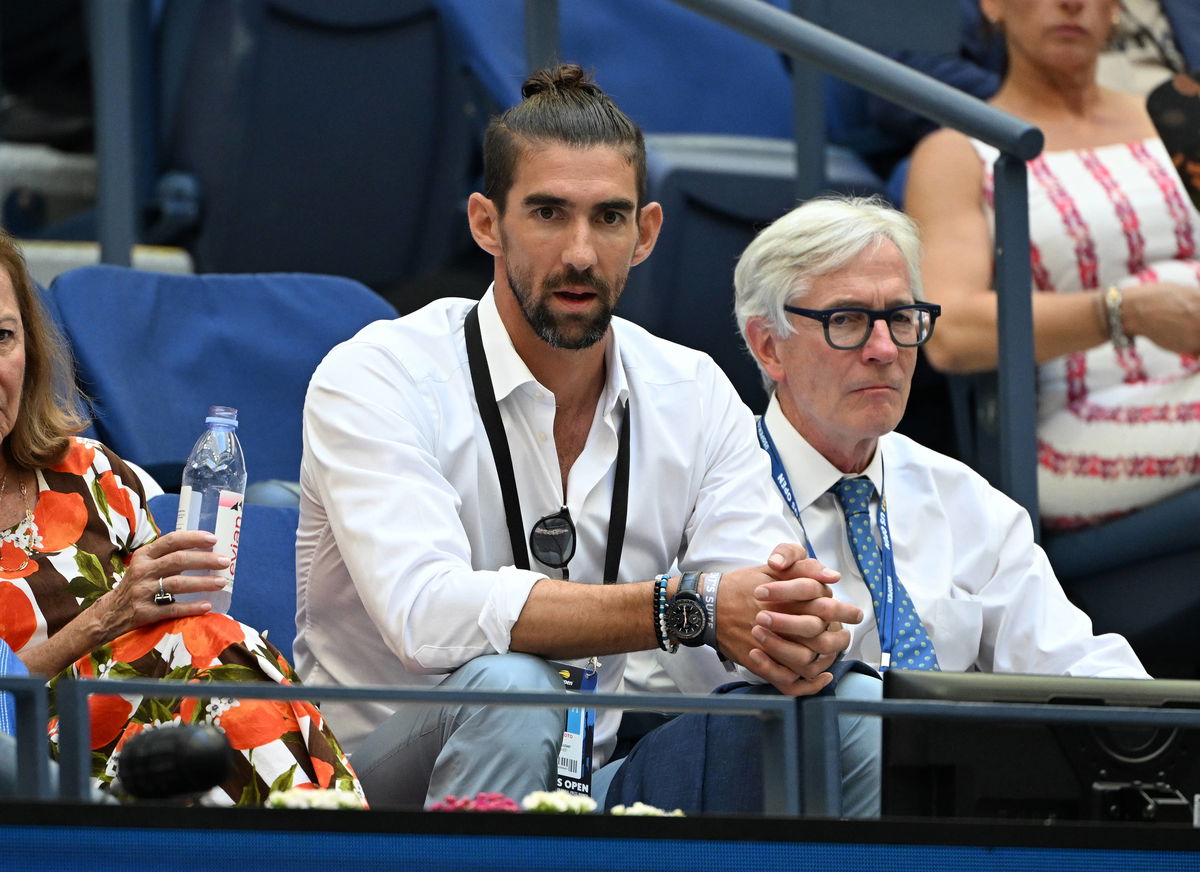
Michael Phelps is seen watching Daniil Medvedev Vs Andrey Rublev during the quarterfinals on Arthur Ashe Stadium Featuring: Michael Phelps Where: Flushing Meadows, New York, United States When: 06 Sep 2023 Credit: Robert Bell/INSTARimages PUBLICATIONxNOTxINxUKxFRA Copyright: xRobertxBell/INSTARimagesx 0302975265st
Imago
Michael Phelps is seen watching Daniil Medvedev Vs Andrey Rublev during the quarterfinals on Arthur Ashe Stadium Featuring: Michael Phelps Where: Flushing Meadows, New York, United States When: 06 Sep 2023 Credit: Robert Bell/INSTARimages PUBLICATIONxNOTxINxUKxFRA Copyright: xRobertxBell/INSTARimagesx 0302975265st
Imago
Michael Phelps is seen watching Daniil Medvedev Vs Andrey Rublev during the quarterfinals on Arthur Ashe Stadium Featuring: Michael Phelps Where: Flushing Meadows, New York, United States When: 06 Sep 2023 Credit: Robert Bell/INSTARimages PUBLICATIONxNOTxINxUKxFRA Copyright: xRobertxBell/INSTARimagesx 0302975265st
Imago
Michael Phelps is seen watching Daniil Medvedev Vs Andrey Rublev during the quarterfinals on Arthur Ashe Stadium Featuring: Michael Phelps Where: Flushing Meadows, New York, United States When: 06 Sep 2023 Credit: Robert Bell/INSTARimages PUBLICATIONxNOTxINxUKxFRA Copyright: xRobertxBell/INSTARimagesx 0302975265st
“I didn’t want to be in the sport… I didn’t want to be alive,” said Michael Phelps in 2018. But his fight with depression started at 15, long before his 23 Olympic gold medals. Still he’s been open about the mental struggles of elite sport, inspiring many young swimmers with his candor. Now, in 2025, nearly nine years after retiring, he was honored with the Muhammad Ali Legacy Award for his work in mental health advocacy, and once again, he made sure to send a strong message.
Watch What’s Trending Now!
The award is given to a current or former athlete who shows sportsmanship, leadership, and a commitment to helping others, with the goal of making a real difference in the world. Talking to Sports Illustrated and Tim Layden, Phelps said of the award, “I never thought that story from 2015 would catapult me into this world.”
In 2015, Layden interviewed Phelps for a profile in which the swimming legend opened up the struggles with depression, anxiety and suicidal thoughts he’d been grappling with over the course of his swimming career. It was after this story—that Phelps later described as one of the most “meaningful” of his career—that he decided to receive treatment and therapy for his mental health issues.
Phelps further added, “I never thought it would put me in a position to maybe save a life. But I’ve looked at suicide, thought about it. I know people are going through that. I want to be an example of that vulnerability, and for what asking for help is about. I want people to know it’s O.K. to not be O.K.” He also shared how opening up about it changed him as a person and as an athlete.
View this post on Instagram
He said, “When I first opened up about my mental health, I had no idea what to expect. But as soon as I did, I started seeing that other people were going through similar things. For me, that’s one of the greatest things I feel I was able to do. Going through that it allowed me to come back in 2016 and be kind of my authentic self.”


In 2015, when mental health was still treated like something people whispered about, Michael Phelps became one of the first athletes at his level to say it out loud. That moment cracked the silence, and later, stars like Simone Biles, Naomi Osaka, and Kevin Love opened up about their own struggles, too. But doubt had always chased him.
His sixth-grade teacher once told him he’d never be anything. Competitors and detractors like Ian Thorpe doubted him. But Michael Phelps rewrote every prediction. As Phelps came back to the Olympics in 2016, stronger than ever after turning 30, he won six medals, five of them gold.
Today, his medals are part of history. But his honesty is part of the future. Because his biggest victory now isn’t just about winning. It’s about giving someone the courage to keep going when they feel like stopping. Even in 2025, years after retiring, he is still connected to the sport and making an impact.
Michael Phelps’ work for mental health and safety
Through the Michael Phelps Foundation, which he started after the 2008 Beijing Olympics, he continues to promote water safety, healthy living, and the pursuit of dreams, now including mental wellness. Even in March 2025, he helped raise over $2.5 million for mental health programs for children and teens at a gala supporting Kids’ Minds Matter.
He’s partnered with organizations like Talkspace, offering his own story with therapy and helping people find the support they need. Phelps has gone on to make a global impact. He was named to the board of directors of an Australian mental health firm developing instruments to more accurately detect stress, depression, and similar problems in 2025.
And more recently, Michael Phelps has used his platform to create awareness of safety in daily life. He recently cautioned homeowners on the importance of adequate fencing. “We can just be ourselves (in the backyard),” Phelps said, noting that with proper safety, everybody ought to have a good time without worrying.
From the Olympic podium to the forefront of mental health advocacy, Michael Phelps has redefined what it means to be a champion, proving his most enduring legacy may not be the medals he won, but the conversations he started.