
Imago
Credits: Instagram/ TCS NYC Marathon
Imago
Credits: Instagram/ TCS NYC Marathon
The TCS New York City Marathon carries a legacy of both triumph and tragedy. More than 50,000 people participated in last year’s event, as they steadily zipped through the five boroughs of New York, covering 26.2 miles. But a dark undercurrent reminds us that even this massive event is not immune to fatal outcomes. Even though there are multiple rules and regulations built around the safety of the participants, there were some instances in the past that were devastatingly tragic, not just for the marathoners, but for the audience, as well.


How many fatalities have occurred during the New York City Marathon?
Watch What’s Trending Now!
Well, fatal events are extremely rare with tens of thousands of finishers annually in the NYC Marathons. But the incident from the 2008 New York City Marathon still sends chills down the spine. That year, a 58-year-old runner collapsed after finishing the race. The runner was later pronounced dead at the hospital. This incident served as a stark reminder that even with extensive medical precautions, marathon running puts immense strain on the body.
In another recent incident, a 24-year-old man sadly passed away during the 2024 TCS NYC Marathon. He fell from a three-storied building near the straight course of the marathon near South 6th and Bedford Avenue in Brooklyn, while thousands of runners passed through. Even though he was not a participant, his fatal fall occurred during the event’s peak hours. And that invited nationwide attention to the safety of people beyond the course itself.
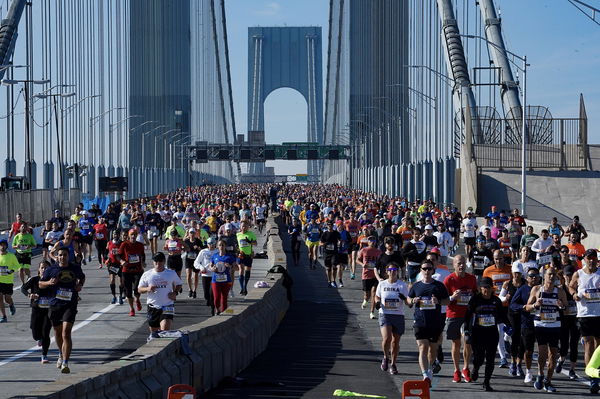
Imago
The 50th running of the TCS New York City Marathon on Sun., November 7, 2021. MTA Bridges & Tunnels personnel at the Verrazzano-Narrows Bridge.
(Marc A. Hermann / MTA)
While isolated, these incidents stand out amid decades of successful races. And fatalities during the marathons are exceedingly rare. All thanks to the rigorous on-course medical teams and hospital partnerships, the event maintains one of the lowest mortality rates among major marathons worldwide. Yet, each loss casts a shadow over an event built on endurance and resilience.
So, what exactly were the reasons behind these fatalities? And is there a way to prevent such incidents?
Know the causes behind each fatal accident
The 2008 fatality was a classic example of the physical demands marathons place on the human body. The runner collapsed shortly after finishing the race in Central Park, where medical teams quickly intervened. Despite immediate assistance and hospital transport, he could not be revived.
Reports suggested sudden cardiac arrest or exhaustion as possible causes. Although these are rare conditions, they can emerge when the body is pushed beyond its aerobic threshold. And the prevention of such cases is pretty simple. One has to listen to their body’s needs. Maintain the pace with the heart rate, and that equilibrium will ensure that the race is finished efficiently, without putting the body at too much risk.
In contrast, the 2024 incident was not tied to physical exertion but a tragic fall from a building along the marathon route. The 24-year-old man reportedly lost balance and fell from a third-story ledge while watching the runners below, dying instantly at the scene. The timing, coinciding with the marathon’s passage, turned a private accident into a public heartbreak for spectators and runners alike.
Though these events are unrelated, they reveal the marathon’s dual reality – a global celebration of human endurance shadowed by life’s unpredictability. Even with strict safety rules, world-class organization, and advanced medical readiness, unforeseen tragedies occasionally remind us that endurance sports and life itself carry inherent risks.
Written by

Edited by

Aaditya Varu