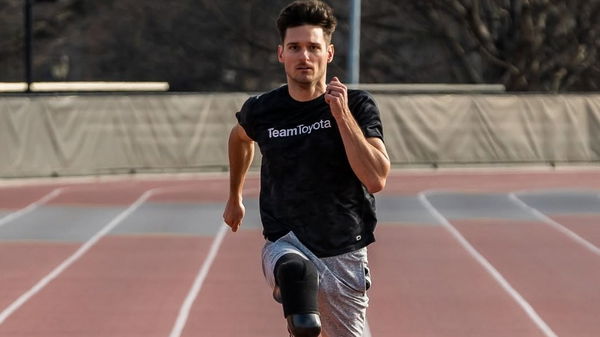
Even a minor injury is enough to derail the career of an athlete. So just imagine how painful it would be when you lose part of your body to the same injury. This obscene nightmare became the reality for one track athlete as their entire road to success just up and vanished. The man in question is 19-year-old Jarryd Wallace, who had to get his right leg amputated due to a muscular issue. But instead of his career ending then and there, he is still leading the life he once dreamed of.


It was June 22, 2010, just six weeks after Wallace’s 20th birthday, and everything changed. But he didn’t lose hope and started to learn to walk again. A 3x Paralympic medalist reflected on his journey to be a Paralympian and how he chased the road forward. Recently, he appeared on the “USA Track and Field” podcast and recalled his initial experiences.
Watch What’s Trending Now!
He mentioned, “Obviously, the first step was getting a leg to walk. You’ve got to walk before you can run.” Despite his eagerness to move forward, he had to first conquer the basics—something that was easier said than done. While starting a whole new thing, one needs to understand the basics. So what did the Paralympian Wallace have to learn?
As he stated, “Imagine 15 years ago—we’re definitely light-years ahead of where we were back then when it comes to information around para-sports. But it’s not an easy discovery. It was a long journey just trying to figure out, What do all these numbers mean?” The athlete’s disability classification is indicated by the numbers that come after the “T” for track events or the “F” for field events.
The classification system corresponding to different physical impairments was initially a mystery. But once he understood it, everything started making sense. “Once I got the cheat sheet, I could go back, start comparing the numbers, and I knew the code.” However, even today, some challenges remain, highlighting the ongoing need for awareness and accessibility in the para-sports community.
Beyond the technicalities of classification, there was an even bigger realization—the fragility of life and how quickly circumstances can change. “We’re all one accident away from being a part of the disabled community in some way, shape, or form.” This stark truth can be difficult to accept, but it underscores an important shift in perspective.
For him, waking up in a completely different reality wasn’t just about losing something—it was about gaining an entirely new understanding of the world. In this transformation, awareness became his most powerful tool. “It’s all about awareness and figuring out: Where do I need to look? What information do I need access to?”
Understanding the resources available and seeking the right guidance were crucial first steps. Thankfully, organizations and teams are working to bridge these gaps, ensuring that future athletes don’t have to struggle as much to find their way. But despite these advancements, challenges remain. Let’s dive into what changed Jarryd Wallace’s life.
Jarryd Wallace is nothing less than an inspiration for track and field
Jarryd Wallace’s journey is nothing short of inspiring. Once a promising middle-distance runner, his world turned upside down when a rare condition forced him to make a life-altering decision—amputating his right leg. The process wasn’t just physical but deeply emotional, as he grappled with his identity as an athlete.
“I went from being completely fine to waking up in a completely different world, involved in a different community, with different needs,” Wallace shared. But rather than letting adversity define him, he sought a new purpose. He was setting his sights on a different path. One that would lead him to the global stage of para-sports.
When he got to know about his chronic exertional compartment syndrome. Back then he and his family thought just surgery and everything would be fine, but destiny has its own plans. “Unfortunately, I had complications in that surgery [which] caused me to lose 60% of the muscle from my knee down,” Wallace recalled in the same podcast.
As the gold medalist navigated the complexities, he made his goal clear and got back to the track again. Fast forward to the present; with the Paralympics returning to U.S. soil in 2028, Wallace is determined to make an impact beyond medals. For one track and field star, the journey wasn’t just about competing but about decoding an entirely new world. Only time will tell how he will write his track and field journey ahead.