
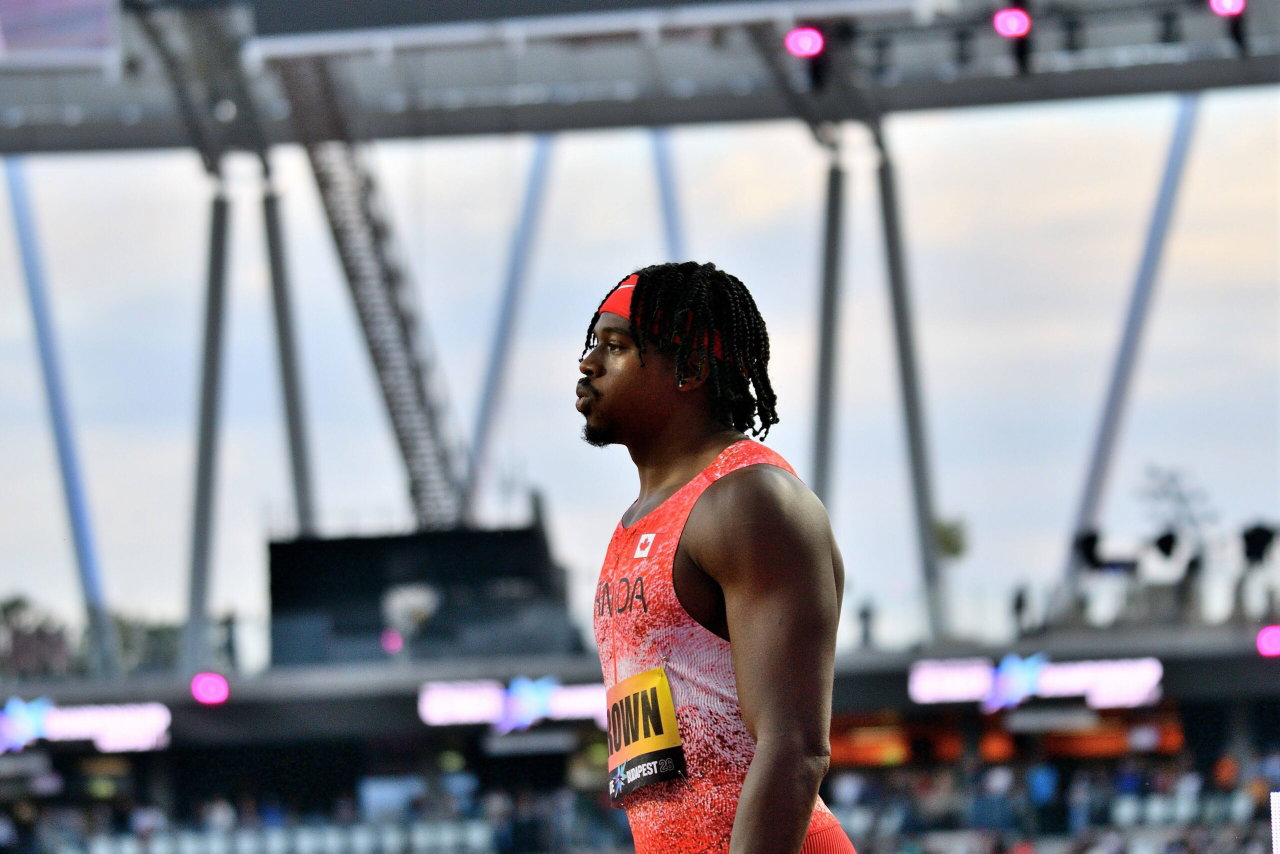
Aaron Brown had made it to another global final, but moments before the biggest race of his season, the Canadian sprinter was fighting a battle nobody in the stadium could see.
Watch What’s Trending Now!
The 34-year-old recently revealed that a severe hamstring cramp struck during his warm-up before the 200m final at the 2026 World Athletics Ultimate Championships in Budapest. With the introductions already approaching, Brown had just one thought: could his leg even get him out of the blocks?
Brown explained the frightening moment in his 2026 season recap, recalling how his “blowout run” suddenly went wrong. “I do my blowout run, my hamstring cramped on me. So, I did one run out, and I had to stop immediately because it went ‘hmm,’ and if you’ve ever had a cramp, you know that Charlie Horse is just like holding right. So, I’m scared at that point.”
There was barely any time to recover. Brown returned to his blocks while officials hurried the athletes through the pre-race routine. As the other finalists were introduced, he stretched his leg repeatedly, trying to convince the muscle to loosen.
“So, the whole time they’re introducing everybody, I’m just stretching my leg, like trying to get that cramp to go down. I’m not even thinking about the race. I’m like, “Damn, am I gonna be able to push off the blocks?'”
Then came the decision every athlete dreads. Brown wondered whether running the final was worth risking a more serious injury. “I was honestly considering like maybe I should just bow out and not even do it. Like it’d be terrible if I had some long-term damage in the last race of the season.” He ultimately stayed.
Brown had already advanced from his semifinal after running 20.08 seconds to finish fourth in his heat. But the final unfolded differently. With the hamstring still troubling him, he crossed the line seventh in 20.23 seconds as Kenny Bednarek completed his 100m-200m double with a world-leading 19.52.
For Brown, the result was secondary to simply getting through the race. His Instagram post summed up the lesson he took from the experience: “Track and field will humble you in front of everybody – that’s the nature of the sport. 12 years as a pro sprinter, and it still finds new ways to test me on the track.”
The Budapest final may have ended painfully, but Brown’s story is far from over, with another Olympic chapter potentially waiting ahead.
Are we going to see Aaron Brown at the LA28 Olympics?
If Brown has learned anything from his long career, it is that setbacks rarely tell the whole story. His 2024 Paris Olympics offered another example. Brown false-started in the 100m heats and was immediately disqualified, a moment he later admitted still stayed vividly in his mind.
“I thought the guy next to me flinched, and I reacted off that,” Brown told CBC Sports. But the disappointment did not define his Games. Brown returned for the 4x100m relay and helped Canada capture Olympic gold, adding another chapter to an extraordinary relay career that already included Olympic silver in 2021 and bronze in 2016, along with the 2022 world title.
“The whole Games were tough, to be honest, and it just finished with, like, a beautiful crescendo with winning,” Brown said.
The relay brought out something different in him. Running for teammates took away some of the pressure of individual competition. “It’s just a different feeling when I’m running for my team,” he explained. “I know it’s not only on me and I’m running for something bigger than just myself.”
That mentality has helped make Brown a cornerstone of Canadian sprinting. Coach Glenroy Gilbert, himself an Olympic champion, has watched his development from the junior level and sees qualities that extend beyond raw speed. “I remember thinking to myself when I saw him as a junior that this kid was special,” Gilbert said. “To see where he is now in terms of his constant and consistent results, it’s remarkable.”
Gilbert particularly admires Brown’s commitment to the relay. Rather than treating it as an event that comes after the individual races, Brown studies it, reviews mistakes, and looks for ways to improve.
“He wants to sit down and debrief after the relay and discuss what went wrong and how he can be better,” Gilbert said. “He’s the type of guy who always goes back to the drawing board.”
That leadership could matter again if Brown makes it to Los Angeles in 2028. The Games would be his fifth Olympics, and the veteran has previously spoken about wanting to keep pushing his limits.
Canada also has emerging sprinters waiting for their opportunity, something Brown welcomes. “The more depth we have in the sport, the better we’re going to be.”
Whether Brown is part of that next Olympic relay remains to be seen. At 34, his career has already survived injuries, disappointment, and some of the biggest pressure international athletics can offer.
Yet the Budapest incident offered another reminder of what has kept him going for so long. Even when his hamstring cramped at the worst possible moment, Brown still walked to the line.
For an athlete who has spent 12 years learning how unforgiving track can be, perhaps that resilience is another part of his legacy.