
Imago
Sha’carri richardson and Christian coleman/ Image Credits: Imago
Imago
Sha’carri richardson and Christian coleman/ Image Credits: Imago
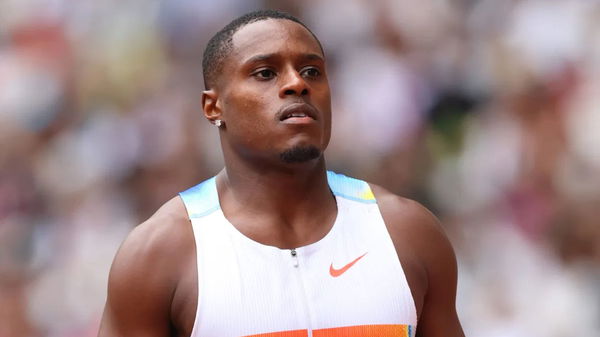
Christian Coleman, once regarded as one of the most explosive starters in world sprinting, now finds his place on Team USA’s relay squad under quiet but unmistakable scrutiny. The 2025 season, far from affirming his dominance, has instead raised questions, most pressingly: Can a man yet to break 10 seconds this year still be trusted to lead off a World Championship-caliber 4x100m team?


Coleman opened the year with promise, clocking 10.06 seconds at the Tom Jones Memorial in April. But the races that followed painted a more sobering picture. From Xiamen to Eugene, his Diamond League outings saw no improvement: 10.18, 10.13, 10.11, and then again 10.06 on July 5, where he placed seventh in a Prefontaine Classic field that hardly flinched. At the Grand Slam Meet in Philadelphia, he was fourth in the 100m and sixth in the 200m, outpaced by rising teenagers like 19-year-old Christian Miller and 18-year-old Maurice Gleaton Jr. For an athlete of Coleman’s caliber, the optics have not been kind.
Watch What’s Trending Now!
And yet, his place on the U.S. 4x100m relay remains, for now, secure. At least according to former Olympic champion Justin Gatlin, who offered an insider’s view of how such decisions are typically made. “That’s not how it works from the USA relay pool,” Gatlin said on the Ready Set Go podcast episode on June 21, 2025. “Usually, if you have secured your spot in the relay, the only way that’s going to unsecure your spot is if you show a bad performance in real time during the relay… if you’re just truly running backwards, like running really bad times or injured, then your spot is up for grabs.”
Gatlin, who has seen the relay team evolve through multiple Olympic cycles, noted that Coleman’s consistency as the first leg runner remains a key asset, even in a year of lackluster individual times. “Right now I think that he’s done an amazing job at being at first leg. It’s hard not to choose him, especially within this era as your number one guy to be your first leg pop off.” In other words, past reliability may still outweigh current performance, at least until someone proves irrefutably better in the role.
Imago
Image Credits: IMAGO
The upcoming USATF Outdoor National Championships, taking place July 31 through August 3 in Eugene, will likely serve as the final determinant. While the relay pool is typically set with the top six 100m finishers, selectors weigh factors like handoffs, chemistry, and veteran trust. For Coleman, the meet is not merely about time—it is about staying indispensable. In an Olympic cycle defined by new names and shifting allegiances, there are no guarantees.
Christian Coleman seeks harmony on and off the track with Sha’Carri Richardson
There are moments in an athlete’s career when the pursuit of medals shares ground with the pursuit of stability. For Christian Coleman, that balance extends well beyond the lane lines. As he steps onto the track at the Golden Grand Prix in Tokyo, his focus is not solely on a winning time, but on equilibrium, both within himself and alongside the person he shares his training life with, Sha’Carri Richardson.
“I feel as if like we just are both finding our way and finding our balance,” Coleman remarked on the eve of the race, reflecting on the dynamic between him and Richardson. Their relationship, nurtured within the same training group, operates without hierarchy or special treatment. “Everybody within our training group just kind of treats us as teammates and, you know, we just support each other, trying to feed off each other,” he explained. This mutual respect appears to have shaped a quiet partnership, grounded less in public declarations and more in shared rhythm, mental, physical, and spiritual.
That sense of internal alignment guides Coleman’s approach to competition as well. “We just work hard and, like I said, it’s trying to find our balance mentally and spiritually. From there, I think that everything will take care of itself as it was supposed to,” he said. He carries that mindset into Sunday’s race without demanding specific outcomes. What matters most, it seems, is that the work continues, on the track and within the spaces that no stopwatch can measure.
Written by

Edited by

Irfan Kabeer