
Imago
Credits: Instagram/@mizzoutfxc
Imago
Credits: Instagram/@mizzoutfxc
“No one becomes a track‑and‑field athlete for the money,” said Olympic champion Sydney McLaughlin-Levrone. Track athletes do not receive the same compensation as football players; they mostly rely on sponsorship programs and prize money. And recently, a young 20-year-old up-and-coming track and field athlete, Sterling Scott, cleverly and humorously shed some light on this truth.
Watch What’s Trending Now!
Scott shared a video on Instagram of an expensive car driving away, transitioning to him standing in front of a car open-mouthed, then freaking out, with the caption, “Track athletes watching football players leave practice in their $100,000 cars.” Simple but telling, he added, “chose the wrong sport,” jokingly made an allusion to the huge disparity in money.
In major professional leagues like the NFL, football stars sign massive contracts with guaranteed money. For example, Patrick Mahomes has deals worth hundreds of millions, with total earnings in 2025 $90M from salary and endorsements.
Meanwhile, track and field athletes, even at the professional level, mostly earn through prize money, sponsorship deals, and appearance fees, without guaranteed pay each season. But wait.. what about college athletes?
View this post on Instagram
At the college level, the gap remains massive. Since the NCAA changed rules around Name, Image, and Likeness (NIL), college athletes can earn money through endorsements, sponsorships, social media deals, and revenue sharing. But the scale depends heavily on the sport’s popularity and media exposure. College football is by far the most lucrative, with top stars like Arch Manning estimated to have NIL valuations of $5.3 million.
Sure, NIL deals can also be made with Track and field athletes; however, the amounts are often significantly lower. To illustrate this point, Sam Hurley, a high jumper at the University of Texas, was one of the highest-paid NIL track and field athletes last year. However, the valuation was only around $1 million, very little in comparison to the NIL deals in football.
Scott’s post showed this reality very clearly. However, with the encouraging words of track and field fans, the reality became a bit more comfortable to accept.
Track and field through the fans’ eyes
One fan wrote, “Nobody but your parents go to track meets, the whole town goes to football games it’s just where the money is.” Another added, “They NIL be 100k my shi be 25 dollars 😂😂”
The comments sound dismissive, but they reflect a reality that track and field has struggled with for decades.
The core of the disparity lies in visibility; while football commands a weekly broadcast slot that keeps fans engaged, track and field typically only captures the mainstream spotlight during the Olympics, making it difficult to build consistent storylines and fan followings.
Moreover, marketing matters too, which track and field is lacking. At last, money solidifies the divide. Sponsors and TV channels pursue assured proceeds. Football is a source of continuous revenue, and therefore it is constantly promoted. On the other side of that equation is track and field. There is little exposure, thus little investment, and even less.
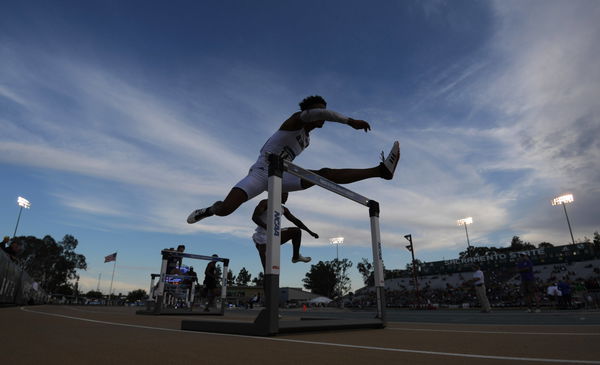
Track and Field: NCAA, College League, USA West Preliminary, May 24, 2019 Sacramento, CA, USA Silhouette of Anthony Easter of UC Davis in a 400m hurdles heat during the NCAA West Preliminary at Hornet Stadium. Mandatory Credit: Kirby Lee-USA TODAY Sports, 24.05.2019 19:14:21, 12780845, Hornet Stadium, UC Davis PUBLICATIONxINxGERxSUIxAUTxONLY Copyright: xKirbyxLeex 12780845
One more added, “Bros making more than the coaches 😂😂😂” and in the NFL, that is actually true. Example: Patrick Mahomes’ contract is worth around $450 million over 10 years, which comes to about $45 million per year. Meanwhile, the highest-paid head coach in 2025, Andy Reid, earns roughly $20 million annually. That is more than a $20 million gap.
One more fan added, “But there only players, whilst we’re true athletes.” Another added, “We need bread too 😢.”
Sterling Scott’s situation highlights the frustrating reality for many elite track athletes. At a young age, he has already become a Pan American U-20 champion in the triple jump, an All-American, a qualifier in NCAA Indoor and Outdoor Championships, and third in the SEC with a 16.14m leap. That is elite in the track and field.
And to most, it is not simply about recognition, but survival. Remember, U.S. 400m runner Jacory Patterson once worked overnight shifts loading trucks at UPS, then trained twice a day just to keep his Olympic dream alive. He eventually secured a Nike deal in 2025, but his story shows the reality that many track athletes live.
That is the real divide. Football turns talent into wealth. Track and field turns excellence into endurance.