
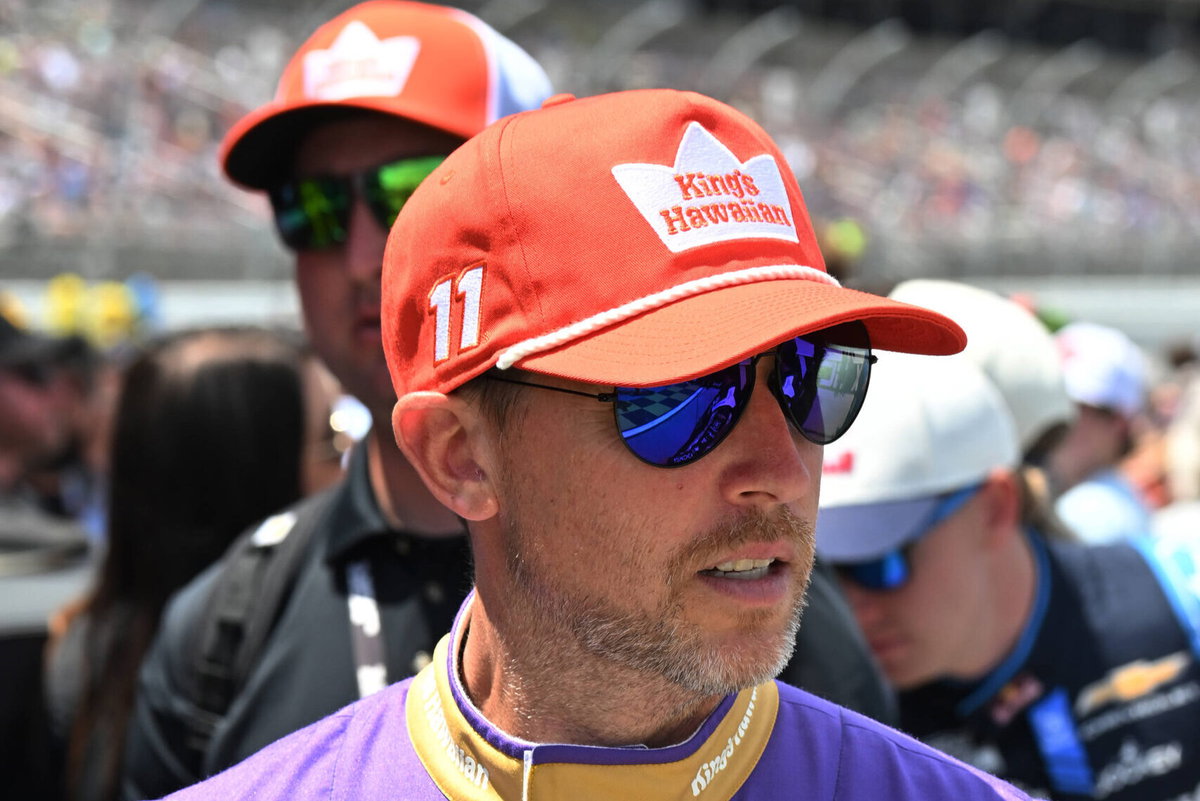
When Denny Hamlin looks at old NASCAR footage, it is not just the cars or the speed that stand out. It is the little protection drivers had while racing at nearly 200 mph. News of Fred Lorenzen’s posthumous CTE diagnosis has brought that reality back into focus, prompting a closer look at the dangers faced by earlier generations and how much the sport’s safety standards have changed.
Watch What’s Trending Now!
Hamlin reflected on the difference between the era Lorenzen raced in and the one he entered, pointing to the advances that helped make modern NASCAR safer.
“I was so blessed, and I think my lucky stars, every day when I came in the sport, it was after safer barriers, which is, you know, we’re not hitting concrete walls anymore; we’re hitting these, you know, styrofoam walls, and we got full-face helmets; we have HANS devices.”
“NASCAR’s got, you know, baseline testing they’re constantly keeping up with, you know, where we’re at neuro neurology-wise.” The No. 11 JGR driver told Daniel Roberts, according to the video uploaded on X.
Lorenzen, known as NASCAR’s “Golden Boy,” died in December 2024 at 89. He won 26 premier-series races, including the 1965 Daytona 500, and became one of the sport’s most celebrated drivers. But his legacy has now taken on another dimension.
His family recently announced that he had been diagnosed posthumously with Stage 3 chronic traumatic encephalopathy (CTE), a degenerative brain disease associated with repeated head impacts.
The diagnosis is believed to be the first publicly confirmed case of CTE in a NASCAR driver. Lorenzen had experienced dementia in his later years, and the finding has renewed questions about the long-term effects of the repeated impacts drivers sustained during an era when the risks were far less understood.
For drivers of Lorenzen’s generation, safety equipment was a world away from what competitors rely on today. Crash barriers, helmets, restraints, and cockpit design have evolved considerably, while greater attention is now paid to neurological health.
For Lorenzen’s family, the diagnosis also offered a possible explanation for the decline he experienced in his later years. The announcement has given fresh urgency to conversations about what former drivers may have endured long after their final race.
Unlike the visible damage left by a wrecked car, neurological injuries can remain difficult to identify for years. Lorenzen’s case has therefore become a reminder that the consequences of a racing career may extend well beyond the checkered flag.
Looking back at the cars and equipment used decades ago, Denny Hamlin was struck by just how exposed drivers once were.
“Some of those old guys, man they just did not I mean, I look, and they just got one little safety belt around it’s like I can’t believe they’re racing 200 miles an hour and in the cars that they were.”
The contrast is especially striking when viewed through the lens of CTE. Unlike an injury that becomes immediately apparent after a crash, the effects of repeated head impacts may take years to emerge.
That makes the experiences of retired drivers important to understanding the potential consequences of competing before modern safety systems and neurological monitoring became standard.
NASCAR has made major changes to reduce the risks of high-speed competition. Safer barriers help absorb energy during impacts, while full-face helmets and head-and-neck restraint systems offer protection that earlier drivers did not have.
Baseline testing and continued research have also given the sport more tools to assess brain health and understand the effects of repeated impacts.
Still, Lorenzen’s diagnosis is a reminder that improvements in crash protection do not erase the questions surrounding long-term brain injury. The announcement has also drawn attention to the families dealing with the consequences years after a driver has left the track.
For them, understanding what happened can be as important as recognizing how much the sport has changed.
Hamlin emphasized that safety work continues, with NASCAR looking for ways to better understand and reduce the forces drivers experience.
“The sport has evolved so much over the years and continues to do so, and we feel good about kind of where we’re at with the sport, but they’re. They’re just like football; they’re continuing to increase staff, increase different data points to figure out kind of how they can reduce the load of the hits of the head for the NASCAR drivers.”
Lorenzen’s diagnosis has brought a difficult chapter of NASCAR history into the present. His achievements remain a major part of the sport’s story, but the finding also highlights the risks that earlier generations faced without today’s equipment or understanding of brain trauma.
Denny Hamlin’s reaction captures both sides of that history: the distance NASCAR has traveled on safety and the work that remains to understand the lasting impact of racing at speed.