
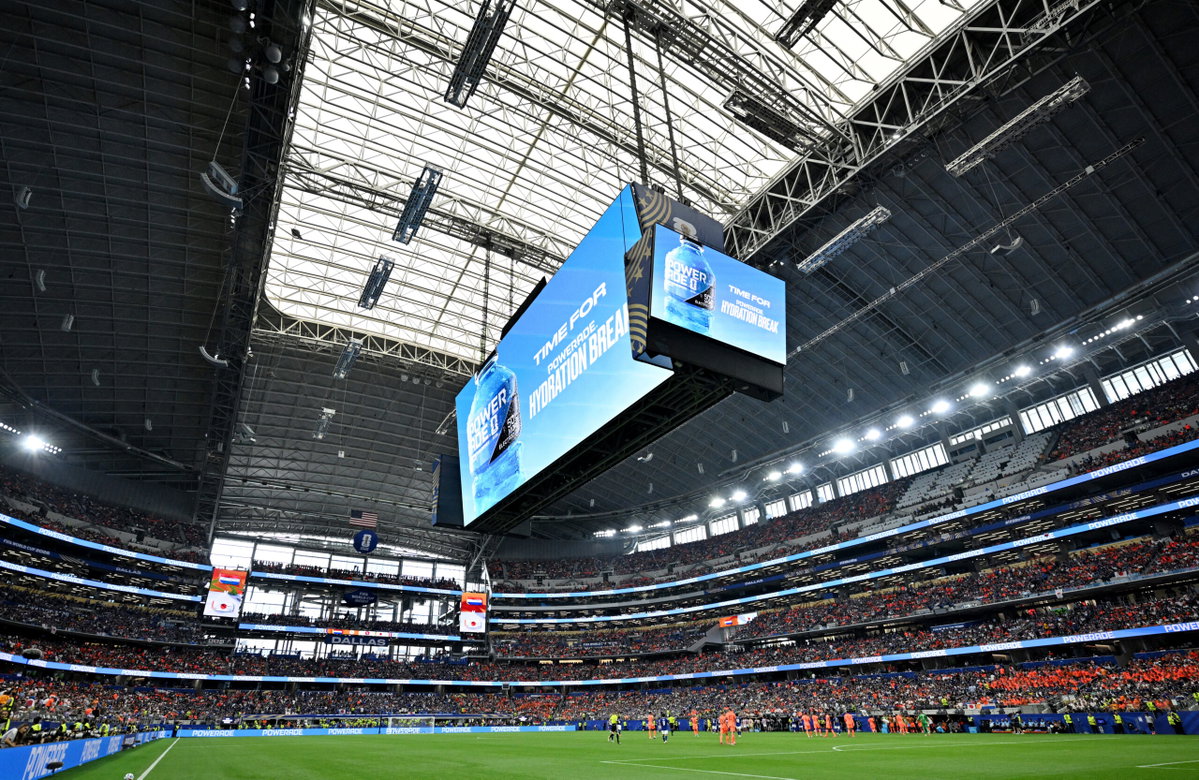
FIFA expected the hydration break to be a game-changer in soccer when it introduced it in 2025. But the reception of it at the 2026 FIFA World Cup made it an example for events around the world. Continuing their never-ending ideological war, UEFA made a move that directly rejected FIFA’s hydration-break proposal.
Watch What’s Trending Now!
UEFA confirmed that there will be no hydration breaks at Euro 2028 in a statement to The Telegraph. However, they were flexible enough to entertain the idea whenever there is a need, and not enforce it every game.
UEFA Euro 28 will be the 18th UEFA European Championship, and it will be co-hosted by England, Scotland, Wales and the Republic of Ireland, running from 9 June to 9 July 2028. The event coincides with the start of the British summer in June. While the days are extremely long, temperatures typically hover around 23-25°C (73-77°F).
In December 2025, Manolo Zubiria, the chief tournament officer of the World Cup, announced the introduction of the hydration breaks to protect players from the intense heat in North America during the tournament.
“For every game, no matter where the games are played, no matter if there’s a roof, or temperature-wise, there will be a three-minute hydration break,” he stated.
The hydration break allowed the broadcasters to cut away for commercial breaks, and it also acted as a roadblock in a usually non-stop 45-minute spell of action in each half. The decision to use hydration breaks even on cooler days (Norway-Iraq game at 23C) and even at air-conditioned stadiums (England-Croatia game at Dallas Stadium) only added fuel to the fire.
The hydration break was widely criticized by players, coaches, fans, and analysts, and UEFA took note of that.
The European body has been involved in a massive power struggle with FIFA. They are at odds with the world body regarding the expansion of the Club World Cup and the FIFA World Cup.
UEFA president Alexander Ceferin openly criticized the decision to expand the World Cup, stating that it creates too many “uninteresting matches.” Multiple non-European football federations and fans were outraged at those comments and rebuffed his statements. However, the recent stance on hydration breaks allowed UEFA to get the fans on their side once again.
Instead of enforcing a mandatory hydration break, UEFA reiterated their desire to use the existing parameters of Wet Bulb Globe Temperature (WBGT) to assess games on a case-by-case basis.
UEFA has a threshold of “32C WBGT/35C” (90F WBGT/95F) currently to enforce mandatory hydration breaks. Moreover, the breaks will be completely at the discretion of the referee, and there is no set time limit or a fixed time stamp on the break, as a spokesperson from UEFA confirmed with the Telegraph.
UEFA recently decided to decline issuing red cards for “mouth-covering” as they aim to maintain their own set of rules over the regions they govern, as it also becomes a show of strength against the global body.
UEFA’s latest decision is a true victory for fans
Just a week into the World Cup, the discussions around the hydration break began dominating the action on the pitch. Uruguay’s head coach Marcelo Bielsa was as blunt as he could be within the confines of media training.
“According to the general consensus, playing four periods instead of two alters the culturally constructed conception of how to interpret football. In my view, it adds nothing and takes away a lot,” he stated in a post-match press conference.
Bielsa’s comments echoed the sentiment every fan shared, as they believed the game was being split into four quarters, which breaks the very fabric of the game. The fans at the England-Croatia game made their feelings clear when they booed continuously during the hydration break.
The reception online was much more unfiltered. “It’s not a hydration break if you make us watch commercials. It’s a commercial break,” a fan bashed the entire notion of FIFA’s grand idea.
The breaks were also increasingly becoming momentum changers. Curacao were playing with a spring in their step when they made it 1-1 against Germany. But the break gave the Germans a chance to regroup, and they rallied on to win 7-1. The same pattern was seen multiple times so far in the tournament.
Fans were naturally worried about the commercial breaks becoming a new normal in football. “It won’t be long before it becomes just a natural advertisement break,” a fan coming out of the Dallas Stadium after the England-Croatia game told the BBC. “I hope it doesn’t become part and parcel of the English game because it will totally ruin it,” another added.
With negative fan sentiment everywhere, UEFA did the most sensible thing by doing away with the hydration breaks and assuring the fans that the game will stay the same.