
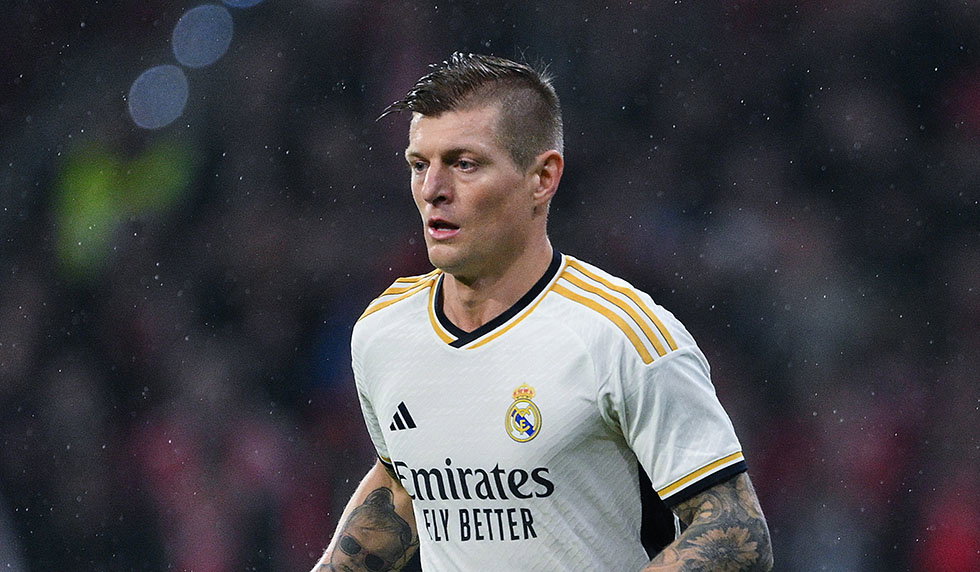
Toni Kroos, the name alone conjures images of perfectly weighted passes, a metronomic presence in midfield, and a trophy cabinet that would make any footballer envious. The man who pulled the strings for Real Madrid and Germany for over a decade has finally hung up his boots. His last professional match? A fitting farewell, a 2-0 victory for Germany against France, a reminder of the class that defined his career.
Watch What’s Trending Now!
But to truly understand the “German technology”, you have to look at the source code. It wasn’t forged in the academies of Bayern Munich or the Galactico pressure cooker of Madrid. It was built in a small town on the Baltic coast, by two people who knew a thing or two about athletic excellence. Let’s meet the architects of a legend, Roland Kroos and Birgit Kammer.
Who is Toni Kroos’ father, Roland Kroos?
Toni Kroos’ father is Roland Kroos. Born in Greifswald, Germany on November 18, 1959, Roland was a former footballer himself, playing for the local club Greifswalder SC. But his real impact started when he hung up his boots and picked up a clipboard.
He transitioned into coaching and became a professional youth coach in Germany. Roland coached Toni and his brother Felix at Greifswalder SC and later at Hansa Rostock. He was the one who laid the foundation for Toni’s career. Toni himself has spoken about their relationship, admitting, “I have a really good relationship with my dad, but what remained is that back then there were no other topics of conversation besides football.” That’s the kind of single-minded focus that builds world champions.
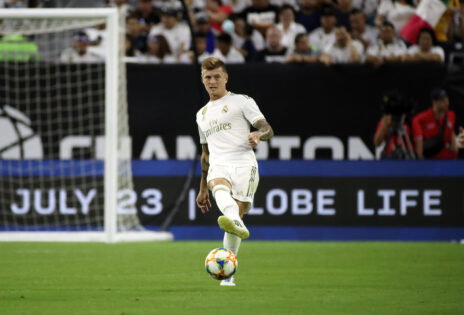
USA Today via Reuters
Jul 20, 2019; Houston, TX, USA; Real Madrid midfielder Toni Kroos (8) in action during the match against Bayern Munich in the International Champions Cup soccer series at NRG Stadium. Mandatory Credit: Kevin Jairaj-USA TODAY Sports
And Roland’s story doesn’t end there. His love for the game is so deep that, even in his late 60s, he stepped in as the Sporting Director for Greifswalder FC in 2025. The man simply can’t stay away from the pitch.
Who is Toni Kroos’ mother, Birgit Kämmer?
While Roland was teaching Toni how to pass, Birgit Kämmer was showing him what it meant to be a champion. Make no mistake, in the Kroos household, Birgit was the original sports star. She was a former professional badminton player, and not just any player, an East German national champion.
Kämmer, born on June 16, 1962, was a force on the badminton court. She won the East German championships multiple times, securing titles in both women’s doubles and singles. In fact, she was a ten-time East German champion in the sport. Imagine the athletic pedigree in that household, a father who played football and coached, and a mother who was a national champion in a completely different sport.
Today, she’s known as Birgit Kroos, and while she might not be on the cover of magazines, she’s a constant presence. She’s the one who famously commented on her son’s potential contract renewal, saying it would “make his coach, his teammates and I think Leon (his son) and many others happy too,” showing that even for a world-class player, mom’s opinion still matters.
What is Toni Kroos’ Parents’ Ethnicity And Nationality?
The Kroos family is as German as it gets. Both Roland and Birgit are German. Toni himself was born in Greifswald, which was then part of East Germany (the German Democratic Republic). Their ethnicity is German.
But their background is more than just a nationality; it’s a story of East German athletic rigor. Roland, a product of the DDR’s sports school system, often spoke about the virtues of the old system’s sports schools and how they benefited his sons. This wasn’t just a family that liked sports; it was a family that was a product of a system that bred athletic excellence from a young age.
How Did Toni Kroos’ Parents Influence His Football Career?
This is the heart of the story. The influence of Roland and Birgit on Toni’s career isn’t a supporting detail, it’s the whole plot. They created the perfect environment for a future superstar.
First, there was the technical foundation. Roland, as his youth coach, didn’t just teach Toni the game; he molded him. He introduced Toni to the game “at home and in youth settings.” Under his father’s watchful eye, Toni’s precocious talent was nurtured. At the age of six, he was already showing up to his local club, Greifswalder SC, “adept at handling a ball, despite being too young to write his name.” That’s not just natural talent; that’s a father who had a ball at his son’s feet before he could even hold a pencil.
Then, there was the competitive spirit. Growing up with a mother who was a national champion and a father who was a coach meant that football wasn’t just a hobby; it was a way of life. The house was filled with talk of tactics, training, and competition. They moved the family to Rostock to support the boys’ football prospects, showing a level of commitment that goes beyond casual support.
It wasn’t just about football, though. Birgit, a biology teacher, instilled the discipline and ambition needed to succeed. As one source notes, she “laid the foundation for her sons’ successful football careers early on.” They were a team. As Toni’s father once pointed out, the brothers “inherited their father’s talent and, thanks to the sporting facilities of East Germany, it was nurtured over the years.” The parents provided the raw materials, the environment, and the unwavering support.
So, while Toni Kroos has retired from the professional game, his story is far from over. He’s been linked with a potential return to Real Madrid in a sporting capacity, and he’s currently enjoying some well-deserved downtime. But his parents? They’re still at it. Roland is busy with his role at Greifswalder FC. The family that built a world champion isn’t slowing down. The Kroos name is synonymous with footballing excellence, and it all started in a small town in East Germany, with a coach and a badminton champion who raised a legend.