
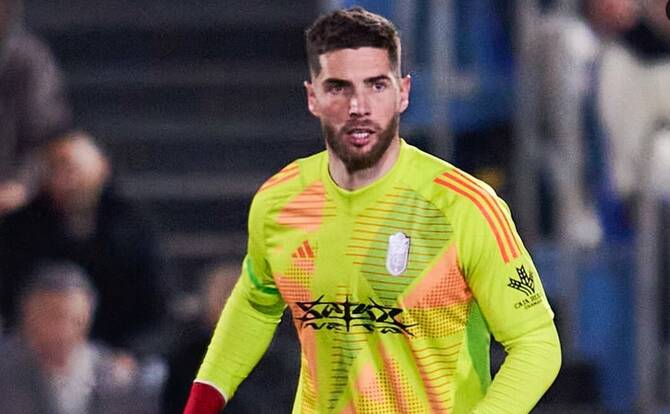
Recovering from a fractured jaw, fractured chin, and concussion just weeks before the World Cup is tough enough. For Luca Zidane, it also marks a major moment. He returns to international football after choosing Algeria over France despite being eligible for both. The son of World Cup winner Zinedine Zidane has long lived under the weight of one of football’s most iconic surnames, with expectations and comparisons following him at every step. Now, wearing a protective mask as he returns from injury, Luca’s journey is no longer just about recovery or legacy, but about identity, belonging, and the path he chose away from France to embrace his Algerian heritage on football’s biggest stage.
Watch What’s Trending Now!
Why does Luca Zidane play for Algeria and not France, and what is the heritage connection?
Luca Zidane’s decision to represent Algeria is rooted in family history rather than football alone. While the goalkeeper was born in France and played for French youth teams, he is eligible for Algeria through his paternal grandparents, Smaïl and Malika Zidane, who emigrated from the Kabylie region of northern Algeria to Paris in the 1950s.
The Zidane family never lost touch with its Algerian heritage. Luca grew up surrounded by Algerian culture and has spoken about the strong connection he feels to his family’s roots. That bond ultimately influenced his decision to switch international allegiance ahead of the 2026 FIFA World Cup cycle, as part of Algeria’s national team setup.
In an interview with The Athletic, he explained the emotional pull of that connection, saying, “We’ve lived in an Algerian culture since we were small. It’s an honor to play for Algeria. The final decision was mine, but I spoke with my family, my parents, my brothers, my grandfather. My father was happy, he knew it was something I wanted to do. To be able to play in a World Cup is a dream for any kid.”
Interestingly, Luca could have represented France, Algeria, or even Spain through his mother’s side. Instead, he chose Algeria, describing the opportunity as an honor. His father, Zinedine Zidane, supported the decision, making Luca’s journey a continuation of the family’s long-standing connection to its ancestral homeland.
How did FIFA rules make the Algeria switch possible, and why didn’t his French youth career block it?
Luca Zidane’s path to Algeria remained open despite his years in France’s youth setup because he was never tied to the senior national team. The goalkeeper represented France at multiple age-group levels, following a route that once seemed likely to lead to Les Bleus, but he never made a competitive senior appearance.
That distinction proved crucial. Under FIFA rules, youth internationals can switch allegiance if they qualify for another country and have not been capped at the senior level. Luca met those requirements through his Algerian heritage, with his paternal grandparents having emigrated from the Kabylie region of northern Algeria to France.
Once FIFA approved his change of association in 2025, he became eligible to represent Algeria internationally. The move allowed him to embrace a side of his family identity that had always been important to him. Rather than blocking his options, his French youth career became part of a journey that ultimately led him to wear Algeria’s colors on football’s biggest stage.
Was this a rejection of France, or was it about legacy and identity?
Luca Zidane’s decision to represent Algeria was not a rejection of France. Instead, it was a choice shaped by heritage, identity, and the desire to forge his own path. Born in France and developed through the country’s youth system, the goalkeeper could have continued pursuing a place with Les Bleus. However, his family’s Algerian roots remained a significant part of his upbringing.
The move also gave Luca an opportunity to step out of the shadow of his father, Zinedine Zidane. Had he chosen France, every performance would likely have been measured against one of the greatest players in the nation’s history. Living up to the legacy of a World Cup-winning icon would have meant constant comparisons and an almost impossible standard to match.
By choosing Algeria, Luca embraced his ancestral roots while creating an international career on his own terms. It was less about rejecting France and more about defining his own identity on football’s biggest stage.
Why is Luca Zidane wearing a mask at the 2026 World Cup?
Luca Zidane’s protective face mask is the result of a serious injury suffered just weeks before the 2026 World Cup. While playing for Spanish club Granada CF in April 2026 against Almería, Luca Zidane suffered a fractured jaw, fractured chin, and concussion following a heavy collision, as reported by Reuters.
The injury initially raised concerns that his season, and perhaps his World Cup dream, could be over. Fortunately, surgery and an intensive rehabilitation program allowed Luca to avoid a longer recovery timeline. After being cleared to return, he began wearing a custom protective mask designed to shield the healing area from further impact while competing at the highest level.
The mask has since become an unexpected talking point during Algeria’s World Cup campaign. Alongside discussions about his famous surname and decision to represent Algeria, it has added another layer to his story. Rather than keeping him out of the tournament, the injury has become a visible symbol of the determination that helped him reach football’s biggest stage.
Luca Zidane’s story is about far more than a famous surname. From overcoming a serious injury to embracing his family’s roots, he has shown a determination to build a legacy of his own. Whether his World Cup journey ends in glory or heartbreak, one thing is already clear: Luca is no longer just Zinedine Zidane’s son. He is writing his own chapter in the family’s football story, and fans will be watching closely to see what comes next.