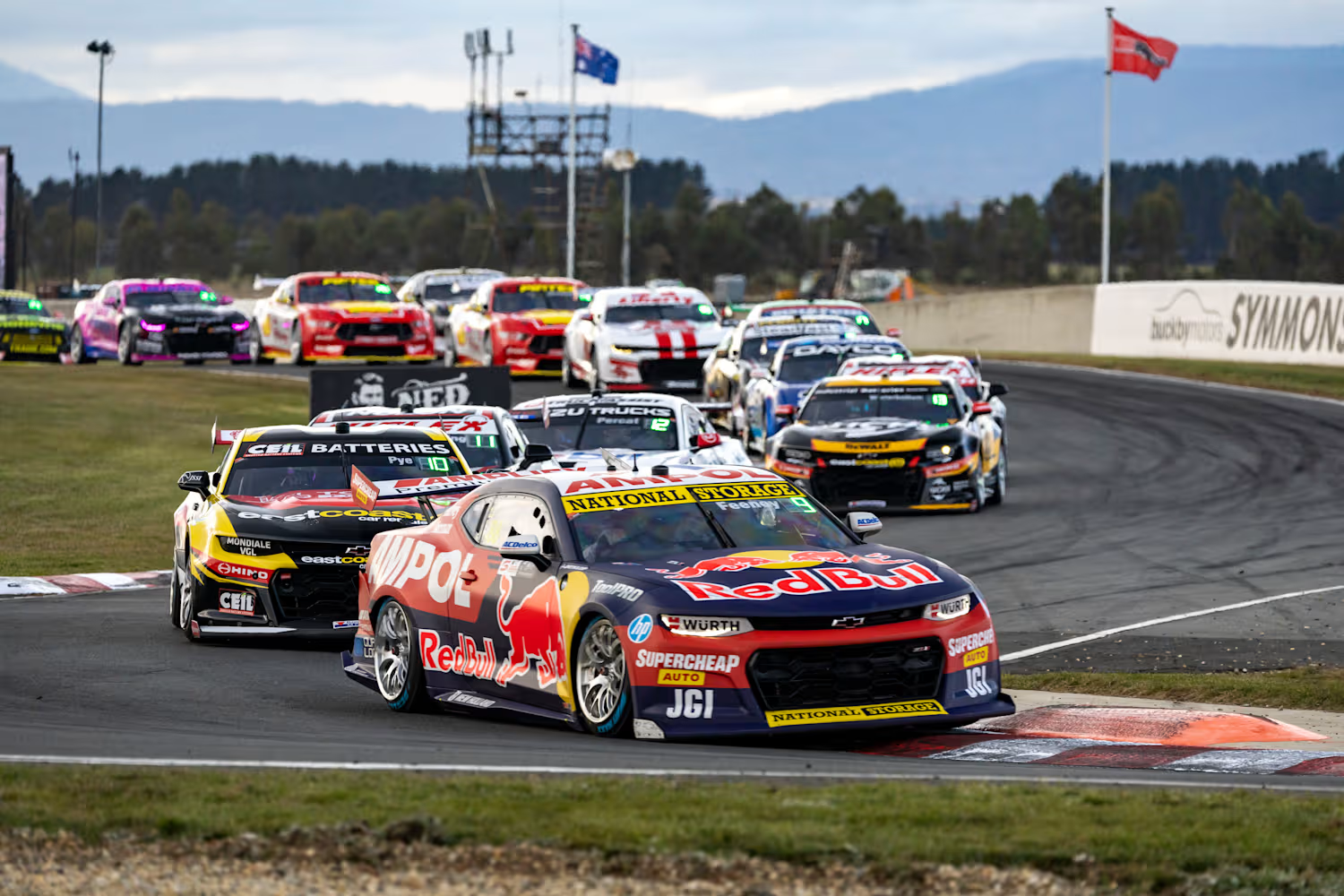
7 million USD! That’s what it cost Red Bull Racing as punishment for breaching the 2021 season’s $145 million Formula 1 budget cap. While the overspend was labeled “minor,” the fallout was anything but, bringing cost caps, loopholes, and competitive fairness into sharp focus across global motorsport. Fast forward to now, and a similar conversation is brewing in Australia.
Watch What’s Trending Now!
Supercars has stepped in with stricter performance rules for 2026, responding to growing concerns that teams were gaming the system to gain an edge. Different series, same problem: when money is capped, creativity finds cracks…and regulators are racing to seal them.
Supercars closes the gray areas
For years, the championship has limited how many “performance personnel” teams can bring to the track in the name of cost control. Engineers, mechanics, data analysts, tyre and electrical technicians, they all count. PR staff, drivers, merch sellers, catering crews? No problem. They’re outside the cap.
“At Supercars sole determination, each team will have one team owner and/or team principal and/or anyone fulfilling an equivalent role under a different title, who has the authority to influence the sporting and/or technical performance of the team and/or its car/s excluded as Performance Personnel.”
This single paragraph pretty much tells you everything you need to know about why Supercars felt the need to step in.


The issue came from the messy middle. Team principals and owners sat in a gray area, with Supercars deciding case by case whether they counted as performance staff. And naturally, some teams got creative. There were accusations of engineers being rebranded as “team principals” just to sneak extra brainpower trackside, all while staying technically within the rules.
Supercars has moved to alter its performance personnel rules for 2026 amid suggestions some teams were abusing the current cap.#RepcoSC https://t.co/Abu0wpwB5r
— Speedcafe.com (@speedcafe) December 24, 2025
In some cases, legitimate team principals couldn’t even attend authorized representative meetings because of how the classifications worked. Supercars initially floated the idea of simply classifying all team principals as performance personnel. But that still left room for loopholes, especially with owners wearing multiple hats. So instead, the series has gone nuclear on clarity.
At the start of each season, Supercars will publish a list of individuals excluded from the performance personnel count. That person can’t be swapped out if they miss an event, shutting down rotation tactics before they start. Numbers otherwise stay the same: two-car teams get 13 staff for Sprint Cup rounds, 15 for Enduros, and 14 for Finals. Single-car teams are capped at nine, 11, and 10, respectively.
On top of that, “work experience” personnel are now tightly restricted, and every performance staffer will wear a Supercars-issued armband identifying their role. The message from Supercars is clear: fewer loopholes, fewer games, and a much cleaner cost-cap battlefield in 2026.
GM insists the Camaro can still win in 2026
Losing Triple Eight was always going to sting. When Supercars’ most successful modern-era team defected to Ford, it immediately raised uncomfortable questions about General Motors’ future competitiveness. Triple Eight wasn’t just another entry. Rather, it was the benchmark. Its departure left a hole in GM’s lineup that can’t be patched overnight, and skepticism quickly followed about whether Chevrolet Camaros could realistically fight at the front again.
GM, however, isn’t backing down. Brand boss Jess Bala has been clear that the manufacturer still believes it can be a genuine Supercars winner in 2026. Speaking on the KTM Summer Grill, Bala struck a confident tone.
“Yeah absolutely,” he said when asked directly if GM can still win. “We know we have a lot of work to do… but we’re working towards the long game here. We consider it’s a marathon, not a sprint.”
Behind that confidence is a flurry of damage control and long-term planning. GM responded to Triple Eight’s exit by locking in key pieces of its technical foundation, including poaching respected engineer Jeromy Moore, retaining veteran Craig Lowndes, and securing engine supplier KRE. Those moves were about stability as much as speed, making sure the Camaro program didn’t unravel overnight.
Still, the reality is tougher. GM’s new homologation squad, Team 18, has just one race win in a decade as a standalone operation. That’s a far cry from the juggernaut Triple Eight was. Alongside Team 18, GM’s hopes rest with Erebus Motorsport, Matt Stone Racing, and PremiAir Racing, after Brad Jones Racing’s switch to Toyota further thinned the ranks.
To close the gap, GM plans to roll out a data-sharing alliance between its teams in 2026, pooling information to accelerate development. Whether every team opts in remains uncertain, but the intent is clear: collaboration over isolation.
There’s also the driver question. GM would love to land Bathurst winner Matt Payne for Team 18 in 2027, though contractual hurdles could delay that move. For now, its 2026 lineup leans heavily on experience from Anton De Pasquale, David Reynolds, and Jack Le Brocq, with the rest of the roster still early in their Supercars journeys.
GM knows the climb back won’t be easy. However, it’s betting patience, structure, and unity can eventually put the Camaro back in victory lane.