
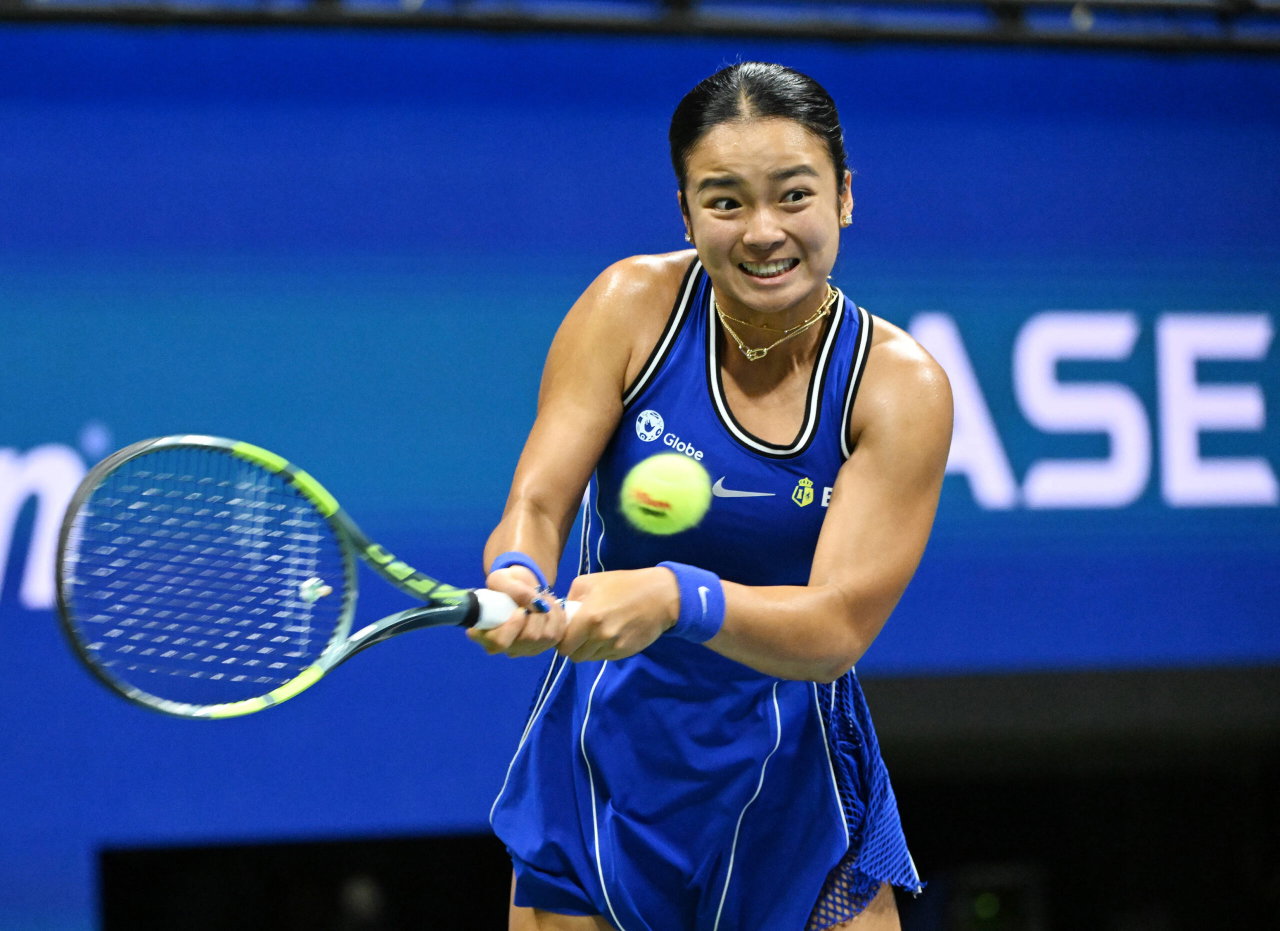
Alex Eala has now lost all three of her professional meetings with Iva Jovic, one of her closest friends on tour, and this one hurt the most. Eala still walked off Arthur Ashe Stadium smiling, but there was no hiding the disappointment. She was only a few games away from another massive US Open breakthrough before Jovic, of all people, slammed the door shut. And with that losing pattern continuing, Eala’s serve has once again raised an important question about what may be the biggest weakness in her game.
Watch What’s Trending Now!
Former Coco Gauff coach Brad Gilbert pointed directly at it during a recent appearance on The Big T podcast.
“So what you were seeing from Eala last night, it’d be impossible to get away with that on the men’s side. She’s throwing in 73 mph first serves. So that would be the first thing, from the coaching standpoint, that you’d really try to focus on. It’s like, okay, I understand throwing in, you know, I call it the three-quarter serve, but let’s go 103. Let’s go 105. I feel like she hits way too many serves where she just literally hits a fifth serve and gets the point started…”
But does he see the potential to get this serve to a much higher level? “That’s going to be… that would be a work in progress. That shot needs a lot of work… If she can improve her serve dramatically, I think her game will go up exponentially.”
Jovic defeated the Filipina 7-5, 3-6, 7-5 in a three-hour battle to reach the US Open fourth round. Eala had led 4-2 in the deciding set, only for the American teenager to fight her way back.
Eala hit three aces but also produced five double faults, while her first-serve percentage was only 53% in the opening set. Jovic sensed the opportunity early, breaking twice and forcing Eala to fight back from 4-1 down.
The Filipina clawed her way level at 4-4 before eventually taking the second set 6-3. But the decider became another test of whether she could protect her serve when the pressure was highest.
Eala broke first and moved ahead 2-0. Jovic responded, and the two traded breaks before reaching 4-4. After three consecutive holds, Jovic found one final opening in the 11th game, broke Eala, and then served out the match.
And this was not the first time Eala’s serve had been flagged as a weakness.
After her Wimbledon run ended with a three-set fourth-round loss to Jasmine Paolini, Greg Rusedski pointed directly at it, even noting the strapping on Eala’s serving elbow.
He felt she could generate more power by improving the throwing position, loosening the wrist and finding a better balance between when to attack the serve and when to take something off it. Rusedski stressed that Eala already had the returns, groundstrokes and competitive level, but said the serve still needed more reps, accuracy and pace before it could become a true first-strike weapon.
Despite Gilbert’s note on Eala’s serve, some other experts have a different opinion on this…
What does Andy Roddick think about Alex Eala’s serve?
Eala’s unusual serve may actually be one of her biggest weapons…
There is another side to the conversation, though. Eala’s slower serve isn’t automatically a weakness. In fact, she has used it cleverly enough to trouble some of the best players in the world.
Last month, Andy Roddick explained why simply copying Eala’s slower delivery wouldn’t work for everyone. The difference, he said, is what Eala does with the next ball. If a returner fails to make clean contact, Eala can immediately punish it with her exceptional ball striking and ability to find the corners.
Iga Swiatek discovered that herself at Wimbledon. After losing to Eala, the former world No. 1 admitted that returning the Filipina’s slower serve was surprisingly difficult.
“It was tougher mentally for me to accept these missed returns from the slow serves,” Swiatek said. “I’ve got to say it’s much tougher to return a serve like that than a normal serve.”
That is what makes Eala such an intriguing player. Her serve may lack the conventional pace of many top WTA players, but her ability to attack the next ball has helped turn that apparent weakness into something opponents have to think about.
Still, Gilbert believes there is room to take the shot to another level. He argued that Eala could retain the variation and disguise of her current serve while adding significantly more pace when required.
Tennis coach Rick Macci has also suggested that the problem could be deeper than simply adding miles per hour. He believes Eala’s serving motion could benefit from a biomechanical rebuild, particularly through better use of the legs and timing.
That could be an important project for her coaching team. Eala is already ranked No. 18 and has shown she can compete with elite opponents. Her first-serve percentage sits at 63.3% this season, with 61.8% of those first-serve points won.
The potential is obvious. The defeat to Jovic hurts, especially after Eala led 4-2 in the deciding set. But it also offers another lesson.
At 21, Eala is already knocking on the door of the sport’s biggest stages. If she can turn her serve from an occasional liability into a more reliable weapon, the next step may not be far away.