
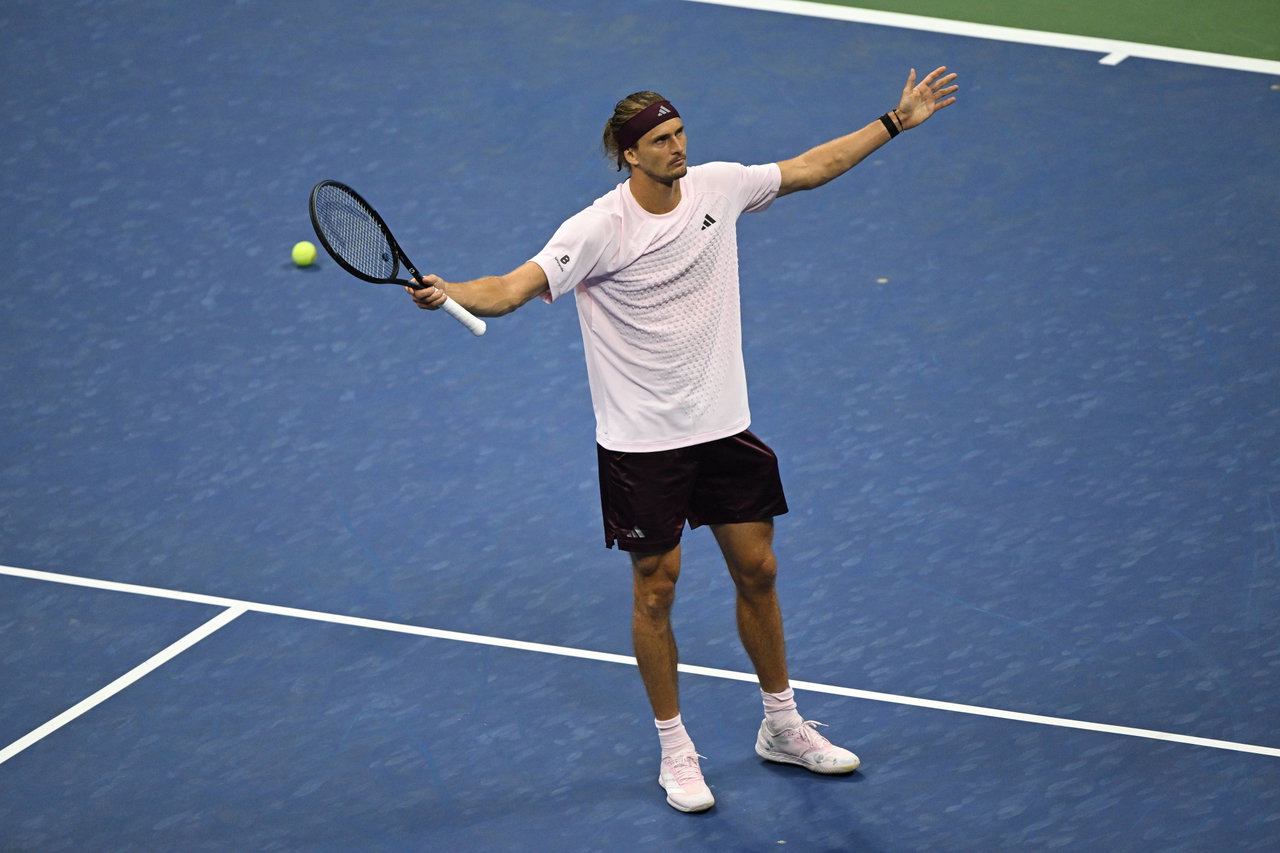
Time taken to serve and off-court breaks are often areas where tennis players push the boundaries in terms of the rules. While players try to gain as much of an advantage as possible, pushing the rules to the limit can also negatively impact the sport, as pointed out by French journalist Olivier Canton. The Frenchman was critical in his remarks regarding the on-court showmanship by the likes of Alexander Zverev and Iga Swiatek at the US Open.
“I blame Zverev for pushing it a little too far, and I blame Swiatek for having that attitude against Zheng,” said Canton in an interview on Eurosport. “At some point, you may be sabotaging your sport. Be careful what you are doing.”
Zverev’s ball-bouncing routine grabbed quite a bit of headlines during the two weeks at Flushing Meadows. The World No.2 developed the habit of bouncing the ball fifteen to twenty times before serving, sometimes even more during second-serve situations. While within the rules, the German’s tactics were viewed negatively because they disrupted the rhythm of the game and often made the audience restless.
On the other hand, Canton has referred to Swiatek’s off-court breaks during her match against Zheng Qinwen. Having lost the first set, the Pole took a bathroom break of five minutes. However, that was not all, as the former World No.1 took another medical timeout during the second set, with Zheng firmly dominating the scoreboard.
In both cases, Zverev and Swiatek were within the rules. There is a 25-second shot clock for first serves in tennis, and violating it results in a warning from the chair umpire. The second-serve situation is a bit more subjective, as it is within the umpire’s sole discretion to impose a time violation if a player is deemed to be delaying the action on the court. Zverev did get two time violations during his US Open run, one against Karen Khachanov in the semifinal and one against Ben Shelton in the final.
As for off-court breaks, players are allowed to take one bathroom break during a set change and are permitted one medical timeout of three minutes if the on-court physio deems it necessary after evaluation. So if one follows the rules to the letter, Swiatek was well within her rights to take the breaks against Zheng.
However, both Zverev’s and Swiatek’s tactics can be seen as gamesmanship, primarily aimed at disrupting opponents’ rhythm. While one bathroom break is allowed in the match, Swiatek has been criticized for taking them, especially after she has lost a set, where all the momentum is with her opponent. Former players like Coco Vandeweghe pointed out the Pole’s pattern as a commentator, criticizing the former World No. 1 for intentionally disrupting her opponent’s momentum.
“It’s been spoken about, Iga’s tactic of going to the bathroom, changing her kit, taking her time, always after losing a set,” said Vandeweghe on Tennis Channel back in 2024. “If I was still playing, I would definitely be very aware of it — she’s trying to disrupt my rhythm.”
As for Zverev, the World No.2 admitted that the ball-bouncing was not a deliberate action, but part of his natural routine. Even so, that did not mean that his opponents were getting frustrated, waiting for quite some time to receive serve. His semifinal opponent, Khachanov, was quite frustrated with the German’s tactics, stating that waiting so long for the serve affected his ability to assume the return position. Not to mention, making your opponent wait to return serve with a long serving routine during a high-stakes Grand Slam match has its psychological effects as well.
After losing the final, even Ben Shelton was not overly impressed with Zverev’s tactics. The American called out for a change in the existing rules, and he was not alone in doing so.
Current and Former Players Have Called for Rule Changes in Light of Alexander Zverev’s Ball Bouncing
While expressing his frustrations with Zverev’s serving routine, Ben Shelton also called for some tweaks to the existing rules. The American rule allowed players to use all 25 seconds before their first serve, but called for a shot clock before the second serve as well, establishing an objective time restriction rather than a subjective assessment by the umpires, which often allows some leeway to the player.
Shelton was not alone, as former player John Lloyd was also of the same opinion, pointing out Zverev’s tedious serving routine. Lloyd also suggested some changes regarding the ball toss. The ball toss is considered part of the service motion, and it is a loophole players often use to get additional time by aborting their serve motion during the toss and starting over. Lloyd was categorical that players would not catch the ball after the toss.
“You have to hit the serve and not catch it,” said Lloyd.
He was not the only former player to suggest changes; Martina Navratilova also proposed a rule to limit the number of ball bounces. However, given that he ended up with the title in New York, it is understandable that Zverev will not bother himself with criticisms of his serving routine.