
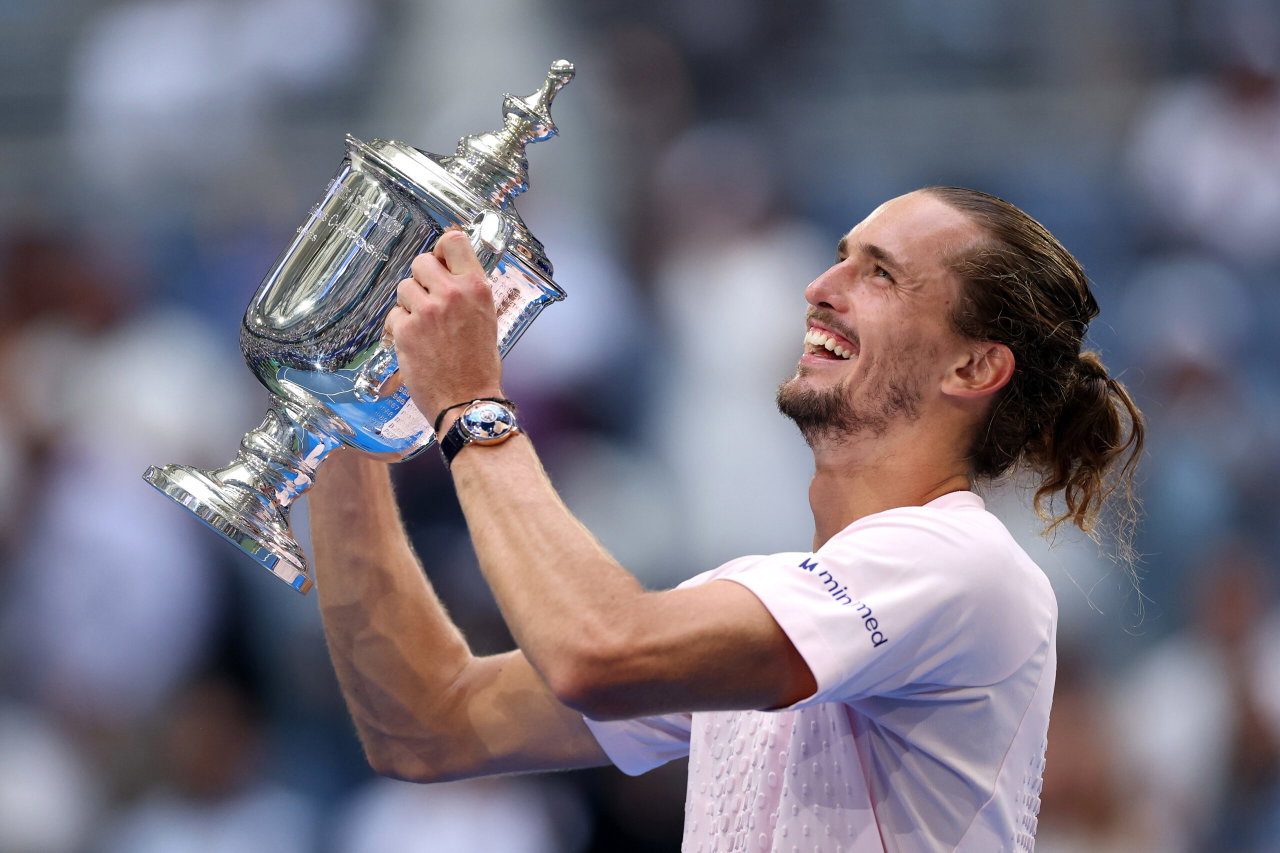
The man who won two Grand Slams in the same year walked onto Arthur Ashe Stadium with something Carlos Alcaraz never found: the blueprint to beat Ben Shelton. Zverev knew Shelton’s biggest weapon could become his biggest weakness if he stopped feeding him pace. So instead of trying to outmuscle the American, the German starved him of exactly what he wanted and spent most of the US Open final exposing the tactical mistake Alcaraz had already made.
Watch What’s Trending Now!
Shelton had arrived with plenty of confidence after beating Carlos Alcaraz in a five-set quarterfinal, but Zverev had beaten him in all five of their previous meetings. The pattern continued as Zverev won 6-3, 7-6, 5-7, 6-2 to claim his second Grand Slam title of 2026.
“Against Ben, you don’t need to be aggressive all the time,” said Zverev to ESPN post-match. “The more pace you play to his backhand the better he plays. I think that’s the mistake Carlos and maybe Frances [Tiafoe] made…”
And Zverev had already done his homework. After reaching the semifinals, the German revealed that he stayed up until 3:30 a.m. watching Shelton’s five-set battle with Alcaraz. “I watched Shelton-Alcaraz until 3:30 a.m. last night,” Zverev said. “I did not go to bed, I was up late, I was watching TV because I was sleeping in until 1 p.m. anyway.” By the time he faced Shelton himself, Zverev had already seen exactly how the American had hurt Alcaraz.
Alcaraz had tried to fight Shelton with aggression, frequently looking to take control with pace and match the American’s firepower. But Shelton was comfortable in that kind of exchange, using his massive serve, sharp returns and angled groundstrokes to keep Alcaraz under pressure. At one stage, the American won nine straight games and finished with 34 winners as Alcaraz lost control of the second and third sets. Zverev took the opposite route, refusing to turn the final into another power contest and instead forcing Shelton to manufacture far more of his own offense.
That approach made sense against Shelton because the American thrives when he can redirect pace rather than constantly create it himself. Zverev’s consistency from the baseline allowed him to keep the ball coming back without feeding Shelton the speed he could immediately turn into offense.
Shelton’s serve had already proved to be the weapon that could drag opponents into trouble. Alcaraz admitted as much after their quarterfinal, saying, “It’s an unknown if you are going to play the point or if he’s going to get a free point with the serve.” That uncertainty is exactly what makes Shelton so dangerous in pressure moments. Against a player who can steal points before a rally even begins, Zverev knew he could not afford to let the rest of Shelton’s game get comfortable too.
That was especially clear in the first two sets, when Zverev broke to open the match after Shelton double-faulted and didn’t face a break point until the third set. Shelton’s serve kept him in several games, but Zverev was rarely uncomfortable behind his own.
Shelton eventually found a way through in the third, breaking for the first time and taking the set 7-5. The 23-year-old opened the fourth set and went up 30-love, but then gave Zverev an opening with a double fault and two unforced errors.
Zverev took the break, added another at 5-2, and closed the match 6-2. It was a huge comeback for the same player who was denied his first major at this event six years ago by Dominic Thiem. This time, he left New York as champion. Shelton finished with 47 unforced errors compared with Zverev’s 35.
Alexander Zverev’s Second Grand Slam Title Still Comes With Questions
Zverev’s second Major title in a single season is a huge feat in isolation, but it becomes more so as a German doing so for the first time in nearly four decades, after Boris Becker in 1989.
Plus, this changes the conversation around his career, as he went 25-2 in Grand Slam matches in 2026, winning Roland-Garros and the US Open. His only losses came against Alcaraz in the Australian Open semifinals and Jannik Sinner in the Wimbledon final.
At the same time, the draw has already given people something to talk about. Zverev reached the finals in Paris and New York without facing a player seeded higher than No. 21. His semifinal opponents were No. 26 seed Jakub Mensik in Paris and unseeded Karen Khachanov in New York.
That doesn’t take away what he did, as Tennis is still about beating whoever is across the net, and Zverev did exactly that. But his next Grand Slam meetings with Alcaraz and Sinner will tell us even more about how much this version of Zverev has really changed.
For Shelton, meanwhile, the loss extends America’s men’s Grand Slam drought back to Andy Roddick’s 2003 US Open title. Still only 23, Shelton will move to No. 4 in the world after reaching the final, and even Zverev admitted that the American will eventually get his hands on a major trophy.