
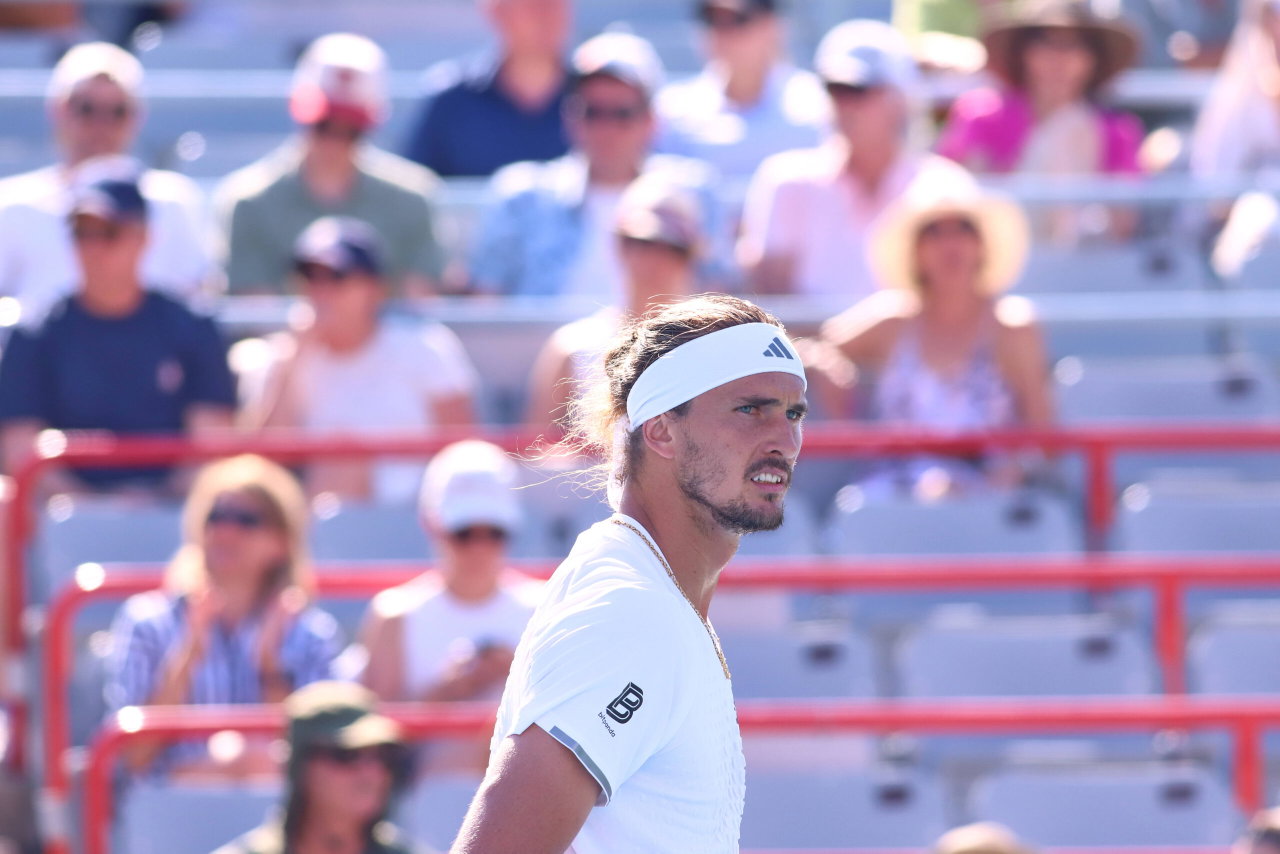
Having been suspended for eight weeks in 2022 during his angry outburst at the Mexican Open, Alexander Zverev is not new to meltdowns on courts. A similar outburst took place during his practice session with Learner Tien just days before the US Open main draw kicks off.
Watch What’s Trending Now!
In a clip that circulated on social media from the practice session, the World No.2 missed a simple forehand, and the ball crashed into the net. Displeased with the miscalculated shot, Zverev immediately threw his racket toward the wall.
A few gasps came from the crowd at his frustration during the practice session. It was hardly the preparation the top seed wanted while chasing another Grand Slam title this season.
But the reaction did not come out of nowhere for tennis fans. Turns out, this reaction is quite common for him during practice sessions as well.
During practice at the Australian Open earlier this year with Alex de Minaur, he missed a sliced backhand and hit the net. The German then threw his racket over the electronic boards in frustration. That incident came after he was knocked out of the United Cup against Hubert Hurkacz, where another racket met its end.
Practice sessions are usually done to help players settle into the atmosphere of the place better, which in turn helps them in their run at the tournament. Unfortunately, the frustration from those early weeks carried into Zverev’s Australian Open campaign.
He fought his way into the semifinals before Carlos Alcaraz ended his Melbourne dream. Their match lasted 5 hours and 27 minutes, becoming another painful setback. Zverev even served for victory, but Alcaraz found a way back. For the German, Melbourne became another reminder of how tough the competition is.
But this time, it feels different, despite the same racket-throwing tantrum. Zverev now enters this tournament with something he did not have back then: a Grand Slam title at Roland Garros. After losing three major finals, he now understands how to survive pressure.
So, the missed forehand against Tien may show shades of the past, but not how he might actually work during games. Alexander Zverev knows that preparation does not always look perfect.
Against Sonego, he will get another chance to turn frustration into something useful. The World No.2 has experienced Melbourne’s disappointment, but New York offers a different starting point.
What should Alexander Zverev do to emerge victorious at the US Open?
Frustrations aside, this might be the best chance that Alexander Zverev has had to win the US Open in a long time and get to the top of the ATP rankings. But it won’t be as easy as he thinks.
Jannik Sinner’s withdrawal has given Alexander Zverev the biggest chance of his season. The German now enters the US Open as the top seed, with a Grand Slam title and the world No. 1 race suddenly becoming far more reachable.
Sinner’s absence removes the player Zverev would have expected to face eventually in the run, but with Sinner out with a knee problem, it opens the door. But the opportunity comes with its own pressure because Zverev is only 630 points ahead of Carlos Alcaraz.
A deep run in New York could push him closer to Sinner, but an early exit could completely change the picture.
That is why this US Open could test more than Zverev’s tennis.
He has already shown this year at Roland Garros that he can survive the pressure of a Grand Slam, but New York could ask different questions. There may be nights when his first serve stops landing, an opponent extends the rallies, or a close set slips away after one loose game.
Alexander Zverev has experienced how a match can change in an instant at the US Open, especially after losing the 2020 final from two sets ahead. When those moments come, chasing points or forcing winners could make the situation worse. He will need to stay patient, trust his serve and baseline game, and focus on the next point rather than trying to go against the tide.
And that is where the opportunity becomes much bigger than simply benefiting from Sinner’s injury.
Zverev could face opponents who attack his weaknesses, force him into long matches, and test whether he can handle expectations as the top seed. The key will be how he responds when the match stops going his way. Grand Slam titles are often decided during those uncomfortable stretches. If he can manage those moments and carry the control he showed at Roland Garros into New York, a second major title might be closer than he thinks.
And if the results fall his way, Alexander Zverev could leave the US Open not only with another trophy, but much closer to the world No. 1 spot.