
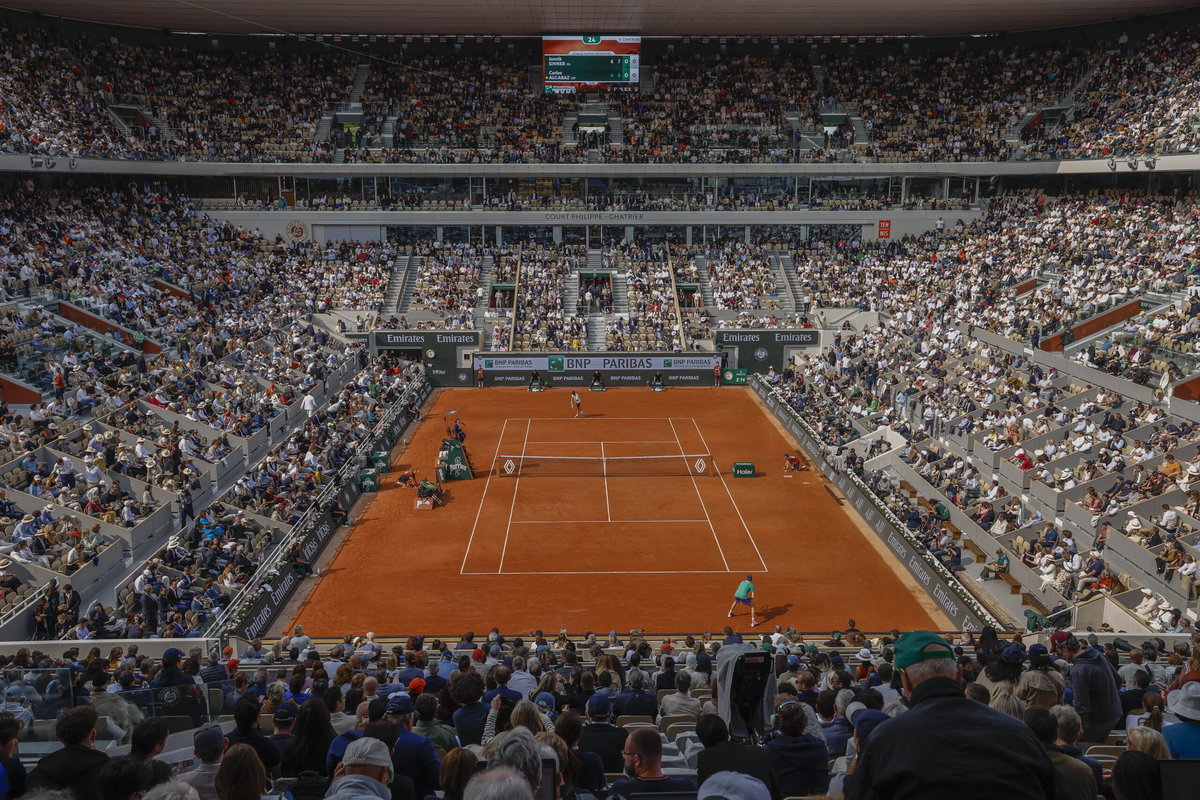
The turning point arrived in a flash for Casper Ruud. Deep in the second-set tiebreak, the Norwegian stood on the brink of leveling the match when a single call shifted everything. Instead of a set point, he faced a setback, one shaped by the French Open’s continued refusal to use electronic line calling or permit player reviews. As the moment unfolded and the replay told a different story, the incident quickly reignited a familiar debate, with Andy Roddick once again stepping forward as one of its most outspoken critics.
Watch What’s Trending Now!
“How don’t we have electric line calling, right? If they use electric line calling, which is more accurate than humans, it’s one set all,” the 2003 US Open champion noted on the ‘Served’ Podcast. “The only tournament in the world that doesn’t use electric line-calling is this one. Massive controversy, as it should be. They’ll both be asked about it.”
“I hate that they have to get asked about it because it takes away from the brilliance we saw during the thing. Let’s review the decisions made at Roland Garros…What are we doing? Like, why don’t we choose to get it right all the time? Every other tournament in the world can do it. I don’t understand”, he added. But what led to this?
With upsets reshaping the men’s draw at the 2026 French Open, the clash between Joao Fonseca and Casper Ruud carried added significance, offering both a rare path deep into a major. The match delivered on that promise. Fonseca edged the first set 7-5, and the intensity stayed high as the second set moved into a tiebreak.
Ruud led 8-7, putting him one point away from leveling the match. With Fonseca serving, the moment carried clear weight. The Brazilian produced a strong serve and looked to finish with one of his trademark forehands, but a sharp “Out” call cut the point short.
Ruud understandably got distracted by the call, hitting the ball into the net, but, as it turned out, the call came from the stands, not from the lines judge. With no ELC at Roland Garros, chair umpire Louise Engzell came down to adjudicate the call and declared the ball to be in, awarding the point to Fonseca. This proved to be huge as the Brazilian won the second set tiebreak and got a two-sets-to-love lead.
The bigger blow for the Norwegian came when he watched the broadcast replay, which confirmed the ball had landed out and handed the second set to the 13th seed. Ruud mounted a brief response by taking the third set, but after already enduring two five-set matches, sustaining that level proved too demanding. Fonseca seized on the dip in Ruud’s momentum, raised the intensity, and closed out the match in four sets, 7-5, 7-6 (8), 5-7, 6-2. Roddick later delivered a scathing assessment of the French Open over the incident.
This is not the first time Roddick has criticized the French Open for refusing to adopt electronic line calling. For instance, during the 2024 final between Carlos Alcaraz and Alexander Zverev, a similar disputed call handed Alcaraz a 3-1 lead in the fifth set instead of leveling it at 2-2, a swing that significantly altered the match’s complexion.
However, despite Roddick’s protests, it does not seem that the French Open is considering changing its stance on ELC anytime soon, as was evident from tournament director Amelie Mauresmo’s comments.
French Open director defends decision not to use ELC
Amelie Mauresmo, the French Open director, had a strong defense in case the ELC was not used at the French Open. She referred to the other clay-court events this year, which had disputed line calls despite having the technology. Mauresmo believed the ELC is not 100 percent foolproof and, as a result, the human eye was the more credible approach.
“What we observed at the clay-court tournaments leading up to Roland Garros is that the reliability of this system is not absolute,” said Mauresmo in her press conference. “As of today, the machine is not 100 percent reliable, so we continue to place our confidence in human officials.”
Mauresmo is not wrong to point out the ELC discrepancies at other clay-court events this year. At the Italian Open, the always calm Elena Rybakina lost her temper at the chair umpire when there was an ELC call against her in the match against Zheng Qinwen. During the match between Rafael Jodar and Luciano Darderi, smoke from nearby celebrations at a football stadium had rendered the camera system useless for a brief period, halting the play.
The issue with clay courts is the loose topsoil that keeps shifting. That is why, whether it be a computer tracking system or the human eye, it is difficult to achieve 100 percent accuracy in making line calls, as when the ball hits the surface, some of the soil shifts. That affects the human eye and the inbuilt error coefficient in the ELC.