
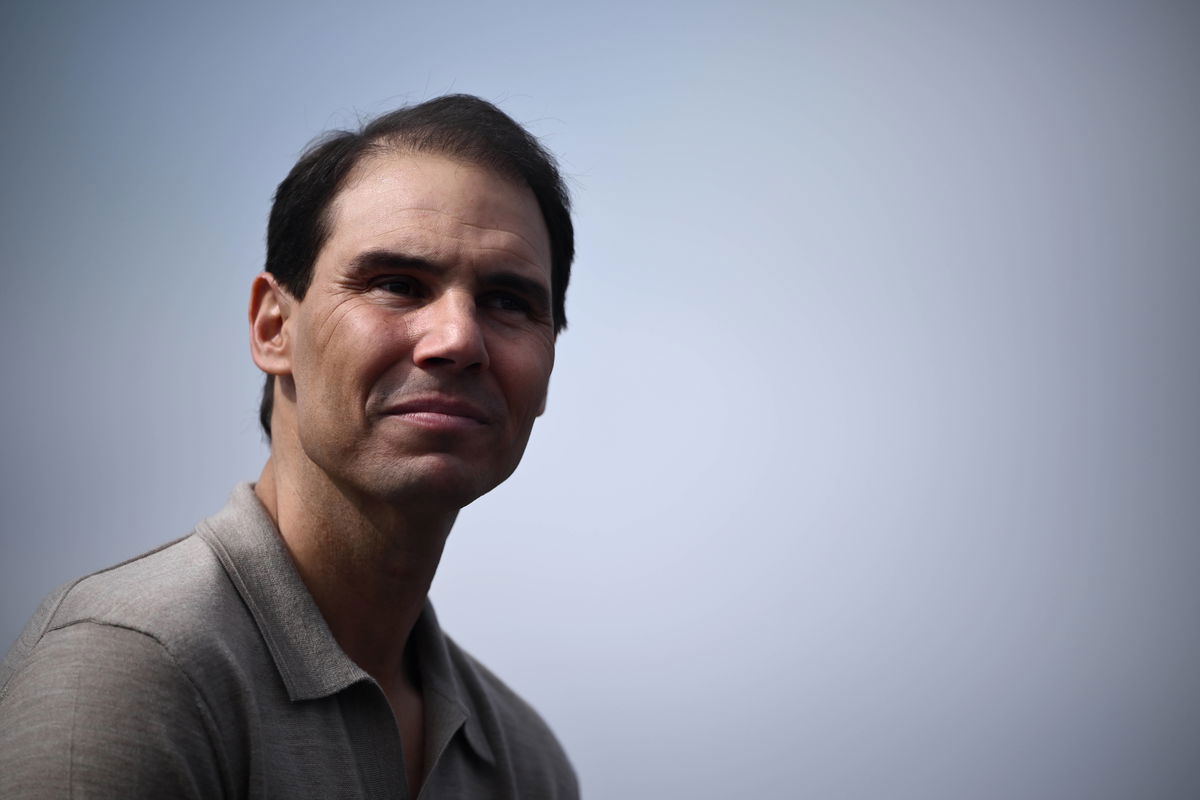
When Marc Maury declared at Rafael Nadal’s farewell that his “footprint will remain here forever,” tennis witnessed far more than a white marble plaque buried in Paris clay. It symbolized 22 Grand Slam titles, 14 Roland Garros crowns, and a warrior whose relentless fight turned the French Open into his kingdom. Yet behind that immortal legacy stood a painful truth, as the shocking image of Nadal’s foot later revealed the brutal physical cost carried by the ‘King of Clay.’
Watch What’s Trending Now!
In his upcoming Netflix documentary “Rafa” set to release on May 29, Rafael Nadal finally reveals the devastating condition of the left foot he spent years hiding from the public. For most of his career, Nadal avoided showing the damage caused by Müller-Weiss Syndrome, protecting the painful reality behind one of tennis’ greatest careers.
One emotional scene takes viewers back to the 2024 season, when Nadal removed his shoe so physiotherapist Rafael Maymò could massage his foot. Watching the moment unfold, former coach Carlos Moyá reacted in disbelief and asked, “Do you have an alien?”
Nadal then removes his sock, exposing a massive lump on the instep of his left foot. Maymó gently touches the swelling and quietly says, “It’s soft,” while the team awkwardly jokes about the shocking growth sitting on Nadal’s foot.

Durante años, Rafa Nadal no quiso enseñar nunca su pie para no mostrar las secuelas del Síndrome de Müller-Weiss. En su próximo documental de Netflix, se atreve a hacerlo. La imagen es impactante 😱 Tiene un bulto que sobresale. No sé ni cómo ha podido ganar 22 Grand Slams Show more

The documentary also revisits the autumn of 2005, when Nadal produced one of the most dramatic comebacks of his early career at the Madrid Masters. The Spaniard fought back from two sets down to defeat Ivan Ljubicic 3-6, 2-6, 6-3, 6-4, 7-6 in an unforgettable final.
Yet during that same match, Nadal first sensed that something inside his foot was terribly wrong. At the time, he brushed the pain aside, believing it was simply another temporary physical issue that would eventually disappear.
“I didn’t think much of it and thought maybe it would go away in a few days,” Nadal recalls in the documentary. “But we went to the hospital in Shanghai, they gave me an MRI, and they told me, ‘You have a broken scaphoid.’”
Nadal returned home from the Masters Cup unable to compete, though he still believed recovery would come quickly like it always had before. Instead, doctors soon realized the problem was far more serious and had likely existed quietly inside his foot for many years.
The crack discovered in Madrid was only the consequence of a much deeper condition. “We realized there was a chronic disease in the scaphoid. It’s an extremely rare disease. We gathered all the world’s literature on it, and across all case studies, there wasn’t a single case of an elite athlete,” explained his longtime doctor Ángel Ruiz-Cotorro in the series.
Eventually, the Nadal family contacted Dr. Ernesto Maceira, one of the leading experts on the condition known as Müller-Weiss Syndrome. After examining Nadal’s foot, the specialist warned that surgery might completely change the future of his career.
“Bones had to be cut, and the position of the foot shifted. The doctor told me, ‘You might never play professional tennis at a high level again,’” Nadal revealed while reflecting on the terrifying diagnosis.
Still, perhaps the most painful chapter came during Roland Garros 2022, when Nadal pushed his body beyond human limits once again. After barely surviving his opening-round match in Paris, the pain in his left foot became almost unbearable.
“I finish my first match and my father has to carry me on his shoulders to my room. I am in so much pain and I don’t sleep a single minute all night. Thinking, thinking, thinking. In the morning I called Cotorro (his doctor) and asked him, ‘Is there any way to numb the sensory nerve without affecting the motor nerve?’ He told me, ‘Yes, we can try.’”
Those words revealed the horrifying physical sacrifice behind Nadal’s greatness and showed that Müller-Weiss Syndrome carried consequences far deeper than most fans could ever imagine.
What exactly is Müller-Weiss syndrome, and how dangerous can it become?
In simple terms, ‘Müller-Weiss syndrome’ is an extremely rare foot condition involving a misshapen navicular bone inside the foot. Over time, that abnormal bone structure creates severe stress around nearby joints and slowly causes early degenerative arthritis.
The condition especially affects the talonavicular joint, which plays a major role in balance, movement, and weight distribution while walking or running. For professional athletes, especially tennis players, the disease becomes even more painful because every movement places enormous pressure on the foot.
Sliding on clay courts makes the situation even more brutal. The condition worsens most during weight-bearing movements, which means every sprint, stop, jump, or slide can create unbearable pain through the affected area.
Many tennis fans only became fully aware of the disease in 2022 when Rafael Nadal openly began discussing it during one of the most painful stretches of his career. Yet Nadal had quietly lived with the condition for far longer than most people realized.
The Spaniard was actually diagnosed with the syndrome at just 19 years old, only three years after beginning his professional career. At the time, few could have imagined that the teenager dealing with such a severe condition would later become one of the greatest players in tennis history.
From that moment onward, Nadal’s career became a constant battle between greatness and pain management. He understood early that the disease was degenerative, meaning it would only worsen as the years passed and his body absorbed more punishment.
“We have known for quite a few years that this is incurable, so anything that we tried would just be trying to lessen the pain, just enough for me to keep playing,” Nadal explained in 2022 while speaking honestly about the reality of his condition.
For many years, treatments, injections, and pain-management methods allowed him to continue competing at the highest level. But by the summer of 2021, even those methods stopped giving him relief.
The pain became so severe that Nadal was eventually forced to cut his season short while desperately searching for alternative treatments. The situation grew serious enough for him to withdraw from the US Open, a decision that revealed just how damaging the condition had become.
And the hardest reality surrounding Müller-Weiss syndrome is that there is still no cure. As Nadal himself admitted repeatedly, the disease only progresses with time.
Doctors can attempt treatments and medical interventions to reduce the pain, but none offer certainty or long-term guarantees. More importantly, those treatments are never truly designed to survive the brutal physical stress professional tennis places on the human body. Even in the Netflix documentary, Nadal’s words paint a horrifying picture of the damage his body absorbed throughout his legendary career.
The Spaniard worked closely with medical experts and sponsors to develop custom-made footwear and high-tech insoles to manage the chronic issues in his left foot. The goal was to redistribute pressure and compensate for the compromised structure caused by his condition.
Among the different treatments and solutions tested over the years, the orthopedic insole for his left foot proved to be the most effective. These insoles helped alter load distribution and improve stability on court. However, doctors had also warned that the body could begin compensating elsewhere, potentially putting extra strain on other joints.
And that is exactly what unfolded over time. As Nadal pushed through one of the most physically demanding careers in tennis history, he accumulated nearly 35 different injuries across his body.
“My knee was left shattered. The tendon had a hole in it. The fact that I played with an insole my entire career structurally disrupted my whole body.”
Yet despite all that suffering, Nadal continued winning Grand Slams, fighting through impossible pain barriers, and building one of the greatest legacies the game has ever witnessed.