
Imago
Silhouette of Andy Murray during practice Australian Open, Saturday Previews, Tennis, Melbourne Park, Melbourne, Australia – 11 Jan 2025 PUBLICATIONxINxGERxSUIxAUTxHUNxGRExMLTxCYPxROUxBULxUAExKSAxONLY Copyright: xEllaxLing/Shutterstockx 15095107l
Imago
Silhouette of Andy Murray during practice Australian Open, Saturday Previews, Tennis, Melbourne Park, Melbourne, Australia – 11 Jan 2025 PUBLICATIONxINxGERxSUIxAUTxHUNxGRExMLTxCYPxROUxBULxUAExKSAxONLY Copyright: xEllaxLing/Shutterstockx 15095107l
After serving a 10-month ban for exceeding IV limits with a 500ml vitamin and magnesium infusion, Australia’s Thomas Fancutt has returned to the tour. As he finally addressed the suspension, the comeback story took a darker turn, with the Aussie revealing chilling experiences of relentless threats and abuse driven by gambling losses.


Thomas Fancutt shared his experience in a conversation with The Good Human Factory.
Watch What’s Trending Now!
The Brisbane-based player revealed how common the messages have become. He said, “I probably get five messages after a match if I lost,” describing the routine harassment he deals with.
Some of the messages have been deeply disturbing. Fancutt said he has received threats like, “I’m going to come find you and k*ll you” and “I hope you get Covid and die” in broken English and Russian.
Imago
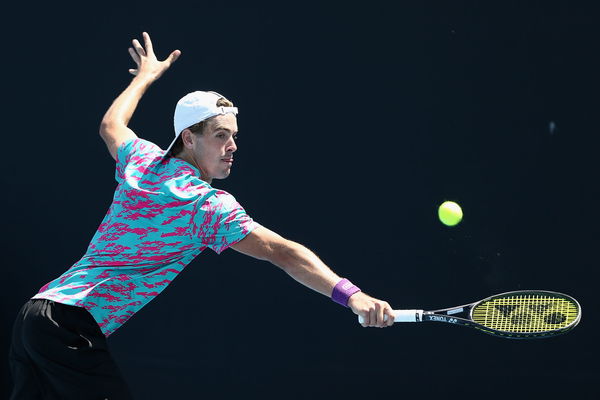
TENNIS AO PLAYOFF, Thomas Fancutt of Australia plays a backhand during his match against Luke Saville of Australia during the Australian Open 2020 Play-off at Melbourne Park in Melbourne, Monday, December 9, 2019. ACHTUNG: NUR REDAKTIONELLE NUTZUNG, KEINE ARCHIVIERUNG UND KEINE BUCHNUTZUNG MELBOURNE VIC AUSTRALIA PUBLICATIONxINxGERxSUIxAUTxONLY Copyright: xROBxPREZIOSOx 20191209001436973956
He explained how closely his matches are tied to betting activity. “Every match I played was bet on. One of my matches I played in China, you could see how much money was wagered on the match,” said Fancutt.
The scale of gambling shocked even him. He added, “I was playing a Challenger match, and there was just on this one app, there was $1.8 million of money totally bet on one match, and that’s one of like nine big betting apps.
“It’s almost like a rite of passage getting your first message that you suck. They make an account, and they write something to you, and then I’ll block and delete it. For 10 years, I’ve gotten them.”
Fancutt also recalled a frightening real-life encounter. It happened during one of his early trips on tour. The experience left him stunned.
He said, “I remember when I was 20, my first trip overseas to Europe, I lost the first round, and I walked in the door of the club, and this guy’s like, ‘Thomas Fancutt, how did you lose your match last week? I bet so much money on you to win. What are you doing?”
The situation felt unreal to him at the time. He added, “I’m looking at my mate like, ‘Is this happening right now?’ Straight to my face.”
His story highlights a growing problem in the sport. Abuse linked to gambling is becoming more common, especially at lower levels of professional tennis.
Tennis is now one of the most popular sports for in-play betting. Reports suggest that around 90% of bets are placed while matches are still ongoing.
The sport has also faced major betting scandals in the past. Cases like the illegal match-fixing network led by Grigor Sargsyan exposed how vulnerable lower-level players can be, showing the urgent need for stronger protection.
Burruchaga and Izquierdo receive death threats at the Rosario Challenger
Betting-related problems in tennis came into focus again recently. Two back-to-back incidents raised serious concerns about player safety and match integrity.
At the Rosario Challenger, finalist Roman Burruchaga reported receiving death threats before his semifinal. The threats targeted both him and his family ahead of his match against Taiwan’s Chun-Hsin Tseng.
Imago
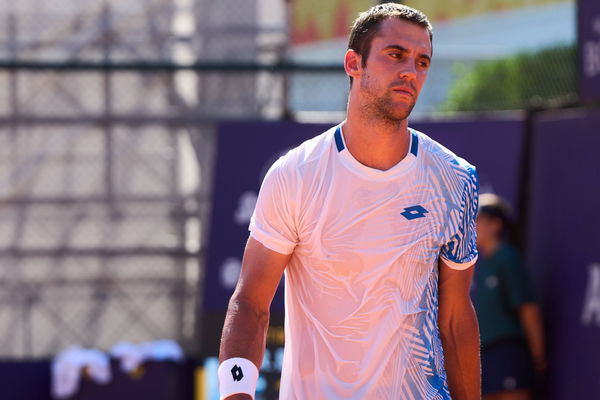
Laslo Djere of Serbia reacts to a missed point against Roman Andres Burruchaga of Argentina during the first round match of Argentina Open at Buenos Aires Lawn Tennis Club on February 10, 2026 in Buenos Aires, Argentina. Photo by Camilla Stolen, Imago Buenos Aires Buenos Aires Copyright: xCamillaxStolenx L1320842 4
According to journalist Sebastian Torok, the world No. 118 was contacted multiple times. The messages were linked to gamblers trying to influence the result of the match.
One message read, “You son of a b****, today you must lose against the Chinese player.” The situation quickly became more serious as the intimidation increased.
Another message warned, “We have enough guns to silence you and your family. Don’t get smart. Execute well, lose without winning a set, and everything will stop there. Otherwise, I promise you won’t leave Rosario.”
In the same tournament, another player faced a similar situation. Nikolás Sánchez Izquierdo also received threats from gamblers before his match against Argentina’s Valerio Aboian.
Security concerns became so serious that the match was delayed for nearly two hours. Officials later decided to play the contest behind closed doors to ensure safety.
Despite the tense situation, Aboian won the match 7-5, 6-4. However, the result was overshadowed by the alarming circumstances of the event. Messages of support soon arrived for Sánchez Izquierdo and his team.
With multiple betting-related threats now emerging, the issue has become deeply worrying. It highlights a growing problem that tennis authorities must address urgently.
Written by

Edited by

Deepali Verma