
Despite decades of calls for unity, professional tennis remains divided between the ATP and WTA, with both tours operating as separate businesses. The latest push toward closer collaboration has taken shape through Tennis Ventures, a proposed commercial vehicle that would bring together media rights, data and global sponsorship opportunities without merging the tours’ sporting operations.
However, combining their commercial interests raises difficult questions about how revenue would be divided, whose interests would take priority and whether both tours would benefit equally. With differences in financial strength, existing broadcast agreements and player priorities complicating negotiations, a deal that promises greater global reach could also deepen the divide it is meant to address.
The Financial Power and Organization Deadlock
The ATP Tour’s greater commercial earning power creates an immediate challenge for merger negotiations: how would the combined business be valued, and how would its revenue be divided? ATP chairman Andrea Gaudenzi has strongly advocated commercial consolidation, which could help the tours negotiate with major global media and entertainment companies as a unified business. However, combining their commercial operations is a different proposition from unifying the sport itself, making the financial terms a logical starting point for negotiations.
The men’s tour obviously produces far greater broadcast revenue and has a far greater volume of central sponsorship. Hence, in the past, negotiators have been suggesting a very lopsided split of around 70/30 in favor of the ATP. The men’s tour set a record $261m in player prize money in 2024, giving them enormous leverage at the table. The issue of agreeing to a lower percentage is that it would effectively be the ATP subsidizing women’s tennis. At the same time as reducing its own immediate distribution pool.
The WTA is in a very tricky position regarding operational stress and the commercial upside available. According to figures reported by The Telegraph’s Simon Briggs, the WTA was running a $23m operating loss and had around $15m in the bank. That level of pressure has led to cost-cutting on the WTA side and to the ATP cutting its doubles programming. WTA Ventures is the exception to that, with CVC Capital Partners taking a 20% stake in the business for $150m in 2023. It reported a 25% increase in revenue in its first full year of operation, with a target of tripling that revenue by 2029.
When Valerie Camillo came in as the new face of the WTA leadership in place of Steve Simon, she flat-out rejected the financial terms as being unacceptable and has effectively put the merger on hold for now. A combined entity worth something in the region of $3.84bn would be a very stable long-term proposition. But accepting a significantly larger revenue cut would be the route to take to solve the immediate cash-flow problem. It would see the WTA give up executive control of its most commercially successful asset.
Broadcasters and Private Investors Face Fragmented Media Rights
Consolidation across the global broadcast distribution arena is a bit of a mixed bag as the various media jurisdictions operate on completely different contractual timelines. In several key Western European markets and in North America, the tours have already been effectively consolidated under a single umbrella through existing agreements. Reports suggest that Sky Sports has a single five-year deal with both tours in the UK, Germany and Italy.
In the US, Tennis Channel has a multi-year deal with the ATP and has the WTA non-domestic rights through to 2032. Consolidating the rights packages in those markets which are aligned is relatively straightforward and will lead to immediate cost savings for the existing licensees.
The friction mounts dramatically in any territory where the rights are held by direct marketplace competitors or by free-to-air disruptors. In France, Eurosport has the ATP and beIN Sports has the WTA. In Spain, Movistar has the men’s rights and Tennis Channel has the women’s. In Brazil, the WTA has a deal with streaming service CazéTV from 2027 to 2030, which will be free to view on YouTube for millions of viewers in that country.
The risk of bundling those rights into a single global package and selling it to the highest bidder in the paywalled market is that you effectively price out free-to-air broadcasters and end up with no access in emerging markets. CVC Capital Partners will also have to be very careful in any commercial merger, as its $150 million stake in WTA Ventures is entirely dependent on the exact equity stake it is given in the merged entity.
Imago
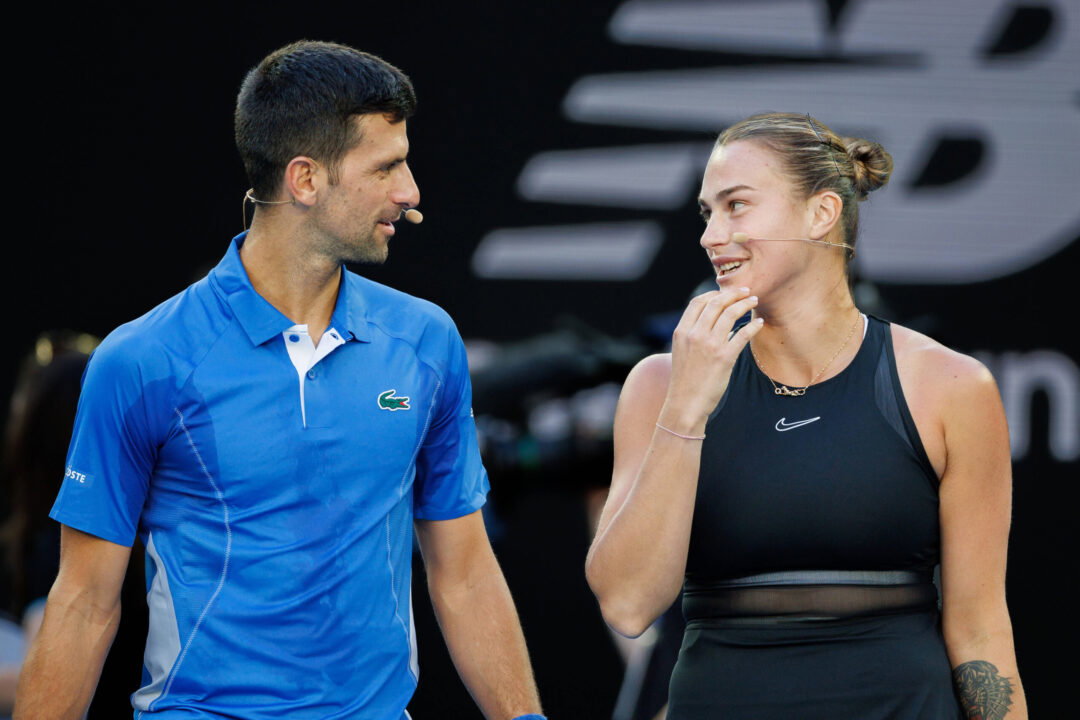
January 11, 2024: Novak Djokovic and Aryna Sabalenka team up for a doubles match on Rod Laver Arena in a charity event for the Australian Tennis Foundation ahead of the Australian Open which starts on 14 January. /Cal Media USA – ZUMAc04_ 20240111_faf_c04_025 Copyright: xSydneyxLowx
Players and Fans Navigate Unequal Sacrifices
Pro athletes have very different views on how commercial consolidation would affect their pay and prize-money parity. The WTA has committed to equal prize money at every combined WTA 1000 event by 2027. The women’s players want that commitment to be in writing as part of any commercial merger.
Gaudenzi points out that the merger itself wouldn’t change the prize money model or the relationship between the tournaments in any way. The standalone events would be subject to their own economic realities. The top players at the combined Tier 1 events will benefit from the joint marketing of the merged entity.
However, the players at the lower end of the scale on the standalone tours are concerned. They believe that the merger’s commercial revenues will remain concentrated in top-tier events. The smaller 250s will be left with no commercial viability.
Tennis fans get both real consumer benefits and the danger of ever-rising subscription costs. The prospect of a single commercial model is to eliminate the ongoing headache of paying for separate digital platforms just to follow both events. However, a single-broadcast monopoly in that situation would be able to easily charge a higher price for the bundle, with no market competition to keep prices down.
There’s also the risk of fans losing access to their free domestic digital feeds in emerging markets. The centralized rights packages could all be geared towards the paywalled platforms rather than open broadcast. The four Grand Slams are still effectively excluded from any such joint commercial, as each negotiates its own broadcast and sponsorship deals. The only way that can change is if the administrators get the Grand Slams and the ITF to the table. Until that happens, fans will continue to be left with a very fragmented viewing experience even if a commercial agreement is reached between the ATP and WTA.
A commercial union between the ATP and WTA would be a massive boost to global market leverage. A far simpler structure for broadcast rights and a huge step towards long-term financial stability. The flip side of an unequal revenue split is that the WTA becomes a junior partner. Besides, there’s a real risk of effectively depriving the international fan base of access to the sport at the grassroots level. The window of opportunity for a genuinely balanced deal is 2027, and both tours have a real chance of getting a deal done then. If the leaders don’t go to the lengths to protect equal governance and tournament pay, then the sport will be sacrificed to corporate convenience.