
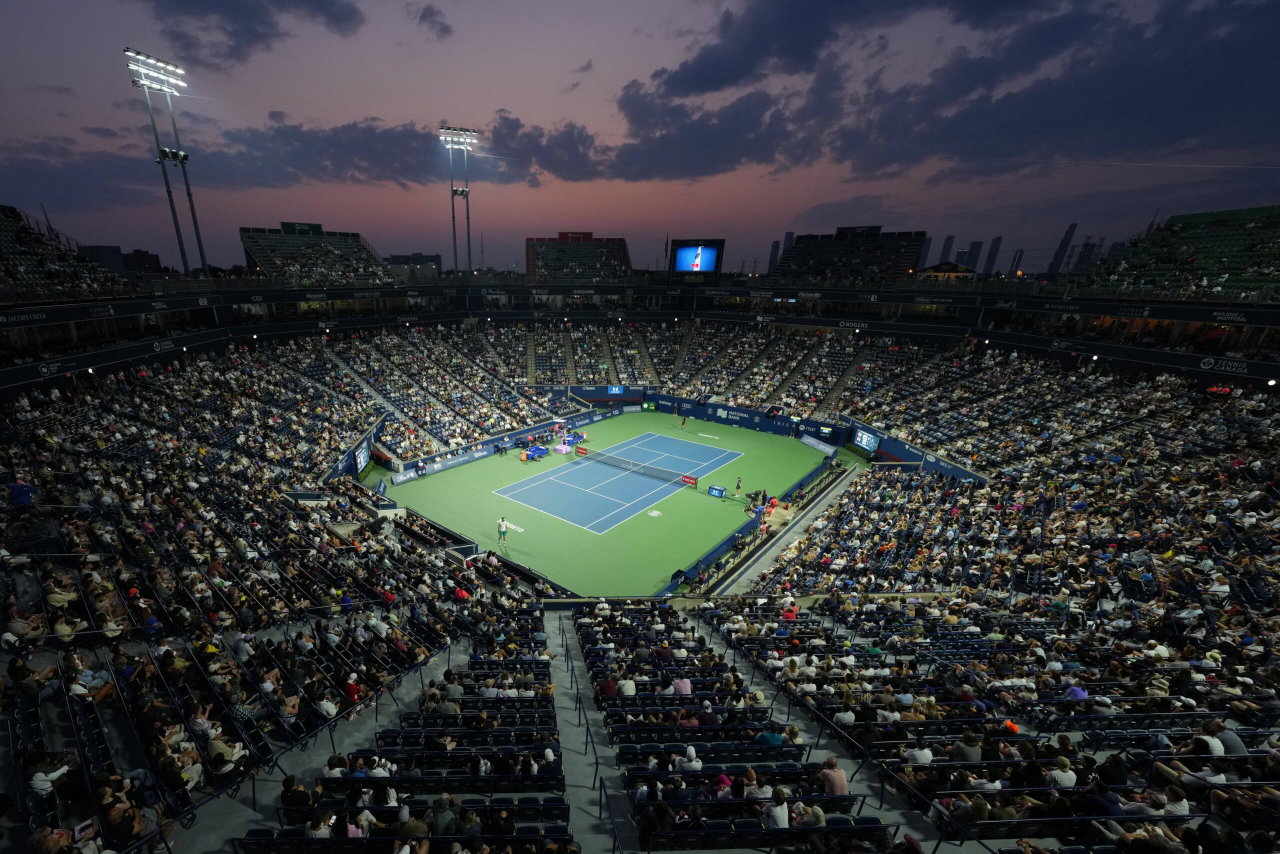
If last year’s numbers are anything to go by, the National Bank Open has clearly caught Canada’s attention. The tournament shattered attendance records after introducing its new 12-day, 96-player main draw format, underlining the country’s growing appetite for tennis. This year, the fans seem just as eager to turn up in record numbers. But there’s a catch: the venue’s limited capacity. Tennis Canada is now looking to expand the stadium in Montreal, though the locals aren’t exactly cheering from the stands, making their opposition to the plan quite clear.
Watch What’s Trending Now!
On Sunday, August 9, over a thousand people came out at Jarry Park in Montreal to voice their concerns about Tennis Canada’s proposed expansion within the public park, bringing a new chapter to a long-standing conflict that began in June. The demonstration took place while the men’s National Bank Open, organized by Tennis Canada, is running at the park’s IGA Stadium from August 1-13.
Protesters arrived with posters that carried messages like “Not another inch: no expansion” and “Everyone deserves a garden”, with pink chalk writing near the stadium claiming Tennis Canada had stolen it. Organized by the Front commun pour la protection du parc Jarry, a coalition of about 20 groups, the event was a mix of music and food, a formal demonstration, and a song composed by protesters asking “Whose park is it?” and shouted back by the audience: “The park is ours.”
The controversy erupted after Tennis Canada’s June 23 announcement of plans to construct a brand-new stadium featuring a retractable roof and expanded seating capacity, as part of a larger overhaul of its facilities in the 360,000-square-metre park. The plan would expand the capacity of the venue from 11,991 to about 15,000 seats, with the introduction of up to four practice courts and a match court. The size of Tennis Canada’s presence in the park would expand from about a fifth to a quarter, organizers said.
The opposition has been building for a while since the plan was first announced, said Michel Lafleur, president of the Coalition des amis du parc Jarry, who added that a public meeting on July 13 attracted over 160 people, four times the number organizers had anticipated.
Protester Matias Vazquez-Levi asked why the expansion had to take place within a public park in the first place. “Why does the stadium have to be in a public park? Why not go elsewhere? A park is a green space, a place people come to have barbecues, not play competitive sports,” he said, capturing the sentiment behind the title chant that “the park belongs to the people.”
Others at the protest, such as residents Louise Trepanier and Guy Latreille, cited concerns over noise from other events that are planned to take place at the courts besides tennis. Additionally, to show solidarity with those living in the adjoining neighborhood of Parc-Extension, a highly populated area where Lafleur noted that about 80 percent of residents have no private yard or balcony.
“The park is their garden, a place where they can be close to nature, so making access to the park more difficult goes against good sense,” Lafleur said, framing the issue partly around public health given the neighborhood’s existing exposure to urban heat.
Local political leaders have also weighed in. Villeray-Saint-Michel-Parc-Extension borough mayor Jean-Francois Lalonde posted on social media that any expansion of the current Tennis Canada footprint was “out of the question,” but he still intended to modernize the existing facilities while respecting the park and the surrounding community.
In a recent interview, Montreal Mayor Soraya Martinez Ferrada expressed a similar sentiment, stating her desire to keep major events like the National Bank Open in the city, but “not at all costs.”
Tennis Canada says the expansion is necessary
Tennis Canada has said the proposal is critical to the long-term future of the tournament, and cited a year-long feasibility study that looked at three potential alternatives: renovating the IGA Stadium, constructing a new stadium at Jarry Park, or moving the tournament entirely to another location in the city.
According to the tournament director, Valerie Tetreault, relocation was not an option as it proved to be too expensive. While the difference between renovating and rebuilding was found to be minimal. “We’re feeling like we’re really falling behind, and that’s what we’re also told by both the ATP and the WTA,” Tetreault said, describing the modernization as necessary to keep pace with facility standards expected at top-tier events on both tours.
Tennis Canada has offered to fund the construction of the facility on its own and has begun discussions with all three governments for possible funding support. The organization also says it is working with the City of Montreal to move a baseball field now located on site and that eventually removing the existing stadium will free up space and enhance park views.
“This modernization project presents a unique opportunity to work closely with all our partners to design facilities that address not only Tennis Canada’s needs but also the needs of as many stakeholders as possible,” Tetreault said.
The uncertainty over funding, costs and construction timelines, along with the ongoing opposition from locals, puts the future of Jarry Park in flux for the foreseeable future.