
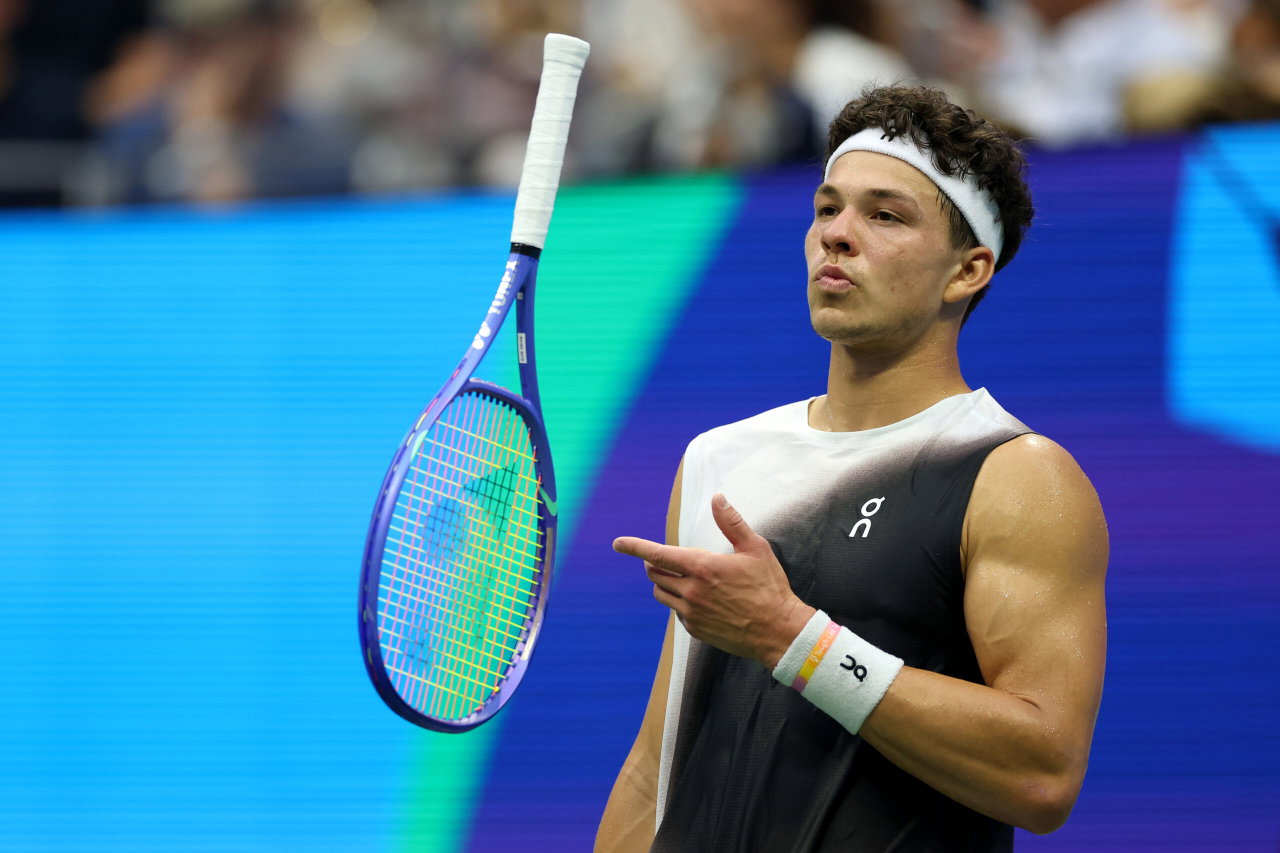
Alexander Zverev’s never-ending service routine became one of the US Open’s biggest irritations, and Ben Shelton finally decided he was not going to play along. Instead of wasting energy crouched in return position while the German bounced the ball over and over again, Shelton simply waited until Zverev was actually ready to serve. The move did not sit well with the chair umpire, sparking a disagreement that exposed the bigger problem: why should the returner be punished for refusing to stand frozen while the server drags out his routine?
Watch What’s Trending Now!
“No, she was telling me I need to get to the line earlier. And I was like, he can start his routine whenever he wants. I promise you, there will never be a time where he serves and I’m not ready. But I shouldn’t have to sit at the line, you know,” said Shelton in his press conference.
“If he’s bouncing the ball 20 to 25 times, I shouldn’t have to just sit there for that. I’m always going to be ready when he’s ready to serve. I think that’s a stupid rule, that you’ve got to be sitting there if it’s a guy who has his routine. As long as you’re ready when he puts his hands together and starts bouncing the ball, that’s what should matter.”
The rules are clear: the server controls the pace of play, and the returner is expected to be ready once the server is prepared to serve. But Zverev’s routine stretched that principle to its limit at the US Open. With the German bouncing the ball 20 to 25 times before serving, the returner was effectively being asked to stay locked in position for several extra seconds, wasting energy in already hot and humid conditions.
Shelton’s approach made sense. Rather than waste energy standing in a return position while Zverev went through his extended routine, the American chose to stay loose and get set only when the serve was actually coming, something he openly defended in his press conference.
“Yeah, I mean, I think there’s not an athlete in the world that you’re going to go look and watch them do their thing, and they’re going to sit in a ready position for 30 seconds, uh, before, you know, the play starts. So, for me, it’s the same. I’m not going to sit there in a ready position with my knees bent, tension in my body, for 30 seconds while I’m waiting,” said Shelton in his press conference.
“Um, I’m going to try to stay loose and, you know, I’ll let him do his thing when he’s up there, but I’m not going to, uh, sit there, be locked in, focused, like I said, in ready position for that long.”
Shelton is not the first opponent to have expressed frustration with Zverev’s drawn-out ball-bouncing routine. In big Grand Slam matches, those extra seconds can disrupt a returner’s rhythm, force them to repeatedly reset their stance, and potentially create a psychological edge. Zverev’s semifinal opponent, Karen Khachanov, also expressed his opinion on the matter, explaining that he would get into position only for Zverev to bounce the ball “another 12 times,” forcing him to prepare and split-step all over again.
The issue even resulted in a time violation during their semifinal. While serving at set point in the second-set tiebreak, Zverev took too long before his second serve and was penalized, although he still went on to win the tiebreak. Under the rules, players have 25 seconds before a first serve, while delays between first and second serves are largely left to the chair umpire’s discretion.
Shelton, however, has called out the existing regulations and asked for changes to avoid such delays in high-stakes matches at Majors.
Ben Shelton Calls for Rule Changes to Avoid Delays in the Matches
Existing rules allot twenty-five seconds to players for first serves, but have no specific time limit for the second serves. That is under the umpire’s discretion, who imposes time violations if a player takes too much time between first and second serves. While discussing it, Shelton agreed with the leeway given for the first serve but emphasized the need to speed up second-serve situations.
“Yeah, I definitely think for the first serve, you should be able to do whatever you want. You can use the full 25 seconds every time. I think there should be some sort of rule,” said Shelton in the press conference.
“I’m not sure exactly how you would do it, but there should be a limit on the time for a second serve. You shouldn’t have unlimited time. I think it would be better for our sport and for the fans.”
Shelton is not wrong about the fans who were not happy with Zverev’s lengthy serving routines. When the top seed received a time violation late in the final, the whole crowd cheered, a scene similar to Zverev’s match against Karen Khachanov in the semifinals.
Moreover, Shelton is not the only one to call for changes to the rules, as former World No. 1 Martina Navratilova suggested limiting the number of ball bounces to reduce time delays during a match.