Billie Jean King Highlights Alexander Zverev’s Feat No Other Tennis Player Has Achieved After French Open Final

Add us on Google
Billie Jean King Highlights Alexander Zverev’s Feat No Other Tennis Player Has Achieved After French Open Final
Add us on Google
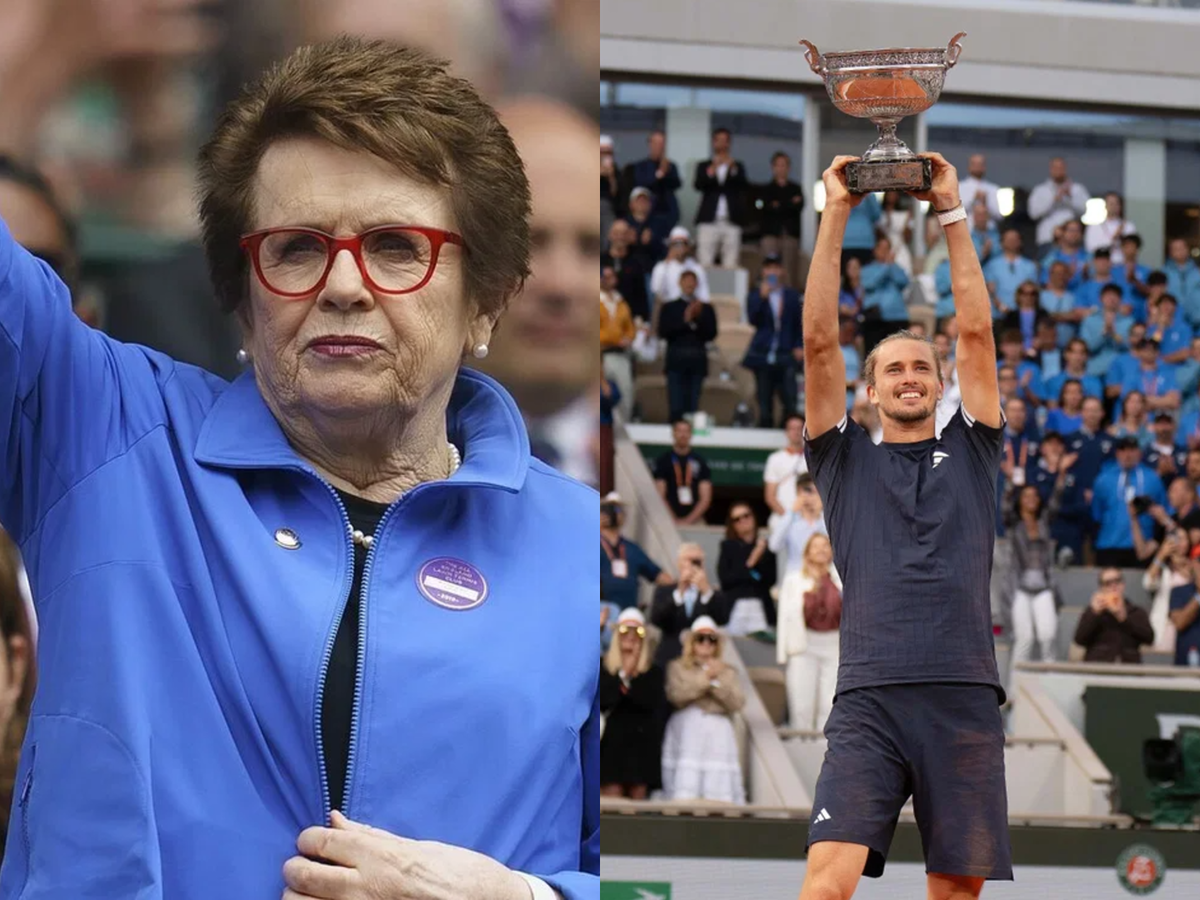
Remember Alexander Zverev‘s inspiring statement at the 2025 Australian Open? Standing on Rod Laver Arena, he had said, “If ever there will be a diabetic Grand Slam champion, even if it’s not me, I’ll be the happiest person in the world.” That sounded more like a prayer than a statement, because God answered it one year and five months later, on Court Philippe-Chatrier in Paris. On Sunday afternoon, he lifted the 2026 French Open title with a 6-1, 4-6, 6-4, 6-7(5), 6-1 victory over Flavio Cobolli in the final, earning congratulations from a 39-time Grand Slam champion.
Watch What’s Trending Now!
“Congratulations to Alexander Zverev on his very first Grand Slam singles title,” Billie Jean King wrote. She also highlighted a feat no one knew about. “He is also the first man with Type 1 diabetes to win a major. What a victory for everyone living with this disease.” One sentence, and the trophy became something bigger than a tennis result.
When Zverev was four, doctors diagnosed him with Type 1 diabetes. Doctors told his parents elite sport was impossible—four-hour matches with blood sugar fluctuations were beyond him.
Congratulations to @AlexZverev on his very first Grand Slam Singles title!
He is also the first man with Type 1 Diabetes to win a major.
What a victory for everyone living with this disease. https://t.co/QhAmiHTgte
— Billie Jean King (@BillieJeanKing) June 7, 2026
Later, his mother would wake him three times nightly to check his glucose and administer insulin. Zverev’s answer was simple: he refused to accept limits.
He refused the verdict. By his early 20s, he ranked in the top five and kept his condition secret—not out of embarrassment, but to avoid being labeled as limited. This changed in June 2022, when he suffered a serious ankle injury while playing in the semis against Nadal at Roland Garros, and took time to reflect.
Sascha came out publicly with an Instagram post and launched the Alexander Zverev Foundation, which aims to deliver insulin, medical equipment, and care to kids with Type 1 diabetes living in developing countries where the disease often proves fatal without basic care. The foundation has since raised nearly $11 million.
The 2023 French Open produced one of the more absurd episodes in that journey. A chair umpire told him he would need to use one of his bathroom break allowances to take an insulin injection courtside. His response was unambiguous.
“They said it looks weird when I do this on court. But this is not a clever take, because if I don’t do it, my life will be in danger,” Zverev had said.
The German has a Therapeutic Use Exemption for on-court insulin use, a simple medical necessity, which had to go head-to-head with an umpire at a Grand Slam to make a player use it. Sunday in Paris answered all those obstacles.
What Zverev’s title means beyond the trophy
The foundation Zverev built reflects his commitment to proving that a diagnosis doesn’t limit achievement. It gives access to insulin and medical attention in countries where Type 1 diabetes in children can lead to death if not treated early on. It runs camps to encourage children with the condition to pursue active lives. Zverev has now validated that premise in the most visible way possible.
Imago
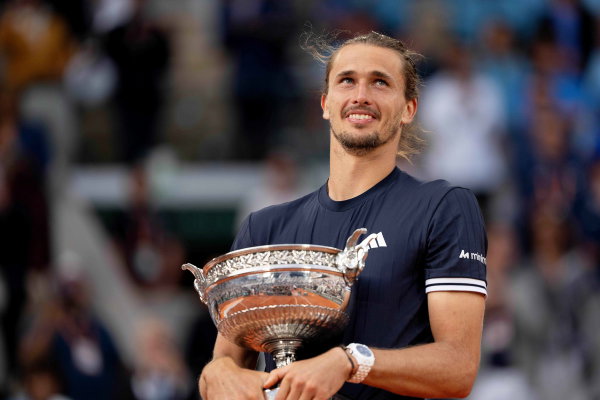
Jun 7, 2026; Paris, France; Alexander Zverev of Germany poses with the trophy after winning the mens singles final against Flavio Cobolli of Italy on day 15 at Stade Roland Garros. Mandatory Credit: Susan Mullane-Imagn Images
The 2025 Australian Open runner-up speech, where he told the crowd he was “just not good enough” after losing to Sinner, still stung when he arrived in Paris. Later, he admitted the wording was unfortunate, not because it wasn’t true, but because it didn’t reflect the amount of effort he and his group had invested. The three losses in the Grand Slam finals over the course of six years were just the culmination of what he felt was a series of setbacks that he’d been unable to overcome with anything other than a win. He finally won.
King’s final message captured the afternoon’s theme. A player who, at age four, was told that elite sport was beyond him had just won the most prestigious clay-court title in the world. He’s shed the ‘choker’ label and got his name struck off the list of ‘the best player without a Grand Slam’.
The only thing that’s left is the fact that the reigning French Open champion has Type 1 diabetes, and the doctors in Hamburg who told a little boy that playing pro tennis was out of the question were wrong. The proof is the Coupe des Mousquetaires!
Written by

Edited by

Abhimanyu Gupta