
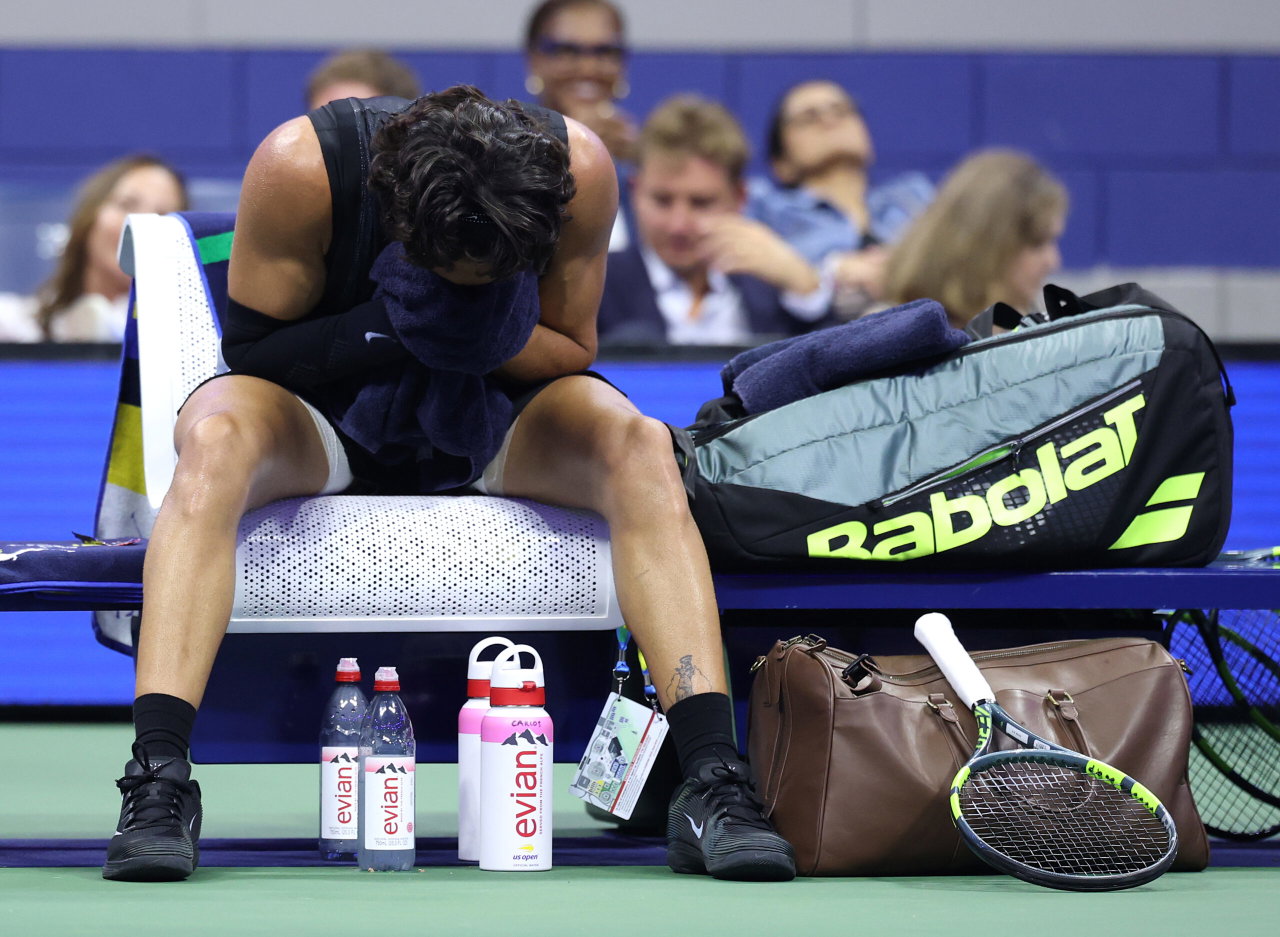
The quarterfinal drew nearly 1.6 million viewers, dragged on for 4 hours and 28 minutes, and finally ended at 3:33 a.m. ET. Carlos Alcaraz emptied the tank against Ben Shelton and still went down 6-7(5), 6-1, 6-3, 1-6, 7-6(7). But while everyone obsessed over the loss, one major piece of context was almost completely brushed aside: the wrist he had only just come back from.
Alcaraz had spent months sidelined by a wrist injury and even missed Wimbledon. Yet the tennis world still rushed to crown him almost the moment he returned.
“But to put that stress also on him, to declare him the favorite after the second round, the guy hasn’t played in five months. It’s his wrist, which is one of the most difficult injuries, as you know, one of the most difficult injuries to get past. Dominic Thiem’s career ended because of it,” Andrea Petkovic said on The Rennae Stubbs Tennis Podcast.
And she is not wrong to point that out. Thiem suffered a tear in his right wrist in June 2021, when he was still inside the Top 5 and less than a year removed from winning the 2020 US Open. The injury struck right in the middle of his prime, after he had already reached a career-high No. 3 and established himself as one of the leading players of his generation.
Three years later, the wrist was still part of the reason Thiem decided to walk away from professional tennis. While announcing his retirement in 2024, he directly pointed to it as one of the reasons behind his decision.
“There are some reasons behind it. Firstly, my wrist is not exactly the way it should be, and it is not exactly the way I want it. The second reason is my inner feeling,” Thiem said. He added that, after thinking carefully about his career and everything he had experienced, he had concluded that retiring at the end of the season was “the only right one.”
Rennae Stubbs backed her up, adding, “And Del Potro.” “And Del Potro’s, exactly. Bencic’s was almost over because of it. She then found a way through it,” Andrea Petkovic responded.
Del Potro’s case only reinforces the point. He had right-wrist surgery in 2010, then underwent three more procedures on his left wrist between 2014 and 2015. The injuries repeatedly interrupted his prime and forced multiple comebacks, even though he eventually returned to a career-high World No. 3 in 2018.
Petkovic continued, “But to then, after the second round, against players who are not very highly ranked, be like, ‘Oh, of course, Carlos is winning it,’ I thought it was a little quick. I wish we, as the tennis world, would have given him a little more time and space to just find his way back. That’s all I can say.”
Before running into Ben Shelton, Alcaraz had quietly built serious momentum in New York. He won four straight matches, dropped just one set, reached the quarterfinals with a 6-4, 6-3, 6-4 win over Tommy Paul, and stretched his US Open winning streak to 11. Even then, Alcaraz was not talking like a man who had already conquered the tournament. He said he came in with no expectations, focused on how his body and especially his wrist would respond, and treated every match as a “gift.”
That makes the next question even more interesting: what if he had survived Shelton?
Stubbs and Petkovic Still Backed Alcaraz to Beat Tiafoe
That is where the conversation took an even sharper turn. Stubbs asked whether Alcaraz would have beaten Frances Tiafoe had he made it past Shelton, and she did not hesitate: “There’s no question he would have beaten Frances.” Petkovic was only slightly more cautious, replying, “Probably. I mean, he probably wins it.” She then made clear that she never thought an Alcaraz title was impossible, only that crowning him so early in his comeback was premature.
Alcaraz had already shown he could survive Tiafoe on the biggest stages. Their 2022 US Open semifinal lasted four hours and 19 minutes, with Alcaraz winning 6-7(6), 6-3, 6-1, 6-7(5), 6-3 to reach his first major final. He did it after already coming through back-to-back five-setters, including a five-hour, 15-minute quarterfinal against Jannik Sinner.
Then came Wimbledon 2024, and once again Tiafoe pushed him to five. Alcaraz trailed two sets to one before turning it around 5-7, 6-2, 4-6, 7-6(2), 6-2 in three hours and 51 minutes. That gave him two Grand Slam wins over Tiafoe in two meetings, both in five sets, which explains why Stubbs was so confident about what might have happened had Alcaraz reached him in New York.
And Tiafoe’s actual semifinal against Shelton only made that hypothetical more interesting. He did not go quietly, taking the opening set 6-4 and keeping the match competitive for more than three hours. But Shelton gradually took over with his serve and backhand, landing 75% of his first serves, firing 20 aces and nearly doubling Tiafoe’s winner count, 47 to 27. After taking the middle two sets 6-3, 6-3, Shelton broke Tiafoe in the final game of the fourth to seal a 4-6, 6-3, 6-3, 7-5 win and reach his first Grand Slam final.