Imago
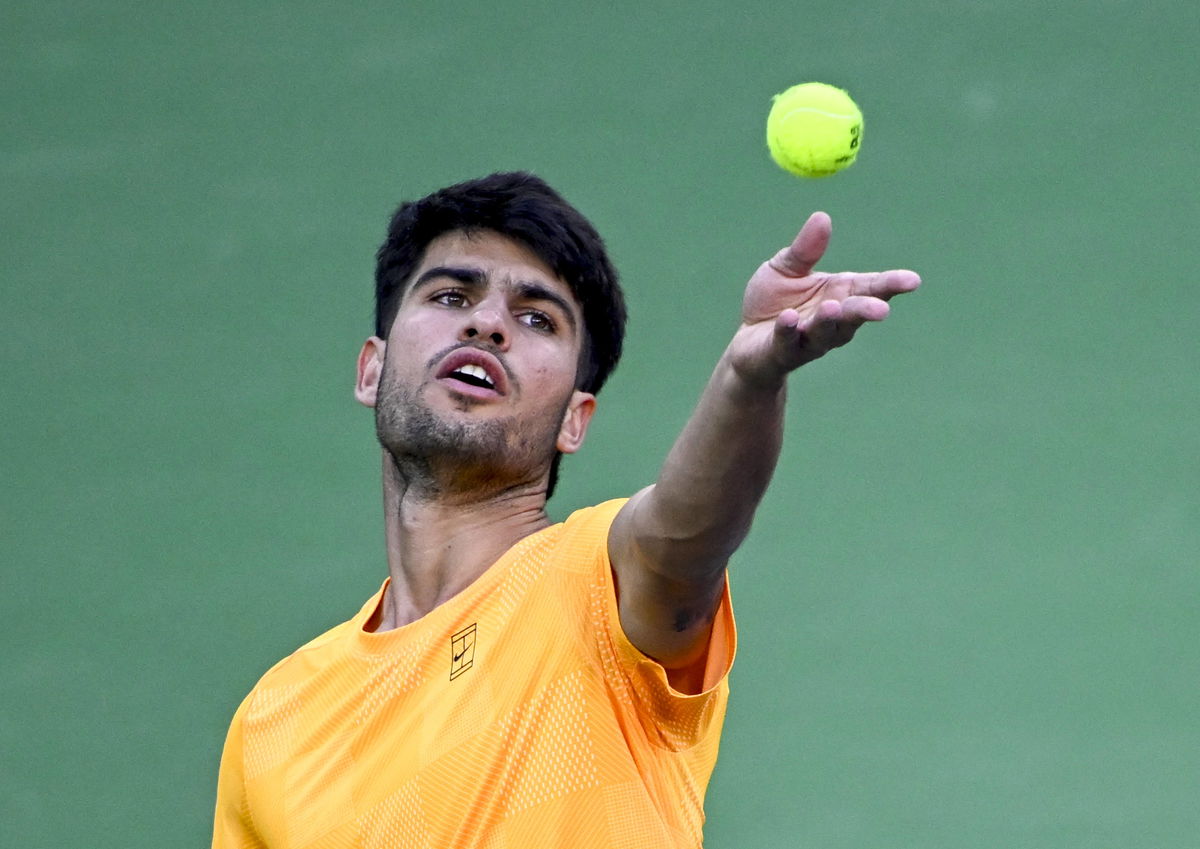
March 07, 2026 Carlos Alcaraz ESP serves against Gregor Dimitrov BUL during their round 2 match at the BNP Paribas Open held at the Indian Wells Tennis Garden in Indian Wells, California. California. Mandatory Photo Credit : /CSM Tennis 2026: BNP Paribas Open MAR 07 PUBLICATIONxINxGERxSUIxAUTxONLY – ZUMAc04_ 20260307_zma_c04_287 Copyright: xCharlesxBausx
Imago
March 07, 2026 Carlos Alcaraz ESP serves against Gregor Dimitrov BUL during their round 2 match at the BNP Paribas Open held at the Indian Wells Tennis Garden in Indian Wells, California. California. Mandatory Photo Credit : /CSM Tennis 2026: BNP Paribas Open MAR 07 PUBLICATIONxINxGERxSUIxAUTxONLY – ZUMAc04_ 20260307_zma_c04_287 Copyright: xCharlesxBausx
Carlos Alcaraz extended his unbeaten 2026 run with a commanding 6–2, 6–3 victory over Grigor Dimitrov at the Indian Wells Open. The world No. 1 wrapped up the contest in just over an hour on Stadium Court at the Indian Wells Tennis Garden. Yet moments after the win, Alcaraz sharply criticized umpires for the lack of flexibility in the shot-clock rule.
Watch What’s Trending Now!
When asked whether he had discussed the issue with the ATP, Alcaraz admitted that no official conversation had taken place. He said that no one had approached him to ask for his thoughts on the matter.
“Honestly, I haven’t talked to them. The truth is, no one has come to ask me for my opinion on the matter. I would say things will continue as they are. I don’t want to waste my time, honestly, because there have been other situations where you complain or simply voice your opinion and nothing changes, so I don’t want to waste my time on that.”
Alcaraz explained that his stance on the issue is already well known. He suggested that it now depends on whether the authorities decide to take action or not. “They already know my opinion on the matter, how I have felt about this whole issue. We’ll see if they change it or not, but I want to focus on other matters.”

Imago
March 07, 2026 Carlos Alcaraz ESP is congratulated by Gregor Dimitrov BUL after their round 2 match at the BNP Paribas Open held at the Indian Wells Tennis Garden in Indian Wells, California. California. Mandatory Photo Credit : /CSM Indian Wells United States of America – ZUMAc04_ 20260307_zma_c04_285 Copyright: xCharlesxBausx
The Spaniard also pointed out that the problem does not involve every umpire. According to him, only a few officials apply the rule too strictly during matches.
“Let’s say there are several chair umpires; the issue lies with one or two, the same ones who have been a problem in many matches. There are others who are flexible regarding this.”
He continued to criticize those who apply the rule without understanding the rhythm of tennis. “I’d say if they understand tennis, they know how to handle it. Those who are very strict and have no flexibility are the ones who know nothing about this sport.”
The debate around the time-clock rule became more visible during the quarterfinal at the Qatar Open. Alcaraz was facing Karen Khachanov in a tightly contested match.
Although Alcaraz eventually won the match in three sets and reached the semifinals, the biggest talking point was his disagreement with the chair umpire during the first set.
After a long rally at 4-4, Alcaraz briefly wiped his face with a towel before serving again. At that moment, chair umpire Marija Cicak issued a time violation warning.
The decision surprised Carlos Alcaraz and quickly sparked a tense exchange with the chair umpire on court. Cicak first explained the situation, saying, “I stopped the clock.” But Alcaraz immediately disagreed and replied, “No, you didn’t.” The brief moment soon turned into a longer discussion about the timing rule.
However, the frustration did not fade for Alcaraz. After losing the first set, he openly criticized the rule and said, “The ATP rules are always s***. They are s***.” Cicak remained composed and responded briefly, “Okay. Well, I think we’ve understood.” The exchange highlighted the tension surrounding time-clock enforcement during matches.
Even after the match, Alcaraz continued to raise concerns about the time-clock rule as he continues to believe the system needs more flexibility.
Carlos Alcaraz urges tennis authorities to change the timing rule
Even after his conflict with the chair umpire on court, Carlos Alcaraz made his feelings very clear. He spoke openly during the match and later in his post-match interview.
During his conversation with Marca, the 22-year-old explained his side of the story. He described the moment in detail and criticized the time rule strongly.
“The rule of time is absurd. I played a point that ended at the net after a sprint. I went to the towel and didn’t have time. She told me she had stopped the clock, and what she told me was absurd. Even the crowd was shouting, and I couldn’t bounce the ball,” Alcaraz stated.
The Spaniard also spoke about how strict timing affects his normal routine. “They need to have a bit more flexibility or change the rule. I know we have to respect the time, and many times that means I can’t do my normal routine: I bounce the ball faster and ask for fewer balls when I see I’m short on time.”
Even though Alcaraz called for a change in the rule, there could be a simpler solution. Tennis is slowly moving toward more automation. Systems already control lets and line calls in many tournaments. However, the shot clock might still work better under human supervision.
If umpires control the timing more carefully, they can use their judgment. They can allow players extra seconds after long and exhausting rallies. This could help maintain the quality and rhythm of matches.
At the same time, clear violations should still be punished. If a player repeatedly wastes time, the umpire can issue a warning or penalty. But in moments like Alcaraz described, some discretion may be necessary.
What do you think about the same now? Share your thoughts below.
Related Newsletters