
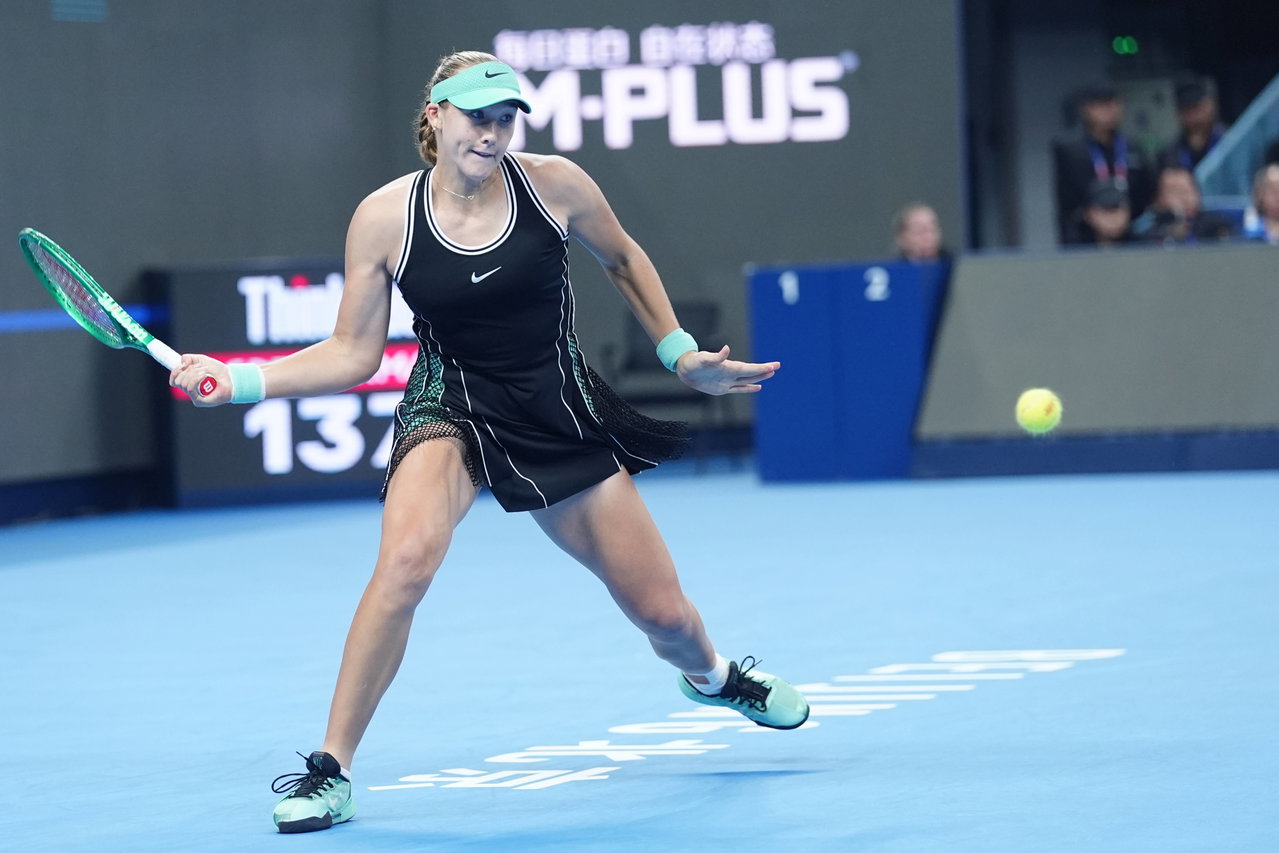
Mirra Andreeva may have missed out on another WTA 1000 title in Beijing, but Chris Evert was not about to let the criticism surrounding her run go unanswered. After the teenager lost to Zheng Qinwen in the China Open final, a fan questioned whether Andreeva had benefited from easy draws, drawing comparisons with Aryna Sabalenka.
Watch What’s Trending Now!
Evert stepped into the debate with a blunt reminder of just how far the 19-year-old has climbed.
“She’s 3 in the world!!!!!”
That was Evert’s response on X, and the four-time US Open champion’s message was difficult to misinterpret. Andreeva was projected to reach a career-high world No. 3 after her run in Beijing, regardless of the final’s outcome. For Evert, that achievement deserved recognition rather than criticism based on the difficulty of a player’s route through a tournament.
The discussion began after Andreeva’s 7-5, 6-4 defeat to Zheng on Sunday, October 11. A fan argued that Andreeva was experiencing something similar to Sabalenka, claiming that relatively comfortable early-round draws allowed players to progress before tougher opponents exposed their weaknesses in the closing stages. The post added that Andreeva was still young enough to turn things around. Evert responded by pointing directly to the Russian’s standing in the sport.
The criticism followed a tournament in which Andreeva had put together several convincing performances. She defeated Yue Yuan, Polina Kudermetova and Daria Snigur before overcoming Ekaterina Alexandrova in the quarterfinals. She then dispatched Nikola Bartunkova 6-2, 6-2 to reach the final. Her loss to Zheng ended that run, but it did not erase the results that had taken her there.
There was also more at stake than a single title.
Andreeva entered the China Open as the fourth seed and was chasing her third WTA 1000 crown. She had already established herself among the tour’s leading players, and the Beijing final strengthened her ranking position even without delivering the trophy. She had already qualified for the WTA Finals and was set to climb to No. 3 in the rankings.
The comparison with Sabalenka raises a broader question about how fans judge a player’s tournament run. A draw can influence the challenges a player faces, but it does not automatically make a deep run undeserved. Andreeva still had to win five matches to reach the final, including a difficult quarterfinal against Alexandrova that went to two tiebreaks. Evert’s post brought the discussion back to the achievement itself: Andreeva had reached the final of a major tournament and was on the verge of becoming the world’s third-ranked player.
Zheng, however, had a compelling story of her own. The Chinese star won 7-5, 6-4 to become the first Chinese woman to claim the China Open title since the tournament began in 2004. She saved three set points in the opening set before taking control, then broke Andreeva in the ninth game of the second set and served out the match. The victory marked Zheng’s first WTA 1000 title and a major milestone in her comeback after elbow surgery in 2025.
Andreeva did not dismiss Zheng’s performance after the defeat. Instead, she acknowledged that her opponent had played well and expressed appreciation for Zheng’s kind words during the trophy ceremony. Zheng had congratulated Andreeva on her French Open triumph earlier in the year and praised her talent. That exchange offered a different perspective from the online debate, with the two finalists showing respect for each other’s achievements.
Mirra Andreeva Admits Her Regret After China Open Final Defeat
Andreeva also gave an honest assessment of the moments she wished she could change. Asked about regrets after the final, she returned to the three set points she had in the opening set. She felt Zheng had produced an excellent serve on the first opportunity but admitted she might have taken more risks on the second.
“I could have taken more risk,” Andreeva explained, reflecting on a return she felt was good but perhaps too cautious. She added that she could have tried to be more aggressive to change the outcome. Zheng ultimately won the set 7-5 after saving all three set points, a sequence that proved decisive in the match.
Still, Andreeva viewed the tournament as a positive overall. She said she had felt herself playing better with each match in Beijing, with improvements in her shots, serve, and confidence on court. The final did not go as planned, but the run gave her several reasons to feel encouraged as the season continued.
Andreeva also praised Zheng’s recovery after a difficult period affected by injury. She said it was good to see the Chinese player performing better again and predicted that Zheng would raise her level further. Her comments showed that she could accept the defeat without overlooking the quality of her opponent.
Evert’s message, meanwhile, remains a sharp reminder of Andreeva’s progress. The teenager left Beijing without the title but with a projected career-high ranking and another deep run at a major WTA event. For Evert, that was enough to push back against a criticism that focused on the draw rather than the achievement.