
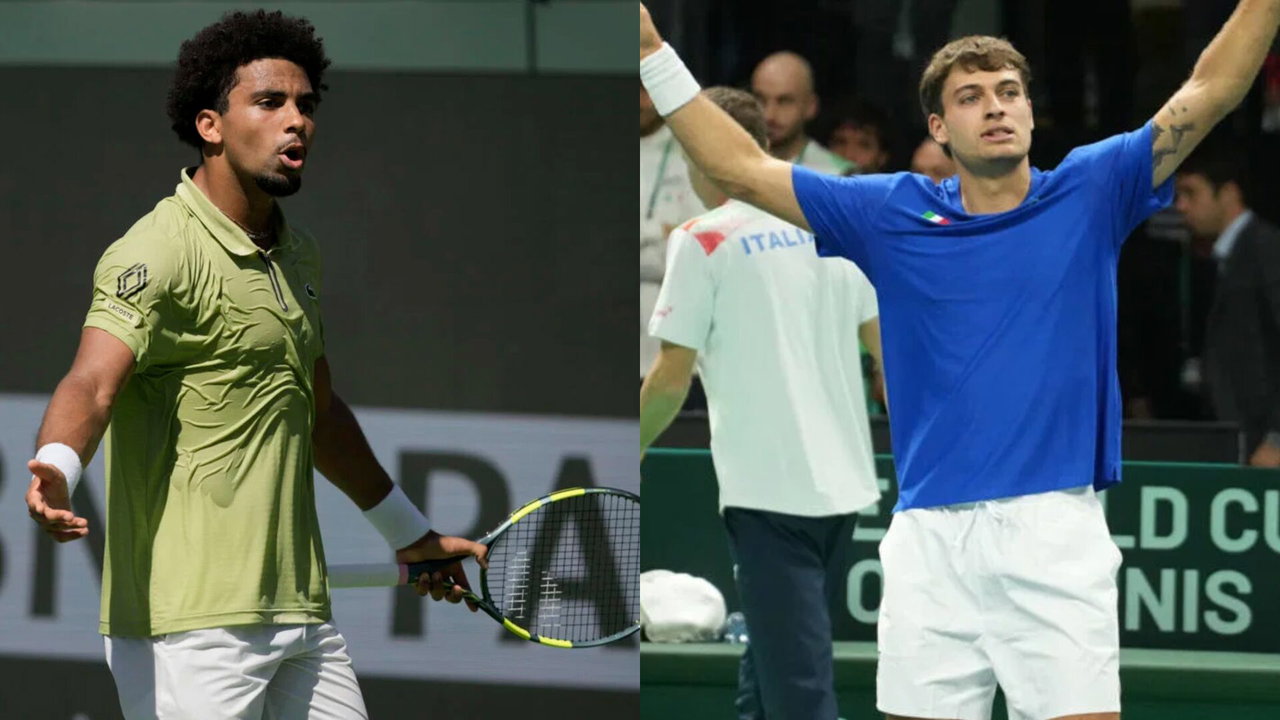
Cincinnati’s ball visibility issue has hit again, and it occurred during one of the most important matches of the tournament, the semifinals. Fans had to squint at home and struggled to follow the ball in this semifinal, which featured Arthur Fils and Flavio Cobolli. Viewers were unable to see the ball against the backdrop of the colorful court and camera setup.
Watch What’s Trending Now!
“It’s impossible on most of the screens during day session on center court. Frustrating,” journalist Jose Morgado summed up the frustration succinctly.
In most Grand Slams like the US Open, the camera is set just behind the baseline, which broadcasters have evolved for years because they know it provides the purest possible view of the yellow ball. While at Cincinnati, the camera is farther behind the baseline, and the viewers cannot quite grasp what’s actually happening in the match, especially during the day sessions.
Despite the complaints of visibility, it was one of the one-sided games of the week. Fils won in straight sets to reach the Cincinnati final, where he will face Frances Tiafoe, who advanced with his own straight-sets win over compatriot Brandon Nakashima in the other semi-final.
The same complaint echoed by fans
“US tournaments continue to be a total embarrassment,” one wrote, pointing out that this isn’t new. This is the same problem that came up at Cincinnati last year, where fans had a hard time following the ball on TV throughout the men’s final between Carlos Alcaraz and Jannik Sinner, even though it was cut short by the Italian’s mid-match retirement.
The facility was just reported to have undergone a $260 million makeover, yet complaints about the broadcast persist. Despite so much investment in the physical upgrade, the organizers could not fix the viewing experience for the fans watching from their TV screens.
“For a sport that’s becoming so obsessed with being TV popular, this is honestly baffling,” one fan wrote.
It’s bizarre that the focus is not on the broadcasting when the sport has produced sensational numbers there over the past year. Last year’s US Open men’s final saw an 82 percent increase in viewership compared to 2024, and ESPN’s 2026 coverage of Wimbledon was 18 percent higher than 2025 and marked as the most watched in history. Now, approximately 15 percent of the world’s population watches tennis worldwide. In that context, the elementary issue of visibility seems like a blunder that Cincinnati cannot fix.
“This is all year round. I can’t track the ball on most clay courts and even some grass courts,” one wrote, a fair point given clay’s reddish tone and grass’s green backdrop both present their own contrast challenges.
“Court is soooo bright,” one fan wrote. Unlike other stops at the North American hard court swing, the Lindner Family Tennis Center offers a unique court color pattern. The arena has a light blue-themed playing surface, which looks sleek in person but causes visibility issues on camera. The Citi Open in Washington, the National Bank Open in Toronto, and the US Open itself feature a darker blue court surface, which provides maximum contrast with the fluorescent yellow ball.
“It looks fine here in person. Very easy to track,” one attendee wrote, a reminder that the issue is specific to the audience watching it on the broadcast rather than the spectators inside the stadium.