Coco Gauff’s Team Slammed Again as Opponent Accuses Them of Mind Games: “Screaming in My Ear”

Add us on Google
Coco Gauff’s Team Slammed Again as Opponent Accuses Them of Mind Games: “Screaming in My Ear”
Add us on Google
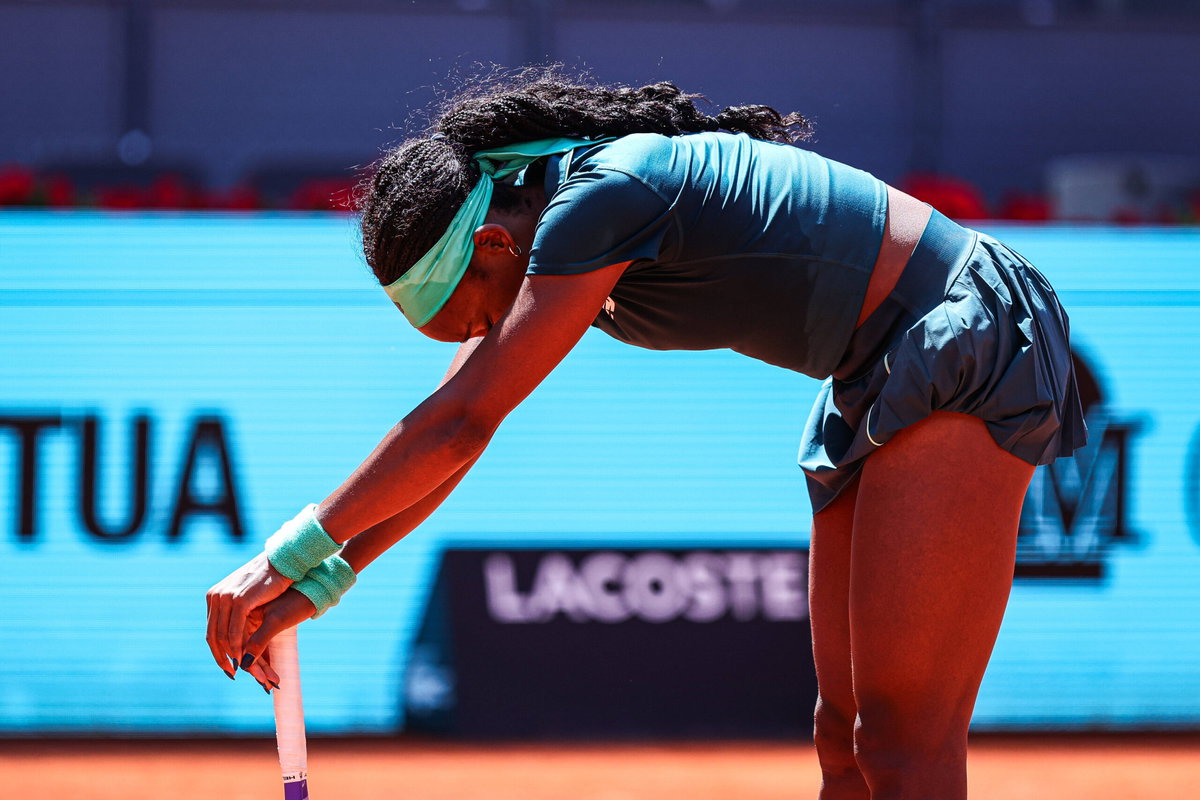
Imago
Mutua Madrid Open 2026 – Day 7 Coco Gauff of the United States appears exhausted after defeating Sorana Cirstea of Romania during their Women s Singles match on Day Seven of the Mutua Madrid Open at La Caja Magica on April 26, 2026, in Madrid, Spain. Madrid Madrid Spain PUBLICATIONxNOTxINxFRA Copyright: xMiguelxReisx originalFilename:reis-notitle260426_npkVS.jpg
Imago
Mutua Madrid Open 2026 – Day 7 Coco Gauff of the United States appears exhausted after defeating Sorana Cirstea of Romania during their Women s Singles match on Day Seven of the Mutua Madrid Open at La Caja Magica on April 26, 2026, in Madrid, Spain. Madrid Madrid Spain PUBLICATIONxNOTxINxFRA Copyright: xMiguelxReisx originalFilename:reis-notitle260426_npkVS.jpg
We’ve seen Elena Rybakina’s box turn matches into theatre; fiery, relentless, almost louder than her own ice-cold composure. Even at the Indian Wells Open, she snapped, “Leave me alone,” as Stefano Vukov animatedly pushed her during the clash with Jessica Pegula, intent clear: ignite belief. But that same sideline firestorm turned toxic at the Madrid Open, when Sorana Cirstea accused Coco Gauff’s camp of crossing the line into coaching.
Watch What’s Trending Now!
With the match locked at one set apiece, tension snapped tight across the Madrid clay as everything pointed toward a brutal final-set showdown. Sorana Cirstea marched to the chair, her frustration no longer containable. She confronted chair umpire Kader Nouni, igniting a controversy that would overshadow the battle itself.
“Her coach is screaming from that end, ‘Come on, aggressive, let’s go, do this all game long, come on, forehand, backhand, first serve’, this is coaching!” she protested.
She didn’t stop there. “Because I’m there and they are bothering me because they are screaming in my ear.” Nouni remained unmoved in the eye of the storm. “For me, I do not hear any coaching,” he replied.
Sorana Cirstea complaining to the umpire Kader Nouni about Coco Gauff’s coaching box in Madrid pic.twitter.com/XpKB9QDfIb
— 🎾nebby🎾 (@1gamesetmatch) April 26, 2026
Cirstea walked away, shoulders tight, disbelief written across her face. “It’s sportsmanship.”
Yet on the other side of the net, Coco Gauff stood in the middle of her own private war. Her box roared not out of defiance, but desperation, to lift a player visibly fading. The timing was no accident; it came when the match teetered on the brink of collapse.
Early on, though, it was Cirstea who dictated terms. She struck first, breaking serve and surging to a 4-2 lead in the opener. Even when Gauff clawed back to 4-4, the Romanian tightened her grip.
A second break sealed the set 6-4, and suddenly the underdog had the upper hand. The script tilted toward an upset, the crowd sensing a shift. Momentum leaned heavily in Cirstea’s favor.
The second set followed a similar arc at first. Cirstea broke early again, racing ahead 2-0 with authority. Then the match twisted into something far more raw. Midway through the set, Gauff’s body betrayed her; she threw up on court, forcing a medical time-out. The physical toll became impossible to ignore.
Illness had already stalked the draw, with Iga Swiatek forced to retire earlier. And now Gauff stood on that same edge. But she refused to fall. Even while battling nausea and fatigue, she clawed back from a breakdown not once, but three times. Each point became an act of defiance.
She stole the second set 7-5, rewriting the trajectory of the match. From there, the final set turned ruthless. Gauff surged, winning the last five games in a blur of dominance to seal a 4-6, 7-5, 6-1 victory in 2 hours and 21 minutes. The result extended her perfect record against Cirstea to 3-0, all in three sets.
The numbers only deepened the story. It marked her third straight run to the fourth round in the Madrid Open and her eighth three-set win of 2026, trailing only Jessica Pegula and Magda Linette.
As for Cirstea’s complaint, the echoes aren’t new. Similar tensions around Gauff’s box trace back to September last year, suggesting a pattern that refuses to fade.
Coco Gauff and Belinda Bencic clash amid accusations of mind games
Back in September last year at the China Open, a similar storm brewed. Coco Gauff and Belinda Bencic found themselves locked in more than just a match. The tension spilled beyond the baseline into something far more personal.
It began with murmurs from the stands, Gauff’s box, animated and vocal. Bencic took notice, her focus splintering under what she believed crossed a line. The match edged toward confrontation.
The flashpoint arrived in the second set. Bencic led 6-4, 2-3, standing at a break point with control in her grasp. Then one moment flipped everything. After a loose drop shot, Gauff sprinted in and carved out a winner. It was sharp, instinctive, and defiant. But what followed ignited the real drama.
Bencic turned toward Gauff’s box, snapping, “Shut up.” The accusation came fast; she claimed they had cheered before her serve. In that instant, the battle shifted from strokes to stares.
Gauff didn’t back down. “I treat your team with respect, you treat my team with respect,” she fired back. The response was immediate, measured, but firm.
After the match, Gauff clarified her stance. “They told me she said, ‘Shut up,’” she explained. “I didn’t hear it, so I can only go based off of what they said. For me, I was telling her to be respectful.”
Bencic, for her part, tried to draw a line. “When the point is over, it’s no problem, I don’t care,” she said. “But when I’m going to the line ready to serve, they don’t need to cheer.”
The tension seeped into her game. She held for 3-3, but cracks appeared in Gauff’s rhythm. Three double faults followed in a single game.
“Immediately after that, next game I was frustrated, threw three doubles,” Gauff admitted. “But after that, I was just like, ‘OK, I don’t want to lose anymore after this point.’” The frustration became fuel.
The argument escalated again at the changeover. Bencic snapped, “No one’s talking to you, she’s talking to me, OK?” Then came the line that cut deepest: “ Your team is chanting! I’m too old for these mind games!”
From that moment, momentum flipped. Gauff broke back, dragged the set into a tiebreak, and seized it. She then stormed through the third set 4-6, 7-6(4), 6-2, turning conflict into control.
Despite the fire, the handshake held. Gauff downplayed the clash, refusing to let it define the victory. But the undertone lingered.
Under WTA rules, coaching exists, but in a narrow lane. Anything excessive or disruptive falls under the umpire’s discretion. Both incidents stayed within that gray zone, resolved without escalation.
Now, with Madrid reigniting the debate, the question is unavoidable. When passion from the box starts dictating the emotional temperature on the court, the system looks fragile.
If the line remains this blurred, the WTA risks turning competition into a courtroom, and that’s a structural failure waiting to happen.
Written by

Edited by

Siddid Dey Purkayastha