Imago
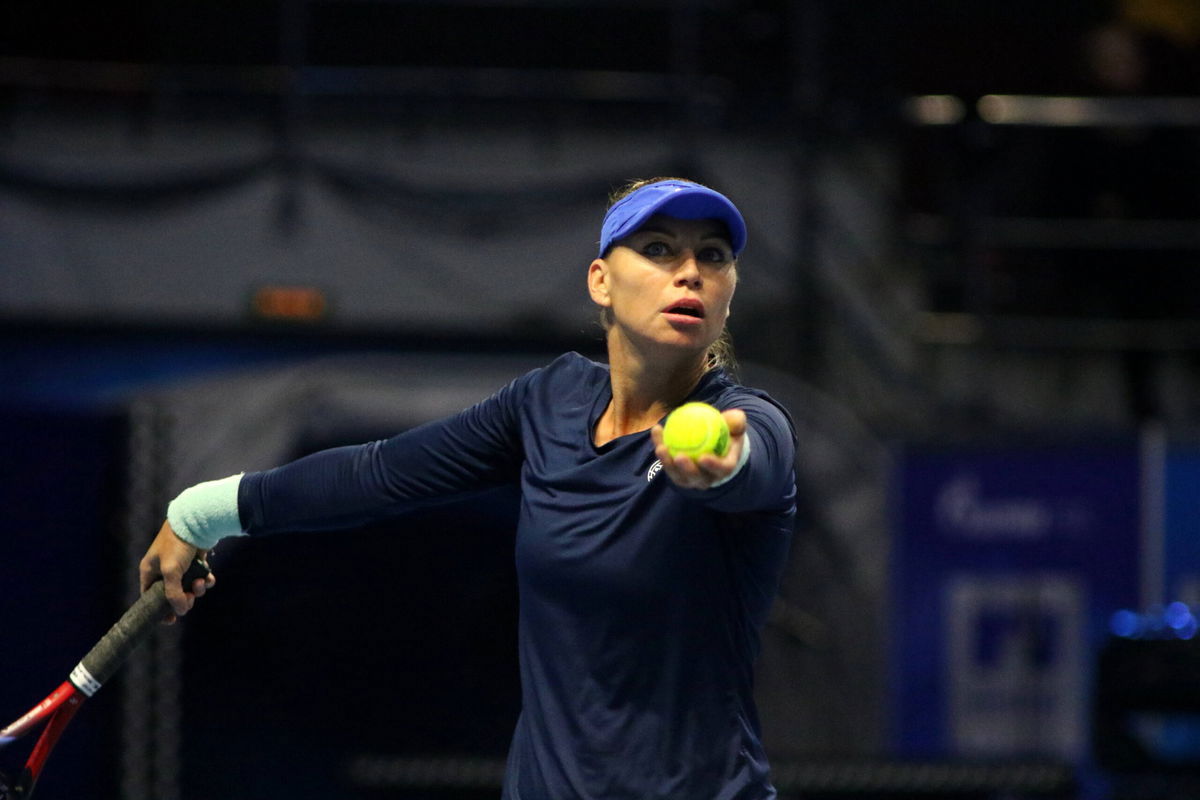
Russian Federation. Saint-Petersburg. KSK Arena. North Palmyra Trophies – International Team Exhibition Tennis Tournament in St. Petersburg. Vera Zvonareva MaksimxKonstantinov
Imago
Russian Federation. Saint-Petersburg. KSK Arena. North Palmyra Trophies – International Team Exhibition Tennis Tournament in St. Petersburg. Vera Zvonareva MaksimxKonstantinov
At 41, Vera Zvonareva is still rewriting tennis narratives. But during her historic win at the Qatar Open, it wasn’t just her performance that grabbed attention—it was an awkward on-air slip that left fans cringing.


After resuming her comeback in December at an ITF event in Dubai, Vera has continued to defy age and expectations. The former world No. 2, who reached both the Wimbledon and US Open finals in 2010, battled her way through qualifying in Doha with straight-set wins over Shuai Zhang and Magdalena Frech. In the first round of the WTA 1000 event, Zvonareva dug deep after dropping the opening set to defeat world No. 50 Peyton Stearns 2-6, 6-2, 6-3 in two hours and nine minutes.
Watch What’s Trending Now!
With that victory, Vera Zvonareva became just the fourth woman aged 40 or older to win a match at a WTA 1000 event, joining Serena Williams, Venus Williams, and Kimiko Date. Ranked 580 in the world, Zvonareva showcased all her experience to register her first WTA main-draw singles win since October 2023, when she triumphed in Nanchang. However, beyond the milestone, another moment stole headlines.
During the broadcast, a commentator mispronounced the former world No. 2’s name, calling her “Zvera Zvonareva” instead of Vera Zvonareva. The gaffe quickly circulated online, turning an otherwise celebratory occasion into an embarrassing broadcast moment.
Mispronouncing players’ names, though, is hardly new in tennis. American legend John McEnroe has faced backlash on multiple occasions for similar errors. Despite his brilliance on court, his commentary has often drawn criticism, most notably during Day 8 of the 2025 Wimbledon Championships. In Novak Djokovic’s match against Alex de Minaur, McEnroe infamously pronounced Djokovic as “Jockavich” and stretched “Di Minaur” into “Dee Minaur.”
The slip-ups didn’t stop there. During the Marin Cilic-Fabio Cobolli clash, McEnroe repeatedly mispronounced Cobolli’s name as “Cabelli,” frustrating viewers who felt distracted by the persistent mistakes. Similar criticism has followed McEnroe for his awkward pronunciation of Alexander Zverev’s name in the past, with fans, broadcasters like Ben Rothenberg, and even players such as Thai-Son Kwiatkowski calling out the issue as disrespectful.
He called her Zvera Zvonareva again and didn't even correct himself wtf 😭
Vera's reaction btw😂is it her first 1000 win since like 2022? Incredible! pic.twitter.com/JdrAgw2BQ0
— til polarity's end 🎾⚡#SpallettiEra⚡⚫⚪ (@lildarkcage) February 8, 2026
Coming back to Vera Zvonareva, the focus will now shift firmly back to tennis. The 41-year-old is making her sixth main-draw appearance in Doha, a tournament where she finished runner-up in 2008 before lifting the title in 2011. Next, Vera Zvonareva will face teenage prospect Victoria Mboko in a fascinating clash of generations. The winner could go on to meet Mirra Andreeva, Sonay Kartal, or Magda Linette in the third round.
If Vera Zvonareva manages a deep run and reaches the quarterfinals, a blockbuster encounter with 2026 Australian Open champion Elena Rybakina could be on the cards. Mispronunciations aside, Vera Zvonareva’s comeback story continues to gain momentum – one win at a time.
What does Vera Zvonareva have to say about her journey in the last couple of years?
Few comeback stories in tennis have been as quietly inspiring as Zvonareva’s recent run. The former world No. 2, who turned pro back in 2000, is once again navigating life on tour, this time with a different perspective shaped by injury setbacks, time away from competition, and a renewed love for the sport.
Vera Zvonareva’s decorated résumé already includes 12 WTA singles titles, the 2009 Indian Wells crown, finals appearances at Wimbledon and the US Open in 2010, and a bronze medal from the 2008 Beijing Olympics.
Yet her latest chapter has been defined less by trophies and more by perseverance. After undergoing arthroscopic surgery in 2024, she spent roughly 18 months away from competitive tennis before making her return in December 2025 at the Al Habtoor Tennis Challenge in Dubai, where she reached both the singles and doubles finals.
Even former Olympic champion Yevgeny Kafelnikov admitted he was fascinated by her resurgence at 41, joking about her “rejuvenating apples” while emphasizing that her enjoyment of the game is reason enough to celebrate her return. For Zvonareva, however, the journey back has been rooted in uncertainty and patience.
But what did she say about all the ups and downs in the last couple of years? Following her surgery, Zvonareva admitted there were real doubts about whether her body would allow her to compete again at a high level.
“There was always a question if my body can handle it or not,” she said while reflecting on her comeback. “I had another surgery in 2024, that’s why I stopped. I still enjoy hitting the ball. I was coaching a little bit and if my body allowed, I wanted to try to play a little bit.
After stepping away from competition, she spent time coaching and staying connected to the sport while waiting to see if physically returning would be possible.
Her approach since coming back has been intentionally cautious. Rather than setting long-term goals or rigid timelines, Vera Zvonareva has focused on enjoying the process. She revealed that she was never in a rush to return, even considering the possibility that she might not come back at all. But once the opportunity presented itself, she decided to try and continue to do so as long as her body cooperates.
The mindset has remained simple: compete while the passion is still there. And working with players across different levels allowed her to see tennis from the other side of the net—something she says has improved her awareness during matches.
Having said that, Vera Zvonareva acknowledged that doubles will likely remain her primary focus moving forward, given her stronger ranking and access to bigger tournaments. Still, she intends to continue playing singles whenever possible simply because she enjoys the challenge.
Her early success after returning has also restored confidence. Experiencing tough match situations again and proving to herself that she can still perform has been vital. Above all else, Zvonareva insists that enjoyment remains the central motivation. What are your thoughts about her incredible journey?
Written by

Edited by

Firdows Matheen