
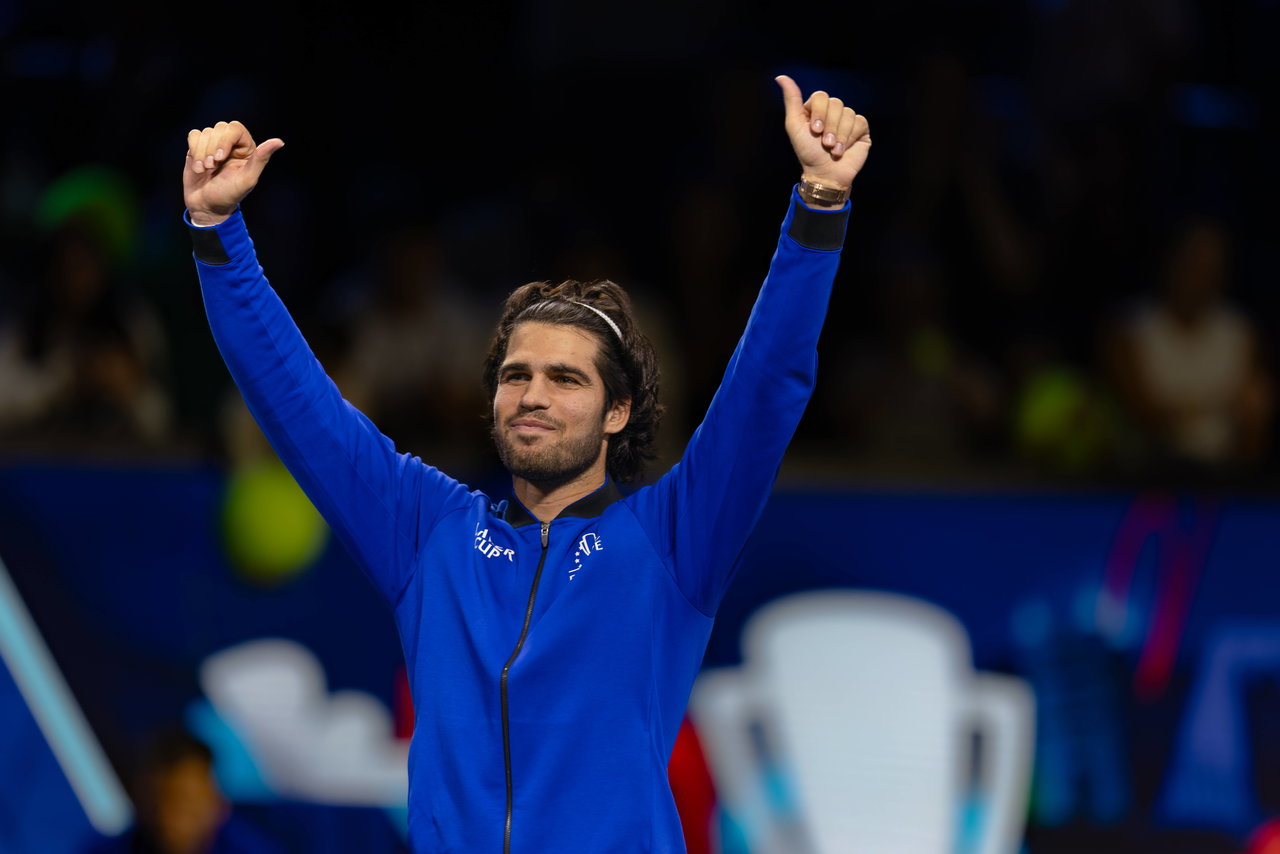
At the 2026 ATP Finals, Carlos Alcaraz broke Alexander Zverev four times in ten service games using a tactic Federer perfected. Roger Federer spent 20 years turning the world’s heaviest serves into harmless, floating dilemmas with a flick of his wrist. Andy Roddick, former world No. 1, now believes Carlos Alcaraz has discovered that very same tactical superpower.
At the 2026 Nitto ATP Finals championship in Turin on November 22, Alcaraz beat world No. 1 Alexander Zverev 6-2, 7-6(7). Zverev had not dropped serve at all in his first four matches; Alcaraz was the first to break him that week. On his Served podcast, Roddick broke down the win and pointed out that Alcaraz has now perfected one of Federer’s most famous attributes: the ability to use the full stretch of his racket face to manipulate the angle and take the rhythm out of a big server.
The vast majority of returners against an elite server will stick to just two options, really. They’ll either step in and play a huge, powerful return, or they’ll play a deep down-the-middle return to reset the point. Alcaraz’s solution to Zverev’s very accurate serve was quite a different proposition. He took the pace on, opened his racket face on the run and went for a very soft, short ball into the centre. “Carlos is otherworldly,” Roddick stated. “It’s making fully extended Racket face, opening it up, finding loft, making Zverev work instead of hitting a backhand where he’s 5 feet inside the baseline coming forward, making him hit that first ball from neutral. That is what Carlos is a genius at.”
Seeing Zverev just freeze in no-man’s-land triggered a whole host of flashbacks for Roddick. Throughout their 24-match rivalry, Federer had time and again used that same chip and float to defuse Roddick’s 140mph bombs. Rather than give the American the pace to feed on, he’d deaden the ball and leave it hovering low over the net, forcing Roddick into a split-second decision.
“His reaction and the ability to manipulate the racket face. Roger did it literally over and over and over to me,” he said while comparing Alcaraz and Federer. “He could get the outside edge of a ball when I would hit a serve tee and float it to my backhand and say, ‘Are you going to come in, or are you going to stay back?’ That’s what I felt like we were watching yesterday. Neither was a good option for Zverev.” However, it was not just Roddick’s nightmare against Federer that drew the comparison. The Swiss tennis legend had similar views in early 2026.
Federer Sees His Own Tactical DNA in Alcaraz
Roddick is by no means the only person on tour who’s picking up on how much Alcaraz resembles Federer in terms of his spatial awareness and touch. Federer himself was explicit about the similarity in style at a press conference at the 2026 Australian Open. When contrasting Alcaraz with Sinner, he was quite clear that watching Alcaraz play is like looking into a tactical mirror.
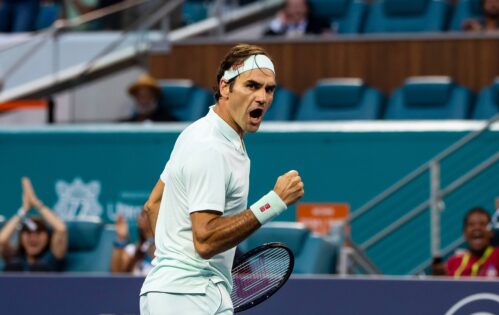
Imago
Sport Bilder des Tages 2019 Miami Open Roger Federer, Switzerland *** 2019 Miami Open Roger Federer Switzerland
Federer points to the precise mix of improvisation, court positioning and variation of pace that sets Alcaraz apart from the baseline batters. “When I see Carlos, I perceive more similarities with myself,” he explained. “How he does drop shots, how he defends and attacks. I feel more identified with him; I understand him.” That shared spatial awareness is down to micro-adjustments of the hands at the right moment rather than swing speed.
Most modern players will go in with a big, heavy topspin to try and overwhelm the server from behind the baseline. Alcaraz quite often will flatten or carve his contact point to take time. He’ll vary the spin and the trajectory of his return to the server in order to take away from the server’s natural footwork before the rally has even really got going. It’s the same kind of rhythmic control that Federer would use to absolutely dominate the indoor hard courts for so many years.
Roddick has actually made that same Federer-like observation in relation to different surfaces previously. In the build-up to Wimbledon 2025, he was suggesting that Alcaraz is far more like Federer than he is like Nadal on grass, in terms of his instinctive approach to the game. Whether he’s cutting off a 135mph serve or a low approach shot, Alcaraz is treating the court as a geometry puzzle rather than a slugfest.
For the big servers on the ATP Tour, that’s a completely different ball game. Power doesn’t necessarily get you the easy holds anymore when you can just deaden the ball on a dime and then dictate exactly where you’re going to be for your next shot. Alcaraz has gone back to the very same psychological warfare that Federer used on Roddick, in that he’s perfected the art of racket manipulation under the most intense pressure. He’s put the modern server in exactly the same impossible position that Federer had Roddick in.