

At this year’s AO, when Carlos Alcaraz took a medical timeout against Alexander Zverev, the German called it “bulls**t” but refused to let it overshadow their epic semi-final. Alcaraz, clutching his right groin late in the third set, received extended physio treatment that eased his pain and boosted his mobility at a crucial moment. Now, a similar drama unfolds as Jannik Sinner’s medical timeout sparks Daniil Medvedev’s demand for rule changes at the Italian Open.
Watch What’s Trending Now!
Talking to his post-match press conference, Daniil Medvedev openly pushed for an ATP rule tweak on medical timeouts, especially for cramps, saying the current system creates too much gray area and arguments on court. “I actually have a solution: allow physical, allow medical treatment for help,” Medvedev added, explaining his perspective clearly.
Later, he elaborated further, saying, “Sorry. Allow medical, meaning physio, three minutes, when you have cramps. Then there’s no problem because then a player could say, I have cramps, I need a physio. For the moment, it’s not allowed. I completely understand.”
As per the rules, players can request a physiotherapist or trainer through the chair umpire during a match. If it’s a sudden or acute issue, play can be stopped immediately for evaluation. Otherwise, the assessment usually has to wait until the next changeover or set break. Under standard rules, a player is allowed one three-minute Medical Time-Out for each treatable condition.
The Russian star then offered a concrete suggestion to prevent future controversies. “Of course, if you start cramping – maybe he was not, I have no idea – what you do is you ask a physio, and you say, I have a small pain in the leg. Probably I did it as well in my career. If medical would be allowed for cramps, there would be no problem, so this is a solution.”
Imago
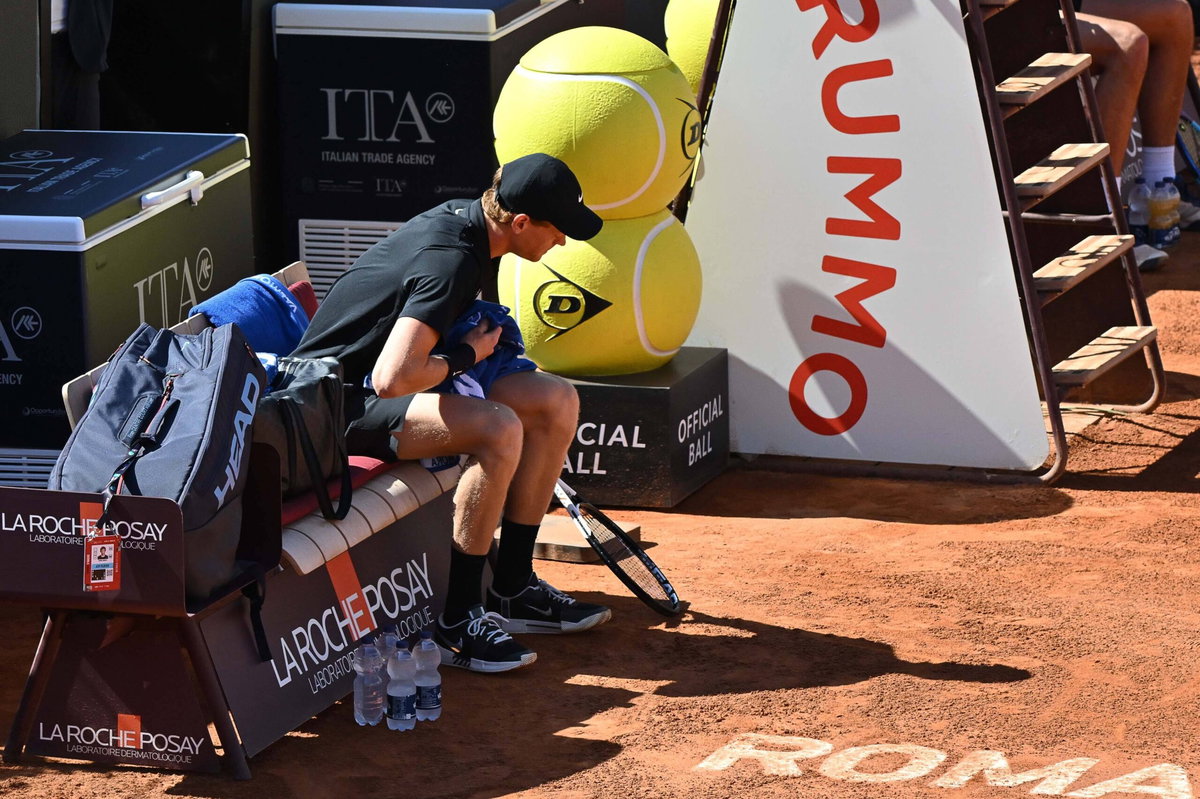
TENNIS – Internazionali di Tennis – Internazionali BNL d Italia Photo by IPA/ABACAPRESS.COM84570725 – Jannik Sinner ITA during the match of Italian Open Tennis, Day 8 at the Foro Italico on May 11, 2026 in Rome, Italy. during Internazionali BNL d Italia, International Tennis match in Rome, Italy, May 11 2026 Rome Italy PUBLICATIONxNOTxINxFRAxUK Copyright: xIPAxSport/ABACAx
Medvedev lost the match 6-2, 5-7, 6-4 after Sinner battled visible discomfort, including vomiting on court, before sealing the win on Saturday.
For Sinner, however, cramping issues are not new. He has faced similar problems before, such as at the 2025 Shanghai Masters and the Australian Open, so the topic was already familiar to fans and players alike.
The match began Friday evening on Rome’s Campo Centrale with Jannik Sinner looking untouchable. He cruised through the first set 6-2, aggressive and sharp on the clay, giving the impression that he would dominate the match effortlessly.
But the momentum shifted in the second set. Sinner slowed down, began grimacing between points, leaned heavily on his racket, and eventually vomited near the side of the court, leaving the home crowd holding its breath in worry.
Shortly before the delay caused by Sinner’s discomfort, he told the umpire that it was ‘raining buckets’ and expressed concern over potentially slipping on the lines at the edges of the court, highlighting the challenging conditions he was facing.
Medvedev’s frustration came to the surface when Sinner requested a medical timeout for treatment on a thigh problem. Speaking in French, he questioned the rules: “When we call the physio for cramps, we don’t get fined?”
Under current ATP rules, players are not allowed to receive medical timeouts specifically for cramp unless it is during the time allotted for changeovers or set breaks. This has long been a concern on the ATP Tour, as there is potential for players to exploit the wording of the rule to their advantage.
While Sinner received the treatment, commentators and fans in the background sided with Medvedev, agreeing that the rules create confusion and spark unnecessary disputes.
Daniil Medvedev revealed ATP locker room talks on Sinner’s struggles
The medical timeout debate has once again put the spotlight on Jannik Sinner’s physical struggles.
Back in January, the Italian struggled with the heat at the Australian Open, underscoring that fitness remains his biggest question mark despite being unbeaten since February.
And during Daniil Medvedev’s press conference, he was asked whether players talk about Sinner’s fitness behind closed doors. “No, definitely not talking about this in the locker room because we try, I think, not to discuss, like, tennis,” said Medvedev.
“When I say ‘tennis in the locker room’, meaning we don’t look at a match and say: ‘Look at his backhand, it’s so bad. Everyone should go there’. At least I didn’t discuss this with anyone,” he added.
The situation becomes complicated when discussing the rule for medical timeouts for cramps. “In cases where there is doubt about whether the player suffers from an acute medical condition, non-acute medical condition, inclusive of muscle cramping, or non-treatable medical condition, the decision of the physiotherapist, in conjunction with the tournament doctor, if appropriate, is final,” the rule states.
The rule also notes, “There may be a total of two (2) full change-of-ends treatments for muscle cramping in a match, not necessarily consecutive.” Much of the controversy arises from the inclusion of the word ‘doubt’ in the regulation, leaving room for interpretation.
A similar bizarre incident occurred last month at the Madrid Open when Ugo Humbert was unhappy with the lack of penalties against Terence Atmane. Despite repeated interruptions late in the second set due to severe cramps, Atmane was allowed to continue without further sanctions.
With the Italian Open nearing its end and the men’s final between Sinner and Casper Ruud scheduled for today, these debates are resurfacing.
Given these recurring issues, it raises the question of whether the ATP needs to reassess its rulebook for medical timeouts to reduce further controversy regarding cramps.