
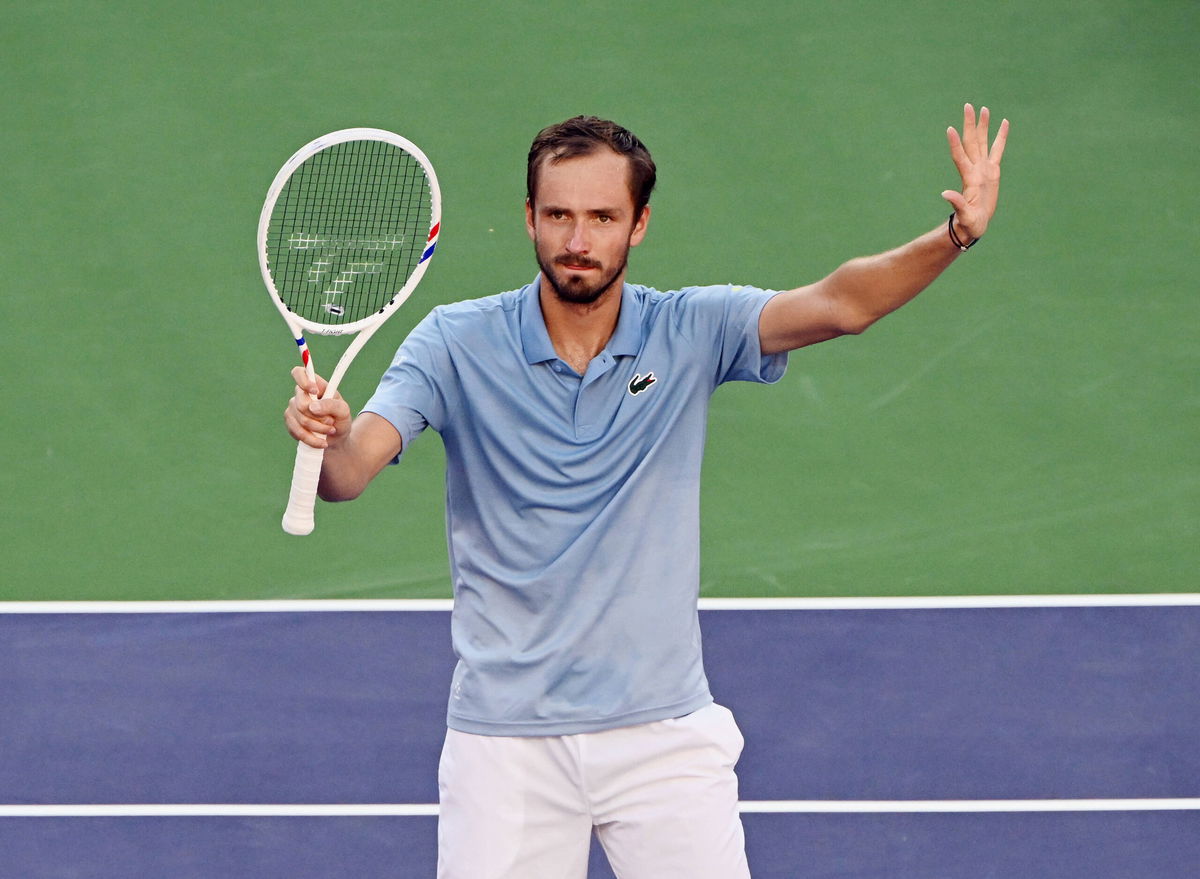
A week earlier, Daniil Medvedev had stood on a podium in Hangzhou with a trophy in his hands and 23 aces behind him. The 93-minute win over Andrey Rublev gave him his third title of 2026, and more importantly, another reason to believe his season was finally turning in the right direction.
Watch What’s Trending Now!
Beijing offered a very different test. Across the net was Novak Djokovic, back at the China Open after 11 years away and still unbeaten in the tournament. Medvedev had not dropped a set on his way to the semifinal. Then, with Djokovic serving at 5-3 in the second set, the match took a turn neither player had planned for. Medvedev was defaulted after a ball he struck hit a spectator in the front row.
“Not the ending we expected 😮@DjokerNole advances to the Beijing final after Medvedev is defaulted whilst down 5-7 3-5 #ChinaOpen,” Tennis TV’s X post read.
Djokovic had just played his shot close to the net, flying past Medvedev, who reached out to his right. As the ball rebounded off the advertising wall close to the stands, Medvedev appeared to swipe at it in frustration. The backhand sent the ball up and behind him, into the first row, where it struck a spectator around the left eye. The fan doubled over and covered his face before being helped out of the arena.
There was plenty of tennis behind the incident, too. Djokovic had saved 16 of the 18 break points he faced, including all six Medvedev earned in the third game of the second set. Medvedev had also fought back after Djokovic broke for 4-2, only for the Serb to break again and move within one game of the final.
At 5-3, Djokovic was serving for the match. His winner made the score 15-15, and when the ball came back off the wall, Medvedev swiped at it. He later said he was trying to keep the ball from leaving the court. Instead, it flew into the stands and brought the semifinal to an immediate end.
Under the ATP’s 2026 Code, “ball abuse” includes intentionally or recklessly hitting a ball out of the court enclosure, hitting it dangerously or recklessly within the court, or hitting it with disregard for the consequences. A player can normally accumulate code violations through warnings, point and game penalties, but the rules also allow an immediate default for a serious violation.
That is what happened here. Chair umpire Mohamed Lahyani consulted an ATP official before Medvedev was defaulted. The Russian did not protest the decision, instead walking to the net to shake Djokovic’s hand after the ruling. There was no prolonged argument over the decision. Medvedev then walked to the net and shook Djokovic’s hand before leaving the court.
Medvedev Apologizes After China Open Default
Medvedev’s first concern after leaving the court was not the lost semifinal, but the spectator.
“Terribly sorry to the spectator, first of all,” Medvedev said. “I’m trying to get in touch with him, if he wants it. Hopefully I can apologise in person and see how he feels. I just hope he’s OK. That’s the most important. I just really care about him right now.”
He also rejected the idea that he had deliberately lashed out at the crowd.
“100 per cent accident,” Medvedev said. “You can see that I didn’t hit the ball in anger. Actually, I do a lot of bad things, but usually ball abuse is not my thing.” He explained that the ball was bouncing back toward him and that he tried to hit it “anywhere” to keep it from going out of the court.
That explanation does not remove the reason for the default. The ATP rule is concerned with whether the act was reckless or dangerous, not whether Medvedev meant to hit the spectator. The distinction matters: an accidental result can still follow a punishable act.
There have been similar incidents where the ball missed a spectator or caused no injury and the punishment was less severe. At Wimbledon in 2022, Stefanos Tsitsipas fired a ball into the crowd after losing a point, narrowly missing a spectator; he received a point penalty. In 2024, Alex Michelsen hit a spectator with a ball at the Winston-Salem Open but received a warning after the spectator indicated he was fine.
There is an even stranger precedent from the 2023 French Open. Miyu Kato was defaulted from the women’s doubles after gently sending a ball back toward a ball kid, who failed to catch it and was struck in the chest. Kato had not been trying to hurt anyone, but the incident still ended her tournament.
Taken together, those incidents expose an uncomfortable difference in how tennis can treat the same basic behavior. A ball sent away in frustration can bring a warning, a point penalty or a default depending on the circumstances and the official’s judgment, with the consequences sometimes turning on whether someone happened to be standing in its path.
There is an older and more serious precedent for the danger. In the 2017 Davis Cup, Canada’s Denis Shapovalov smashed a ball in frustration after being broken by Kyle Edmund. It accidentally struck chair umpire Arnaud Gabas in the eye, and Shapovalov was immediately defaulted. Gabas suffered an orbital fracture and required surgery.
That history helps explain why officials treated Medvedev’s shot as more than another routine act of frustration. A player may not be able to control exactly where a swatted ball lands, but the decision to hit it toward an area containing spectators is the part the sport can control.
And the player standing across from Medvedev on Monday knew better than most what an immediate default can do to a match.
Djokovic was himself defaulted from the 2020 US Open after hitting a ball in frustration that struck a line judge in the throat during his fourth-round match against Pablo Carreño Busta. That incident also did not involve an intention to hit the official.
“I was shocked, to be honest,” Djokovic said of Medvedev’s default. “I hope that person is not badly injured. I also feel sorry for Daniil. I know exactly how he feels to be disqualified in a big match. I’m sure that Daniil didn’t want to do this intentionally.”
There was a striking difference between the two situations, though. Djokovic’s 2020 default came while he was the top seed and title favorite at the US Open; Medvedev’s came with him already trailing 7-5, 5-3 and Djokovic serving for the match. The Serbian had saved 16 of 18 break points and had already survived several chances to let Medvedev back into the contest.
Medvedev’s History Makes the Incident More Complicated
This was not Medvedev’s first major confrontation with the sport’s disciplinary system. His previous default came at the 2016 Savannah Challenger, after a dispute with chair umpire Sandy French during his match against Donald Young. That incident was about his conduct toward the official, rather than an errant ball striking someone in the crowd.
The bigger pattern, however, is how often Medvedev’s frustration has found a physical outlet. At Wimbledon in 2017, he emptied coins from his wallet toward umpire Mariana Alves’ chair after a five-set loss to Ruben Bemelmans, earning three fines totaling $14,500.
At the 2025 Australian Open, he was fined $76,000 across his first two matches after destroying a net camera with his racket, then throwing his racket during his second-round loss to Learner Tien. Months later, at the US Open, a photographer stepping onto the court during match point against Benjamin Bonzi sparked another prolonged confrontation with chair umpire Greg Allensworth; Medvedev was later fined $42,500 for unsportsmanlike conduct and racket abuse.
Then came Monte Carlo this April. After falling behind 2-0 in the second set against Matteo Berrettini, Medvedev smashed his racket seven times during a 6-0, 6-0 loss, the first double-bagel defeat of his professional career, and was fined another $7,000 for unsportsmanlike conduct.
So the China Open incident fits into a much longer history of Medvedev struggling to keep frustration from spilling over. But it also differs from most of those episodes: this time, the object of his frustration was not an umpire, a camera or his own racket. A spectator ended up in the path of the ball.
In 2025, Medvedev acknowledged to BBC Sport that the intensity he feels while competing can spill over into behavior he later regrets.
“When I’m on the court I hate to lose; I love to win. My first goal is to win the match, so it brings a lot of adrenaline out and it brings all the energy out,” Medvedev said. “Sometimes it is a good energy. Sometimes it is a bad one.”
The cost of Monday’s mistake was substantial. Medvedev forfeits the prize money and ranking points he had earned in Beijing, with reports putting the loss at $219,925 and 200 ATP ranking points.
For Djokovic, meanwhile, the strange ending extended a remarkable Beijing run. The six-time champion improved to 33-0 at the China Open after returning to the tournament for the first time since 2015. He advanced to the final against Alex de Minaur, still chasing his first title of 2026.
The other semifinal also ended before the scheduled finish, with de Minaur advancing after Hubert Hurkacz retired while trailing 6-4, 3-2 because of an adductor injury.
For Medvedev, the timing made the ending harder to absorb. He had arrived in Beijing fresh from a title in Hangzhou, had reached the semifinal without dropping a set and had just fought his way through a match in which Djokovic repeatedly denied him at the biggest moments. One swing at a rebounding ball ended all of it.