

Even though tennis is meant to be an outdoor sport, the use of a retractable roof in a tennis court is a show of modernism and innovation in the sport. The Grand Slams have been paving the way for this innovation on both the Tours, with the French Open being the last of the Slams to use the roof.
Watch What’s Trending Now!
Which Courts at Roland Garros Have Retractable Roofs?
Even though the French Open was the last of the four to embrace this innovation, Roland Garros has two iconic stadiums with retractable roofs: the Court Phillipe Chatrier and the Court Suzanne Lenglen.
While the roof on Chatrier came in 2020, the Suzanne Lenglen got its roof in 2024, just ahead of the Paris Olympics. Barring these two iconic showcourts, all 18 other courts at Roland Garros, including the third showcourt of Simone Matthieu, are open-air. which are covered with tarp sheets in case of rain to protect the surface.
How Does the Retractable Roof Work at the French Open?
The use of the roofs in the two main showcourts lies in the discretion of the chair umpires. To maintain uniformity in conditions, if a match is started with the roof closed, it is played with the roof closed throughout. The prerogative is always to play matches in the open air, as the French Open is an outdoor event, but the roofs are brought into use in case of inclement weather. The roofs take at least 15 minutes to close or open.
The roof in Phillipe Chatrier is a great piece of architecture, weighing almost 3,500 tonnes and covering an area of 10,000 sq cm, while the roof at Suzanne Lenglen is a lighter structure, with a membrane-like design, a tribute to the pleated skirts worn by Suzanne Lenglen back in the 1920s. The structures are efficient as well, taking only 15 minutes to close, ensuring there are no long delays. The roof also enabled the French Open to start a dedicated night session under artificial lighting from 2020.
Why Did Roland Garros Add a Roof So Late Compared to Other Grand Slams?
The French Open is the last among the four Majors to use the benefit of a roof. Of the four competitions, the Australian Open was the first Slam to be at the forefront of this innovation, installing a roof in 1988, when the tournament was moved from Kooyong to Melbourne. Wimbledon introduced a roof over its Center Court in 2009, whereas the US Open installed a roof over Arthur Ashe Stadium in 2016. However, it is not just traditional norms that prevented Roland Garros from installing a roof earlier; politics and legislative concerns also played a role.
Unlike the other three Slams, the Roland Garros complex is built on a smaller site, and building a roof required expanding the site. Here is where the French Tennis Federation (FFT) faced resistance from environmental groups and had to navigate through the legislative process. However, the situation changed when Paris was selected as the host of the 2024 Olympics, and the governing bodies realized the importance of roofs at Roland Garros. The French government itself took a central role in clearing all the red tape, and construction began in 2018, with the roof becoming operational in 2020.
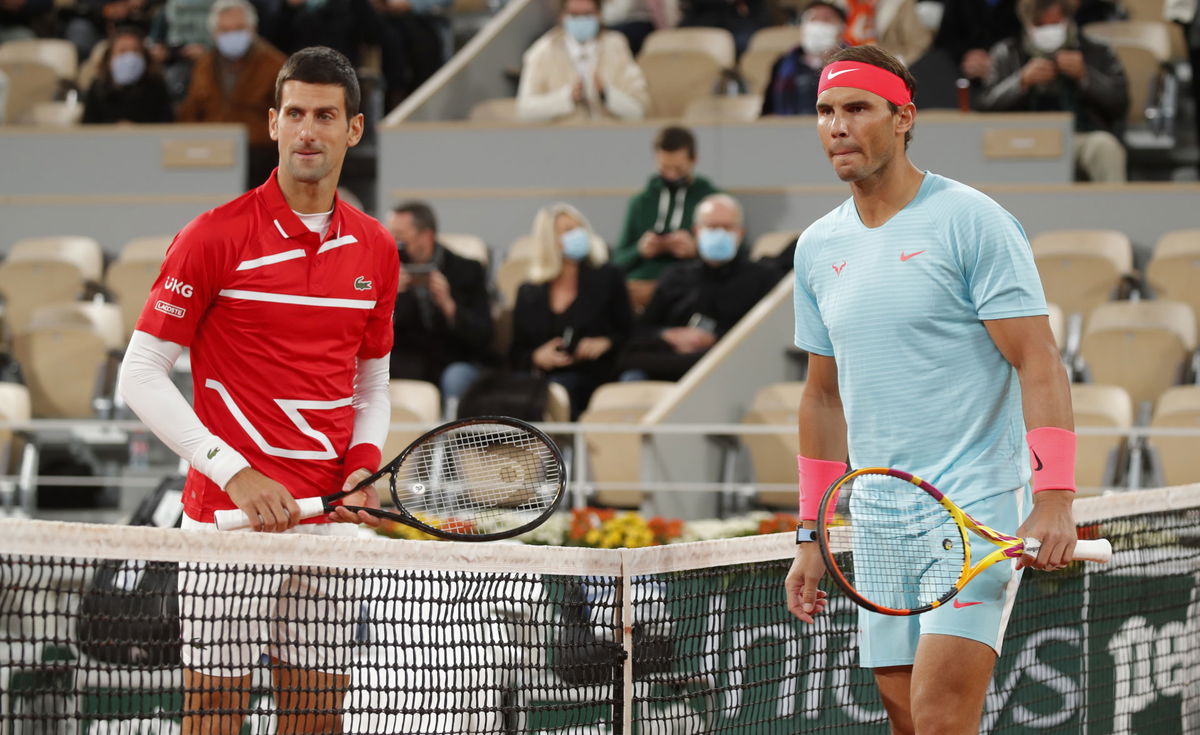
Hosting the French Open with the roofs in 2020 was significant, as it was the only time the event was played in October due to the pandemic. The conditions were cooler than in Paris during May, when the event is traditionally played. The roof was in play in the men’s singles final between Rafael Nadal and Novak Djokovic, adding to the drama of the occasion. In indoor conditions, the clay’s high bounce factor is supposed to die down, with players getting more purchase from flat hits than from topspin shots. However, that did not deter Nadal from winning the match against Novak Djokovic, despite the conditions being in the Serb’s favor.
Reuters
Serbia’s Novak Djokovic and Spain’s Rafael Nadal on the court before the final REUTERS/Charles Platiau
This time around, with Paris undergoing a heatwave, roof use will likely be much lower, maintaining the usual clay-court characteristics that favor clay-court specialists, who will be comfortable with the higher bounce and the use of topspin shots.