Elena Rybakina Shows Rare Emotion as She Confronts Umpire Over Controversial Electronic Line Call In Madrid

Add us on Google
Elena Rybakina Shows Rare Emotion as She Confronts Umpire Over Controversial Electronic Line Call In Madrid
Add us on Google
Imago
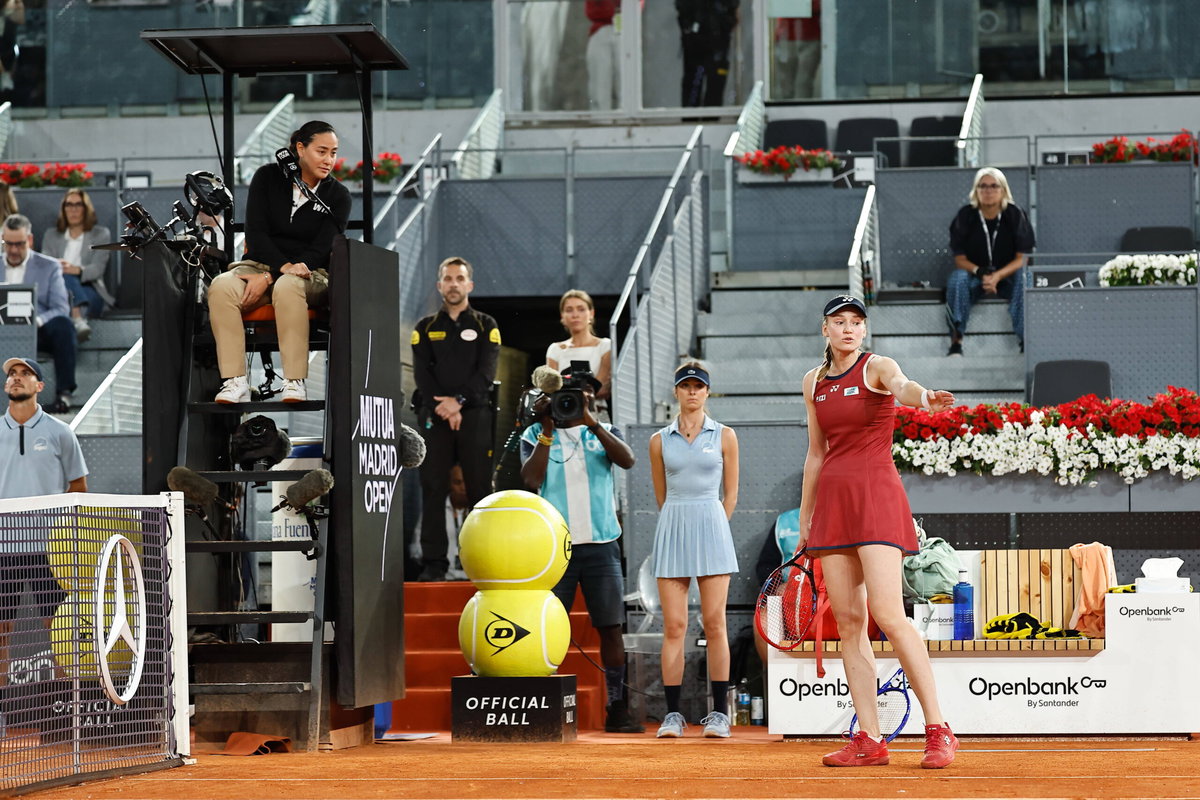
Elena Rybakina KAZ, APRIL 26, 2026 – Tennis : Elena Rybakina protests to the umpire during singles round of 32 match against Qinwen Zheng on the WTA, Tennis Damen tour 1000 tournaments Mutua Madrid Open tennis tournament at the Caja Magica in Madrid, Spain. Noxthirdxpartyxsales PUBLICATIONxNOTxINxJPN aflo_328394536
Imago
Elena Rybakina KAZ, APRIL 26, 2026 – Tennis : Elena Rybakina protests to the umpire during singles round of 32 match against Qinwen Zheng on the WTA, Tennis Damen tour 1000 tournaments Mutua Madrid Open tennis tournament at the Caja Magica in Madrid, Spain. Noxthirdxpartyxsales PUBLICATIONxNOTxINxJPN aflo_328394536
For Elena Rybakina, composure has always been her armor as she calls herself “a pretty calm person,” insisting she keeps emotions locked beneath the surface, even when frustration brews. That icy control defined her at the Australian Open, where she sealed victory with an ace and offered only a faint smile at the net. But at the Madrid Open, that armor cracked, erupting in a rare, heated clash with the umpire.
Watch What’s Trending Now!
After dropping the opening set to Zheng Qinwen, Elena Rybakina found herself battling more than just her opponent. The tension escalated at 4-3 in the second set during a highly contentious moment. A serve from Zheng was ruled in by the electronic line-calling system, triggering immediate disbelief from Rybakina.
The World No. 2 quickly reacted by pointing to the ball mark on the clay. She approached chair umpire Julie Kjendlie, insisting the call was incorrect.
Kjendlie, however, refused to leave her chair to inspect the mark more closely. She explained her position calmly, relying on protocol rather than visual interpretation. The explanation only added fuel to the situation.
Elena Rybakina in a disagreement with the umpire in her match against Qinwen Zheng in Madrid.
Qinwen hit a serve that was called in by electronic line calling.
Elena shows the umpire the mark, which is out.
Elena: “Are you kidding me? This is not a joke. The system is wrong.… pic.twitter.com/kIOfxGB19s
— The Tennis Letter (@TheTennisLetter) April 26, 2026
“I can’t go down. How it looks there and how it is usually looks different. That is the mark, but I cannot go down. What I see from here is that it is very close. What I see over there, it is just touching [the line].” The umpire’s stance was clear and procedural.
Rybakina did not accept that explanation. She grew visibly frustrated and openly questioned both the call and the system behind it. “Are you kidding me? It’s like that. This is not a joke. The system is wrong. This is not a joke. There is no such mark which is shown on the TV. It is absolutely wrong,” she said.
Despite the protest, Kjendlie emphasized that her hands were tied. She reiterated that the decision had to align with the electronic system in place. There was no room for subjective intervention.
“That’s what I have to go with. Now that we have live ELC, that’s what I have to go with.” The ruling remained unchanged, reinforcing the authority of technology over human judgment.
Even with the frustration lingering, Rybakina managed to refocus. She did not allow the incident to derail her performance. Instead, she responded with resilience.
She mounted a strong comeback to win the match 4-6, 6-4, 6-3. The victory secured her place in the fourth round and underlined her mental toughness. It was a turnaround shaped by control after chaos.
Moreover, in matches using Review ELC, situations can occasionally arise where the outcome of a challenge is unclear. For example, if a serve is called out, the receiver still returns it, and that return lands close to the baseline, the server may challenge the original out call.
If there is any confusion about the replay, such as the wrong line being shown or uncertainty over which ball is under review, the chair umpire must immediately consult the Review Official as per WTA’s ELC Cases & Decisions. It is then the Review Official’s responsibility to ensure the correct ball and line are displayed before a final decision is made.
And, the Madrid Open operates with a full electronic line-calling system. This removes traditional line judges and limits the umpire’s ability to overrule decisions. It is a structure designed for consistency, but not without flaws.
On clay courts, however, visible ball marks remain a natural part of the game. These marks provide a physical reference point that players instinctively trust. In this case, that visual evidence appeared to contradict the electronic call.
Unlike hard courts, where technology is the sole authority, clay has historically allowed inspection of marks. The coexistence of these two systems creates tension when they do not align. This moment exposed that conflict clearly.
After the match, Rybakina did not hide her skepticism. “Well, with this thing, I won’t trust it at all,” she said. “Because there was no mark even close to what the TV showed.”
Her reaction highlighted a deeper structural issue within the system. Once a call is made, there is no secondary verification process available. Even when visual evidence suggests otherwise, the decision stands final.
With this incident breaking her usual calm exterior, it also echoed past controversies. The Madrid Open has seen similar outrage over line-calling decisions in previous editions. The debate, clearly, is far from settled.
Alexander Zverev warned after using a photo to challenge a disputed ball mark
Last year at the Madrid Open, a controversy similar to Elena Rybakina’s incident grabbed attention. That time, it involved top seed Alexander Zverev.
Zverev was facing Alejandro Davidovich Fokina in a high-intensity clash. Despite losing the opening set, he fought back strongly. He eventually secured a 2-6, 7-6 (7-3), 7-6 (7-0) victory to reach the last 16.
However, the win did not come without controversy. In the 10th game of the second set, a crucial point sparked disagreement. Zverev believed a backhand from his opponent had clearly gone wide.
The electronic line-calling system, however, ruled the ball in. Zverev immediately challenged the decision. He approached umpire Mohamed Lahyani to voice his concern.
The German was firm in his protest. He argued there was a “malfunction in the system” after the call went against him. His frustration was evident as his appeals failed to change the decision.
When his arguments were dismissed, Zverev took an unusual step. He pulled his phone out of his bag during the match. Then, he took a photograph of the disputed ball mark on the clay.
This action led to immediate consequences. The 28-year-old received a warning for unsportsmanlike conduct. Despite the setback, he managed to regain focus.
Zverev put the controversy behind him and elevated his performance. He went on to win both the second and third sets in tie-breaks. The comeback victory highlighted his ability to recover under pressure.
The incident later became a topic of discussion on the Nothing Major podcast. Former American player Sam Querrey questioned whether such actions were appropriate. He asked Jack Sock for his view on taking photos during matches.
Sock supported Zverev’s reaction. “I’m a fan of it, to be honest. Like, I think I mean that ball is like we’re not talking an inch…we’re talking like more than that.” His comment reflected the frustration players feel in such situations.
Rybakina also referred to this incident after her own experience. “It was, I think, similar to what Zverev had last year because it was in front of her nose. You can’t see it. It was pretty frustrating,” Rybakina said. “It’s kind of a stolen point. I understand it was her serve and she was serving really well, but it’s really frustrating.”
Interestingly, this was not an isolated case. At the Stuttgart Open last year, Aryna Sabalenka faced a similar situation against Elise Mertens. She asked umpire Miriam Bley to check a mark, then took a photograph using a team member’s phone, which also resulted in a warning.
Now, with Rybakina encountering a comparable issue, concerns are growing again. The repeated nature of these incidents raises doubts about the reliability of electronic line calling.
It is clear that the system, while designed for accuracy, is now facing increasing scrutiny.
Written by

Edited by

Purva Jain