
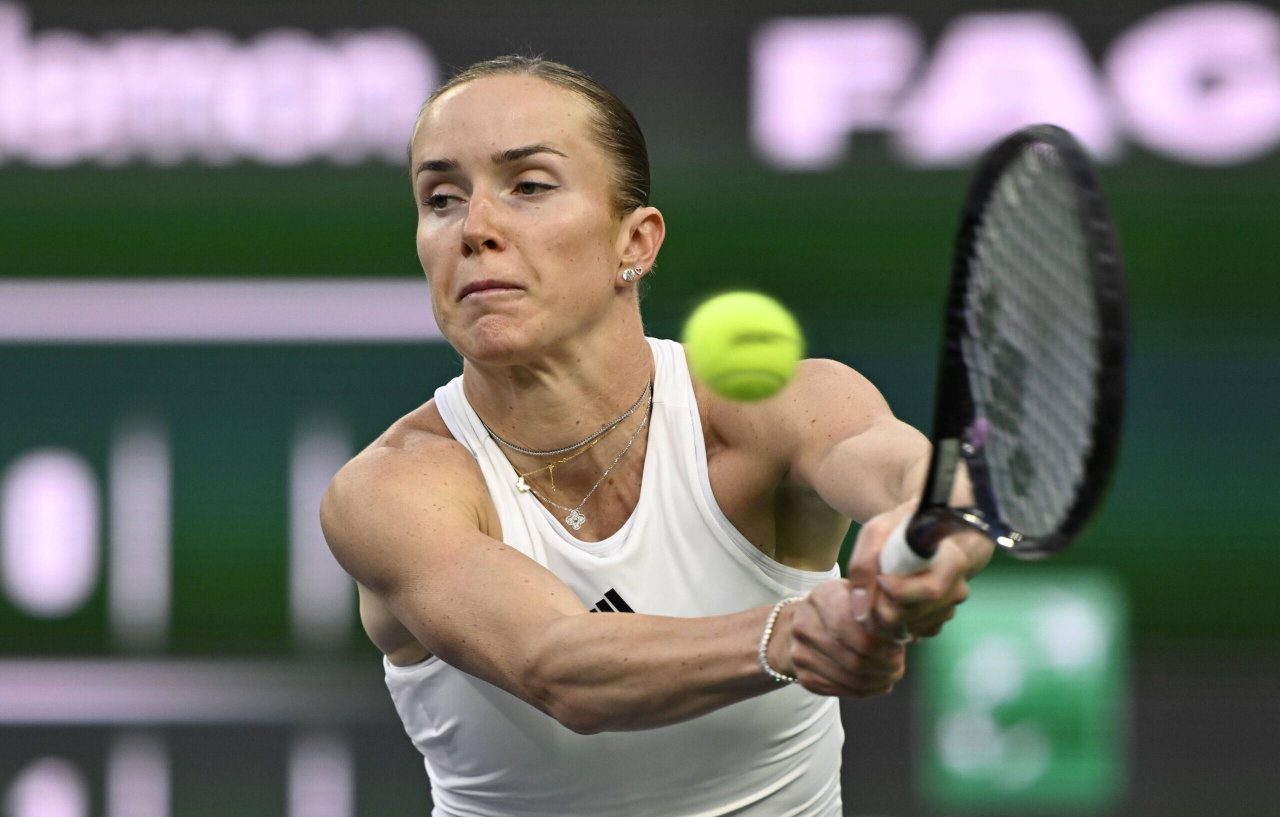
Elina Svitolina maintained her no-handshake stance this week at the National Bank Open. The Ukrainian defeated Anastasia Potapova in straight sets in the third round before once again skipping the customary handshake at the net. What made the moment particularly intriguing was Potapova’s nationality switch. The Russian-born player began representing Austria in 2026 after changing her sporting allegiance in December 2025, but that did not change Svitolina’s approach, raising questions over what exactly determines her long-standing stance toward Russian-born opponents.
Watch What’s Trending Now!
On court, there was little drama in the result, with Svitolina dropping just two games in a dominant victory. The bigger talking point came after match point, when there was no handshake at the net. Instead, Svitolina acknowledged the crowd with a wave as she left the court, while Potapova remained by her bench packing away her equipment.
Since 2022, after the whole Russia-Ukraine situation with the invasion, the world No. 9 has consistently refused to shake hands with Russian-born players and has restated on numerous occasions that it is a matter of principle and not of nationality on paper. Shortly after the chaos, the tennis federation stepped in with a clarification.
The ITF suspended the Russian and Belarusian tennis federations from ITF membership and international team competitions, including the Davis Cup and Billie Jean King Cup. Individual players from both countries were still allowed to compete on tour, but only as neutral athletes, without representing Russia or Belarus by name or flag until further notice.
That is why players such as Aryna Sabalenka, Diana Shnaider, Mirra Andreeva, and other Russian and Belarusian athletes were still allowed to compete in WTA, ATP, and Grand Slam events as neutral individuals, without officially representing Belarus or Russia.
The neutral-player policy also meant tennis authorities were strict about displays that could be interpreted as support for Russia. Potapova experienced that firsthand at Indian Wells in 2023, when she walked onto court wearing a Spartak Moscow football shirt. The WTA formally warned her afterward, saying the action was neither appropriate nor acceptable. The incident showed how tennis authorities were enforcing neutrality, allowing Russian players to compete while keeping a close eye on visible national symbols during the war.
That said, Svitolina has maintained her own stance when facing them. She has skipped the customary post-match handshake with several Russian and Belarusian players this year, including Elina Avanesyan in Monterrey, Diana Shnaider, Mirra Andreeva, and Belarusian world No. 1 Aryna Sabalenka in the Australian Open semifinals. The organizers even displayed a message on the big screen informing the crowd that no handshake would take place in Melbourne. Sabalenka had addressed the situation directly at the time, saying she respected Svitolina’s decision. “They’ve been doing it for so long, it’s their decision, and I respect that,” she said.
The Ukrainian has explained her reasoning in detail on past occasions, most notably after a fourth-round win over Russia’s Anna Blinkova at the 2023 French Open, where she was booed by some fans for declining to shake hands.
“It started with the Ukrainian government that went to the meetings with the Russian government. They were against shaking hands because they’re not sharing the same values, obviously, and what the Russians are doing to our country,” she said at the time.
She framed the decision as not an individual choice, but a national one, taking a stand on the situation. This means that not just Svitolina, but other Ukrainian tennis players, including Marta Kostyuk, have also refused to shake hands with Russian and Belarusian opponents. Svitolina believes her visibility in tennis can help keep Ukraine in the public conversation and remind people that the country still needs support.
That makes it reasonable to infer that the lack of a handshake can also draw audience attention and, in turn, keep media focus on the broader issue. While the no-handshake stance continues to draw attention off the court, Svitolina has also been making a strong statement with her results this season.
Elina Svitolina’s season continues to flourish
The outcome extends Svitolina’s one of the better seasons in recent times and keeps her in contention to win the title. The Ukrainian, who is currently ranked world No.9, has a 39-11 record in 2026, having won titles in Auckland and Rome, as well as reaching the semifinals of the Australian Open and Indian Wells. Her shape has been fantastic on hard courts, where she is 23-6 for the season, and her career hard-court win percentage is one of the highest on tour.
Toronto itself carries some history for Svitolina, having won the title here in 2017, which proved to be a breakout year for her as it even included titles in Dubai, Istanbul and Rome. She was up against eighth seed Amanda Anisimova in the fourth round, leading their head-to-head 4-1.
The ninth seed blew off the American 6-2, 6-4 to make a place in the last eight for the fifth time in her career. She will be facing another Russian player in the quarterfinals, Ekaterina Alexandrova, who is coming off her own upset win over top seed Aryna Sabalenka. Svitolina holds a 3-1 advantage in their head-to-head matches against the Russian, with their most recent encounter occurring five years ago.
With Russian-born players remaining a regular part of the tour, Svitolina is likely to encounter them again. Her refusal to shake hands has become a consistent way of showing solidarity with Ukraine.